What is Reta + Cagri Blend?
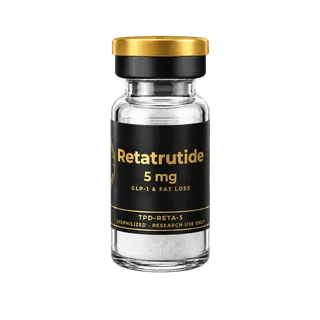
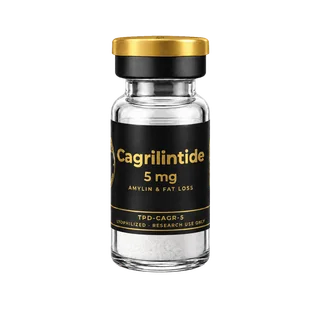
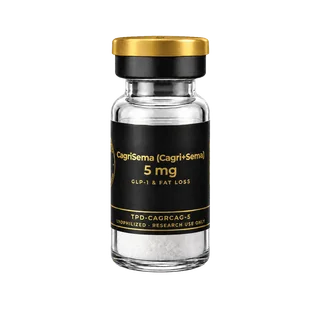
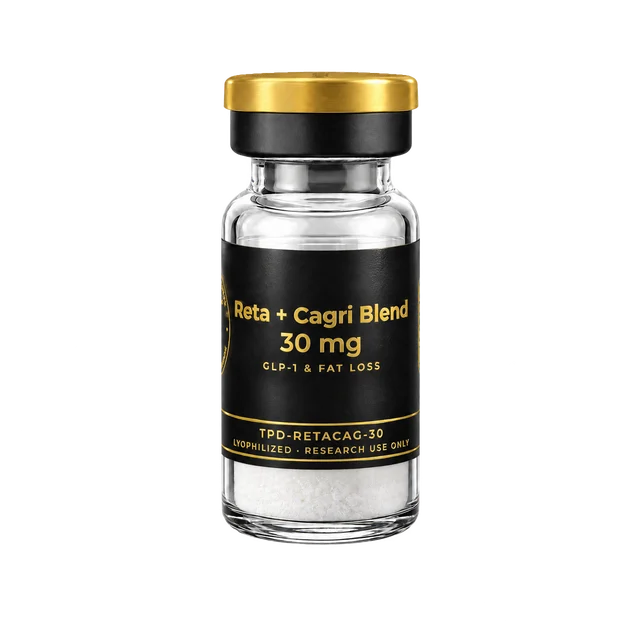
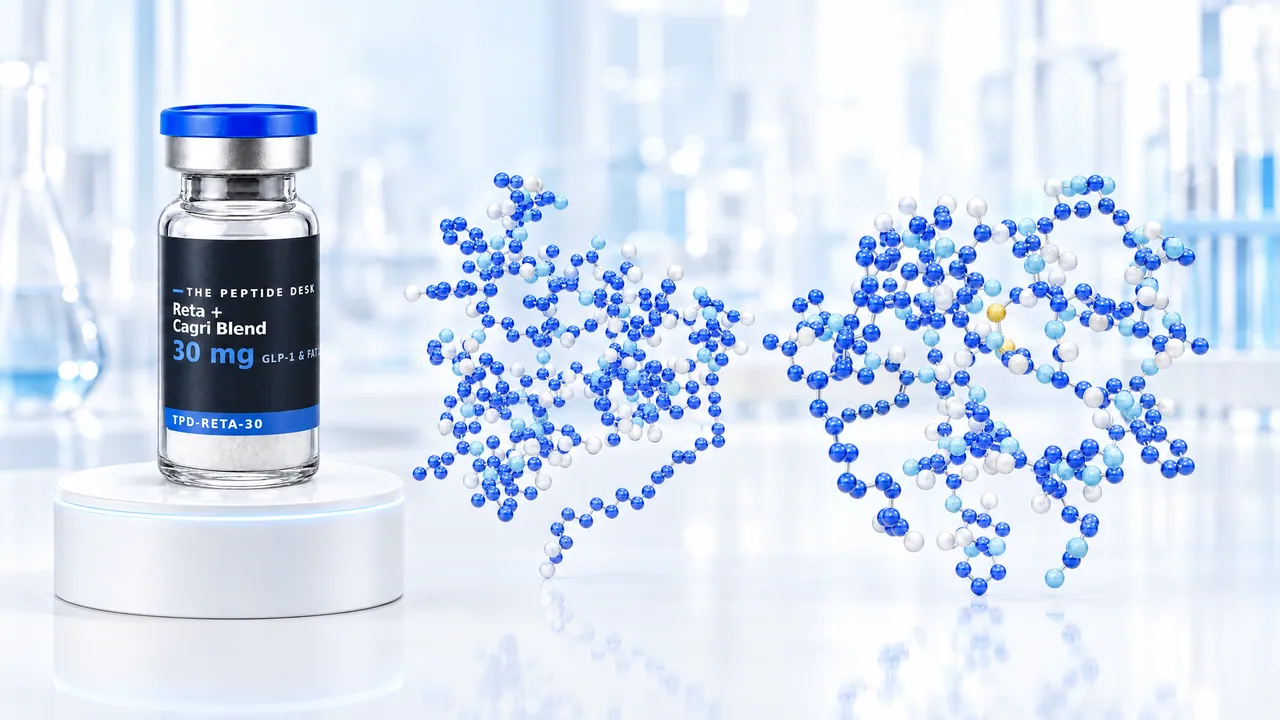
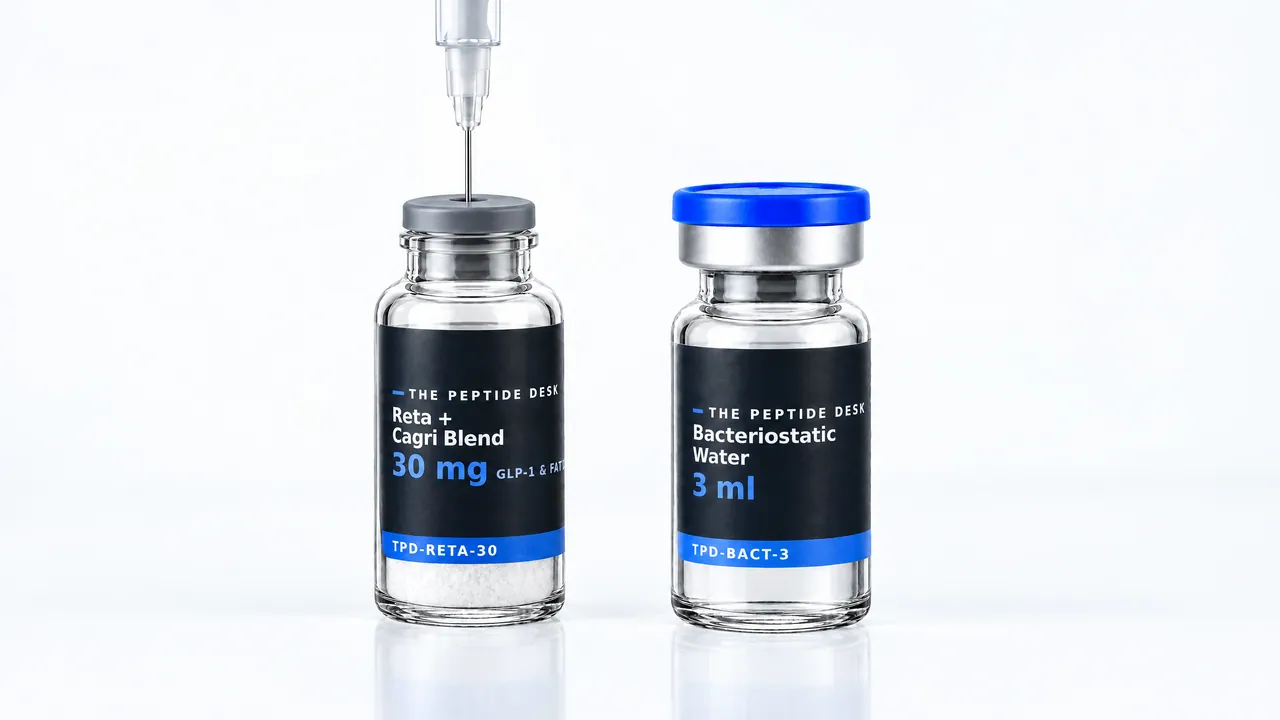
Reta + Cagri Blend is a fixed combination of two weight-management research compounds in one vial: 25mg retatrutide (LY3437943), a triple agonist at the GLP-1, GIP and glucagon receptors. It is paired with 5mg cagrilintide, a long-acting, lipidated analog of the beta-cell hormone amylin. Together that is 30mg of active compound per vial at a fixed 5:1 ratio.
The principle is the same as with CagriSema, just with a different incretin partner: an incretin agonist and an amylin analog address two different satiety pathways. Retatrutide is by far the more potent part, which is why the blend is built reta-anchored and dosed that way too. Both building blocks have their own lexicon entries with the details of each mechanism.
The vial comes as lyophilised powder that you reconstitute with bacteriostatic water and inject subcutaneously once a week. There are no controlled studies of this exact combination; the evidence comes from the individual compounds and from research on cagrilintide with semaglutide.
This information is for research and educational purposes only. No medical advice.
Comparison
One to four targets
Which receptors each compound targets, as stated in the TPD lexicon. Tap a card to open its entry.
Simplified: more targets do not automatically mean more effect. The blend itself has not been studied. 91410
How it works
Retatrutide activates three receptors at once. Through the GLP-1 receptor it dampens appetite and slows gastric emptying, the GIP component reinforces the metabolic effects. The glucagon component is associated in research with higher energy expenditure and increased fat breakdown in the liver. In the phase 2 trial the higher doses reached up to 24.2 percent weight reduction after 48 weeks (Jastreboff 2023).
Cagrilintide acts elsewhere: amylin is released together with insulin from the beta cells and works via amylin receptors, mainly in the circumventricular organs of the brainstem. There it strengthens satiety after a meal and likewise slows gastric emptying, but through a pathway independent of the incretin receptors. Thanks to its lipidation, cagrilintide stays active long enough for a weekly dose (Lau 2021).
In the blend both signals come together. That is the logic of the incretin-plus-amylin combinations: in the phase 1b trial of cagrilintide plus semaglutide, weight loss after 20 weeks was 17.1 percent versus 9.8 percent with semaglutide alone (Enebo 2021). Whether this carries over to retatrutide as the partner has not been studied. On top of that, the cagri share in the blend is small: at 2.4mg of blend it is 0.4mg of cagrilintide.
Where it acts
Where the components act
Tap a point or a card. Colour = receptor, grey = seen in studies. All from studies of the components, not of the blend.
- Brain
Lower food intake via Retatrutide (animal models)9
GLP-1GIP - Stomach
Gastric emptying slowed (effect of amylin)11
Amylin - Liver
Liver fat dropped sharply on Retatrutide (substudy)2
Glucagon - Energy balance
Energy expenditure increased (Retatrutide, animal models)9
Glucagon - Heart
Heart rate rose slightly on Retatrutide, dose-dependent1
Observed in trials
Targets in the ChEMBL database14
Compound CHEMBL5095485 + CHEMBL4802169: six recorded mechanisms, type of action on each card.
- Gene
- GLP1R
- UniProt
- P43220
- ChEMBL
- CHEMBL1784
- Action
- Agonist, direct binding
- Gene
- GIPR
- UniProt
- P48546
- ChEMBL
- CHEMBL4383
- Action
- Agonist, direct binding
- Gene
- GCGR
- UniProt
- P47871
- ChEMBL
- CHEMBL1985
- Action
- Agonist, direct binding
- Gene
- CALCR + RAMP1
- UniProt
- P30988, O60894
- ChEMBL
- CHEMBL2111189
- Action
- Agonist, binding shown in structural data
- Gene
- CALCR + RAMP3
- UniProt
- P30988, O60896
- ChEMBL
- CHEMBL2111190
- Action
- Agonist, binding shown in structural data
- Gene
- CALCR
- UniProt
- P30988
- ChEMBL
- CHEMBL1832
- Action
- Agonist, binding shown in structural data
What you need
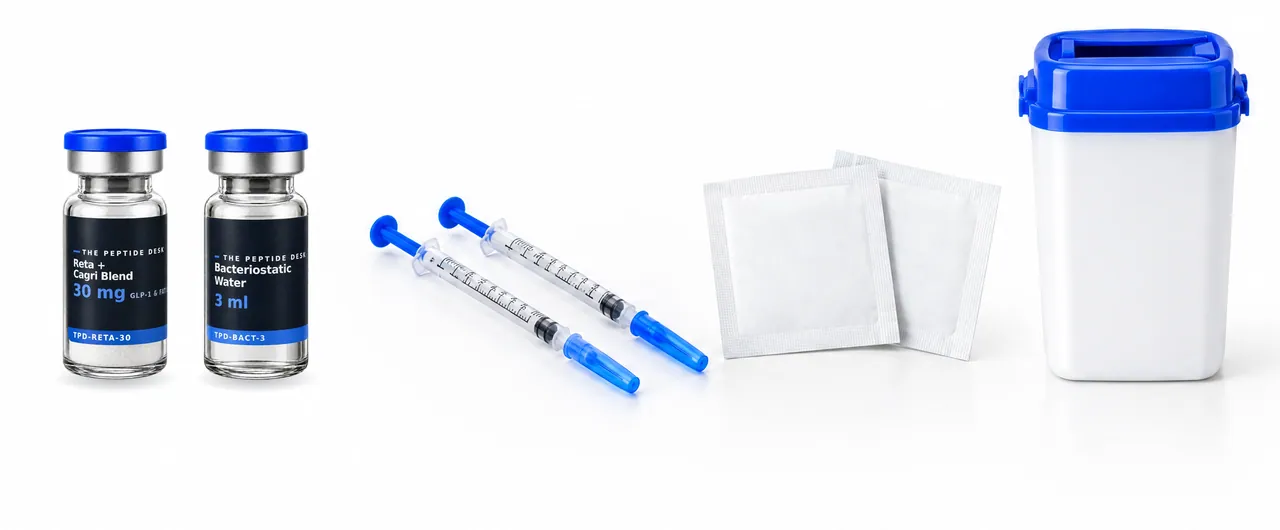
The kit is the same as for retatrutide or cagrilintide on their own:
Supplies
5 things, numbered as in the picture
Tick off what you already have. Vial and BAC water are our real shop photos at the same size.
-
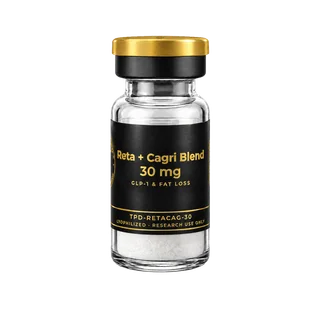
Blend vial
The Reta + Cagri Blend vial with the lyophilised powder (30mg, two compounds)
-
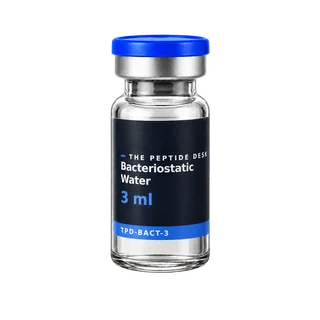
Bacteriostatic water
Bacteriostatic water for reconstitution, 2 or 3ml per vial
-
U-100 insulin syringes
U-100 insulin syringes
-
Alcohol swabs
Alcohol swabs for the vial cap and the skin
-
Sharps container
A sealable container for used needles
As an Amazon associate we earn from qualifying purchases. Links open Amazon - no extra cost for you.
One vial lasts a long time: around twelve weeks at 2.4mg per week, twice that at 1.2mg. So a clean routine when piercing the stopper pays off, it gets used a lot.
Reconstitution
All figures refer to the total amount of both compounds; the 5:1 ratio stays fixed in every dose. With 3ml of bacteriostatic water on 30mg you get 10mg of blend per ml: 0.6mg is then 6 units on the U-100 syringe, 1.2mg is 12 units, 2.4mg is 24 units. With 2ml the solution is 15mg per ml, 2.4mg is then 16 units and 1.2mg is 8 units.
The peptide calculator works this out for any water volume. 3ml is the more comfortable standard because every step lands on whole units and the solution is less concentrated. 1ml is too coarse for the low steps, 0.6mg would be only 2 units.
Add the water slowly to the vial, then swirl or shake until everything is clearly dissolved, both are fine. The solution is clear to slightly opalescent; if it turns cloudy, gel-like or lumpy, do not use it.
Step by step
Dissolving the powder
Four steps, the same for every vial size.
- 1Wipe the cap
Clean the rubber stopper with an alcohol swab.
- 2Add BAC water
Just add it, it does not matter if it hits the powder directly.
- 3Swirl or shake
Until everything has dissolved, both are fine.
- 4Draw up
With the U-100 insulin syringe.
Injection
Inject subcutaneously into the fat layer under the skin, classically the abdomen (keep two finger widths clear around the navel), the front and the inner side of the thigh or the back of the upper arm. Once a week, ideally on the same weekday, so the level stays even.
Injection
Where and at what angle
Pick a spot or switch the angle. Subcutaneous means: into the fat layer, not the muscle.
Rotate the spot each time, never the same one twice in a row.
Rule of thumb: where there is more fat under the skin, insert straight at 90 degrees. In lean people with little fat, 45 degrees, so the needle stays in the fat layer. Simplified diagram.
-
Clean the skin with an alcohol swab and let it dry briefly
-
Lift a small fold of skin
-
Insert the needle: at 90 degrees where there is more fat under the skin, at 45 degrees in lean people with little fat
-
Inject, slowly or briskly both work, wait a moment, then withdraw the needle
-
Put the needle straight into the sharps container
Rotate the injection site from week to week. People who struggle with nausea often inject in the evening so that the peak of nausea falls into sleep.
Use and dosing
Dosing
Dosing, titration and syringe
Loading the dosing information …
- Getting started and stepping up, drawn as a staircase
- Units on the U-100 syringe for every step
- How long one vial lasts
What the research shows
There is no study of the retatrutide plus cagrilintide combination, neither preclinical nor in humans. The evidence comes from three directions. For retatrutide there is the phase 2 trial (Jastreboff 2023): up to 24.2 percent weight reduction after 48 weeks in the highest dose group, plus the phase 2a data in MASLD with a marked reduction of liver fat (Sanyal 2024).
For cagrilintide, the phase 2 trial with 706 participants over 26 weeks showed dose-dependent weight reduction in mono application (Lau 2021). The principle of combining an amylin analog with an incretin is best documented for cagrilintide plus semaglutide: 17.1 versus 9.8 percent after 20 weeks in the phase 1b trial (Enebo 2021) and 20.4 percent on average after 68 weeks in the phase 3 trial REDEFINE 1 (placebo 3.0 percent).
It does not follow that retatrutide plus cagrilintide works the same way. Retatrutide on its own is already stronger than semaglutide. Whether the small cagri share of the blend adds anything on top is an open question. You find the studies with links in the source block below.
Study results
What the trials measured
Interactive: switch tabs, tap points, show or hide arms. Arms are named relative to each other, no dosing advice.
Body weight over 48 weeks, Retatrutide alone1
Mean change in percent, phase 2 trial with 338 participants
Placebo: Week 0 0.0%, Week 24 -1.6%, Week 48 -2.1%. Retatrutide level 1 (lowest): Week 0 0.0%, Week 24 -7.2%, Week 48 -8.7%. Retatrutide level 2: Week 0 0.0%, Week 24 -12.9%, Week 48 -17.1%. Retatrutide level 3: Week 0 0.0%, Week 24 -17.3%, Week 48 -22.8%. Retatrutide level 4 (highest, 12 mg): Week 0 0.0%, Week 24 -17.5%, Week 48 -24.2%.
Only the time points reported in the abstract are shown (weeks 0, 24 and 48). Levels 2 and 3 each combine two groups with a different starting dose. Trial with Retatrutide alone, not with the blend.
Body weight at the end of the trial, per component63
Mean change in percent, one trial per component alone
Values from the abstracts. The trials differ in population and duration and are not directly comparable. The blend contains five times as much Retatrutide as cagrilintide.
Cagrilintide together with semaglutide45
Mean change in body weight in percent, a different partner than in the blend
Values from the abstracts. Shown is the combination with semaglutide, not with Retatrutide. Whether the small cagrilintide share in the blend adds anything to Retatrutide has not been studied.
Research status
Where the research stands
There is no registered trial of the blend. Listed here are the trials of both components with status, participants and results. As of 26 Oct 2026. 12
- Preclinical Cell assays and animal models of the components
- Phase 1 4 trials on components, 4 completed
- Phase 2 4 trials on components, 4 completed
- Phase 3 18 trials on components, 5 completed
- Approval not yet
Show all 22 phase 2 and 3 trials on a timelineHide timeline
NCT03856047 · 706 participants, started Mar 2019, primary endpoint reached Mar 2020.
Registry entry ↗ · Results: Lau et al., The Lancet, 2021
NCT04881760 · 338 participants, started May 2021, primary endpoint reached May 2022.
Registry entry ↗ · Results: Jastreboff et al., New England Journal of Medicine, 2023, Sanyal et al., Nature Medicine, 2024
NCT04867785 · 281 participants, started May 2021, primary endpoint reached Jul 2022.
Registry entry ↗ · Results not yet in PubMed
NCT05936151 · 146 participants, started Jul 2023, primary endpoint reached Oct 2025.
Registry entry ↗ · Results not yet in PubMed
REDEFINE 1 · NCT05567796 · 3,400 participants (planned), started Nov 2022, primary endpoint planned Oct 2024. Tests several agents.
Registry entry ↗ · Results: Garvey et al., New England Journal of Medicine, 2025
TRIUMPH-3 · NCT05882045 · 1,946 participants, started May 2023, primary endpoint reached Apr 2026.
Registry entry ↗ · Results not yet in PubMed
TRIUMPH-1 · NCT05929066 · 2,335 participants, started Jul 2023, primary endpoint reached Apr 2026.
Registry entry ↗ · Results: Jastreboff et al., New England Journal of Medicine, 2026
TRIUMPH-2 · NCT05929079 · 1,152 participants, started Jul 2023, primary endpoint reached Jun 2026.
Registry entry ↗ · Results: Bellido et al., The Lancet, 2026
TRIUMPH-4 · NCT05931367 · 445 participants, started Aug 2023, primary endpoint reached Nov 2025.
Registry entry ↗ · Results not yet in PubMed
TRANSCEND-T2D-2 · NCT06260722 · 1,250 participants (planned), started Feb 2024, primary endpoint planned Aug 2026.
TRANSCEND-T2D-3 · NCT06297603 · 320 participants (planned), started Mar 2024, primary endpoint planned Oct 2026.
TRANSCEND-T2D-1 · NCT06354660 · 537 participants, started Apr 2024, primary endpoint reached Jan 2026.
Registry entry ↗ · Results not yet in PubMed
TRIUMPH-OUTCOMES · NCT06383390 · 10,000 participants (planned), started Apr 2024, primary endpoint planned Feb 2029.
TRIUMPH-5 · NCT06662383 · 800 participants (planned), started Nov 2024, primary endpoint planned Nov 2026.
TRIUMPH-6 · NCT06859268 · 643 participants (planned), started Mar 2025, primary endpoint planned Apr 2028.
TRIUMPH-7 · NCT07035093 · 586 participants (planned), started May 2025, primary endpoint planned Sept 2027.
SYNERGY-Outcomes · NCT07165028 · 4,500 participants (planned), started Oct 2025, primary endpoint planned Aug 2030. Tests several agents.
TRIUMPH-8 · NCT07232719 · 250 participants (planned), started Nov 2025, primary endpoint planned Jul 2027.
RENEW 1 · NCT07220642 · 300 participants (planned), started Nov 2025, primary endpoint planned May 2027.
RENEW 2 · NCT07220759 · 330 participants (planned), started Nov 2025, primary endpoint planned May 2027.
TRIUMPH-9 · NCT07357415 · 600 participants (planned), started Jan 2026, primary endpoint planned Oct 2028.
RENEW 4 · NCT07745504 · 285 participants (planned), started Aug 2026, primary endpoint planned May 2027.
Bar: start to primary endpoint (planned for running trials). Green = completed, blue = progress until 26 Oct 2026. Phase 1: 4 trials on safety and pharmacokinetics, not shown as bars.
Side effects
Both components are considered generally well tolerated in the trials. The profile of both is shaped by gastrointestinal effects. In combination two satiety signals add up, which amplifies nausea especially at the start. Slow titration therefore matters even more than with the individual compounds.
- Gastrointestinal: nausea, fullness, vomiting, diarrhoea or constipation are the most common observations, clearly dependent on how fast the dose is raised.
- Fluids and nutrients: with food intake strongly reduced, fluid intake often drops too; drink enough and keep an eye on protein.
- Heart rate: mild increases in heart rate are documented for the glucagon component of retatrutide.
- Muscle mass and gallbladder: rapid weight loss takes muscle mass with it and can favour gallbladder problems; resistance training and protein counteract that.
- Fixed ratio: the dose of both components rises and falls together, neither can be reduced on its own.
- Evidence: no clinical studies exist for the combination. Long-term data are missing for retatrutide.
If the solution turns gel-like or lumpy, do not use the vial. Slight cloudiness on its own is not a reason.
Tolerability
Frequency in studies of the components
Share with the event in two large phase 3 trials of the components. There are no data on the blend.
| Event | Placebo | Retatrutide, lowest study dose | Retatrutide, middle study dose | Retatrutide, highest study dose (12 mg) |
|---|---|---|---|---|
| Nausea (Retatrutide, TRIUMPH-2)7 | 8% | 14% | 21% | 28% |
| Diarrhoea (Retatrutide, TRIUMPH-2)7 | 13% | 27% | 34% | 34% |
| Gastrointestinal overall (cagrilintide plus semaglutide, REDEFINE 1)5 | 40% | 0% | 0% | 0% |
Rounded values from the abstracts. TRIUMPH-2: obesity with type 2 diabetes over 80 weeks, REDEFINE 1: overweight without diabetes over 68 weeks. In REDEFINE 1 the complaints were mostly transient and mild to moderate.75
Storage
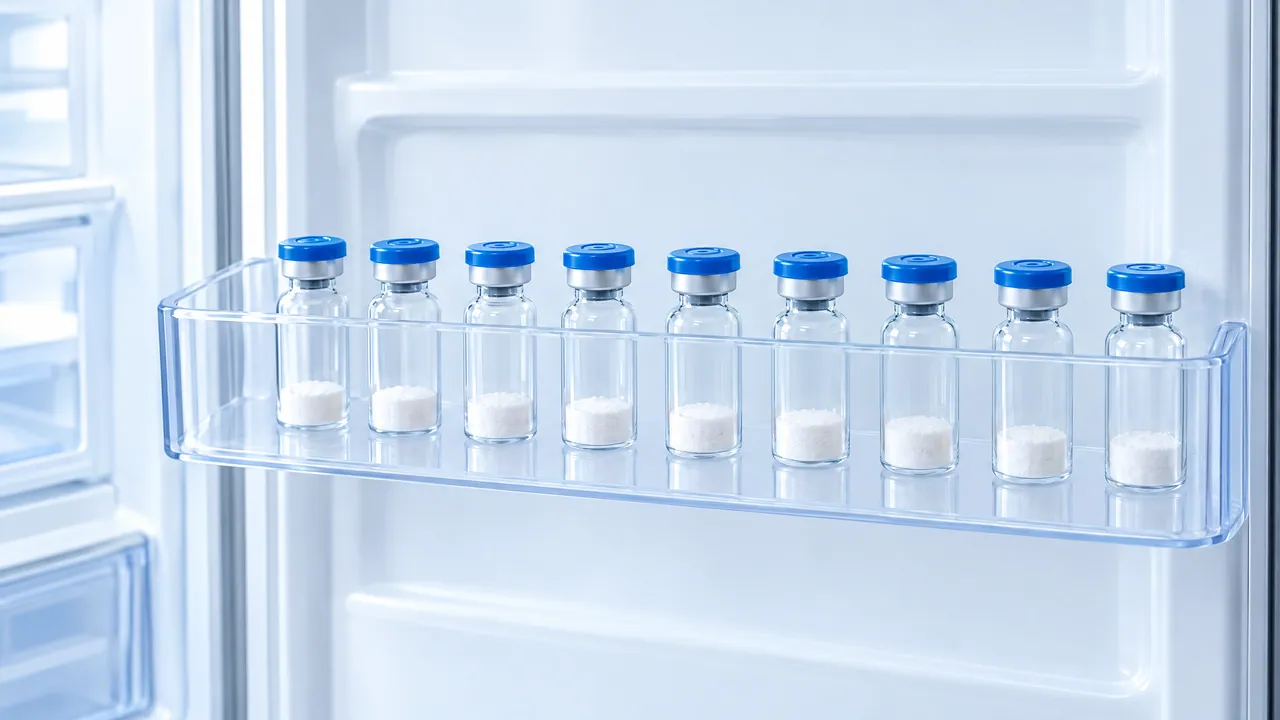
The unreconstituted powder is robust: normal room temperature (around 20 to 25 degrees) is fine, ideally dark and dry. For longer periods it can go in the fridge, but it does not have to.
Once mixed, it keeps for at least 4 to 6 months in the fridge (2 to 8 °C); the bacteriostatic water brings a preservative for that. At 2.4mg per week a 30mg vial is empty after around twelve weeks. The solution stays perfectly usable for that long. Do not freeze and do not leave it in the sun.
Swirling or shaking is both fine. Going through the same stopper repeatedly is normal, just wipe the cap each time first.
Shelf life
How long it keeps
Robust, no fridge needed. Keeps for several months without trouble.
Keeps for at least 4 to 6 months. The bacteriostatic water brings a preservative.
- Keep it dark
- Dissolved: 2 to 8 degrees
- Note the mixing date on the vial