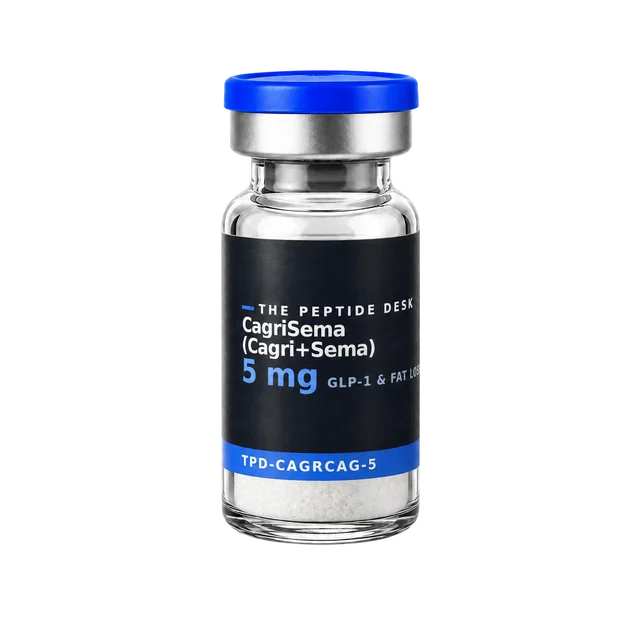
What is CagriSema?
CagriSema is the fixed combination of two compounds you also find individually in the lexicon: cagrilintide (an amylin analog) and semaglutide (a GLP-1 agonist). Both dampen appetite but via different routes, together giving a stronger effect than either alone.
Our 10mg vial holds half of each (5mg cagrilintide + 5mg semaglutide). Novo Nordisk develops the fixed combination clinically as CagriSema.
Comparison
One, two or three receptors
Which receptors each compound targets, as stated in the TPD lexicon. Tap a card to open its entry.
Simplified: more receptors does not automatically mean better, each path also brings its own effects. 914
How it works
Semaglutide acts at the GLP-1 receptor (incretin axis), cagrilintide at the amylin receptor, a different satiety axis. Because they engage two different systems, their effects on satiety and appetite add up. That is the appeal of the combination.
Details on the individual mechanisms are in the lexicon entries for semaglutide and cagrilintide.
Where it acts
Three receptor families, several organs
Tap a point or a card. Colour = receptor, grey = effect seen in trials.
- Brain
Satiety via nerve cells, cagrilintide via the brainstem (shown in animal models)10
AmylinCalcitoninGLP-1 - Stomach
Gastric emptying slowed11
AmylinGLP-1 - Pancreas
HbA1c fell by 2.2 percentage points in 32 weeks in type 2 diabetes6
Observed in trials - Body weight
On average -20.4% after 68 weeks (placebo -3.0%)1
Observed in trials
Known targets9
Compound CHEMBL4802169 + CHEMBL2108724: four described targets, type of action on each card.
- Gene
- CALCR + RAMP1
- UniProt
- P30988, O60894
- ChEMBL
- CHEMBL2111189
- Action
- Cagrilintide: agonist, binding shown in structural data
- Gene
- CALCR + RAMP3
- UniProt
- P30988, O60896
- ChEMBL
- CHEMBL2111190
- Action
- Cagrilintide: agonist, binding shown in structural data
- Gene
- CALCR
- UniProt
- P30988
- ChEMBL
- CHEMBL1832
- Action
- Cagrilintide: agonist, binding shown in structural data
- Gene
- GLP1R
- UniProt
- P43220
- ChEMBL
- CHEMBL1784
- Action
- Semaglutide: agonist, mechanism according to ChEMBL
What you need
Supplies
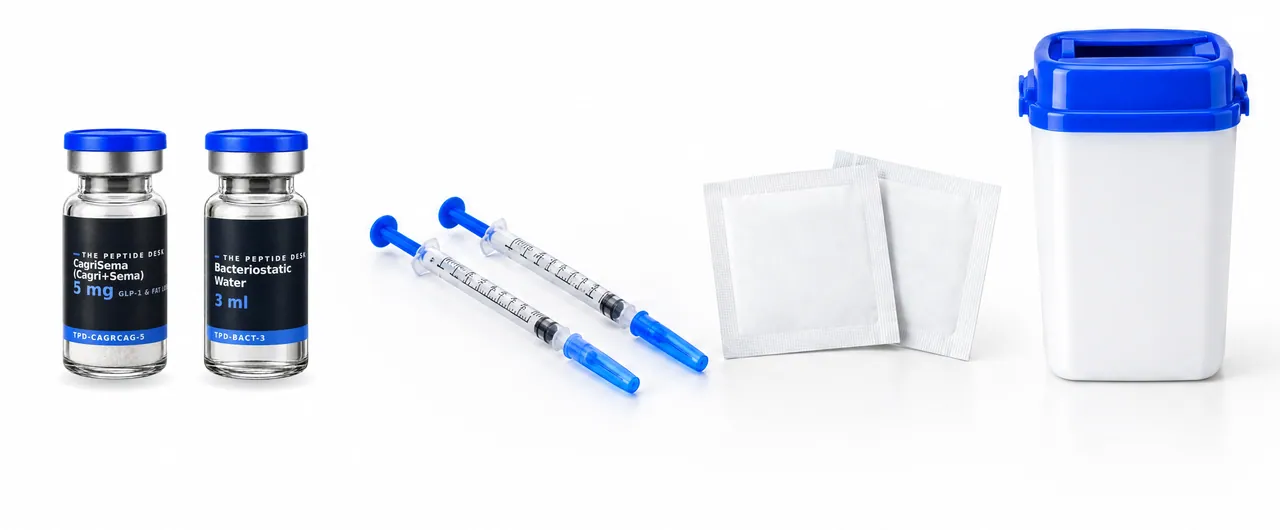
2 things, numbered as in the picture
Tick off what you already have. Vial and BAC water are our real shop photos at the same size.
-
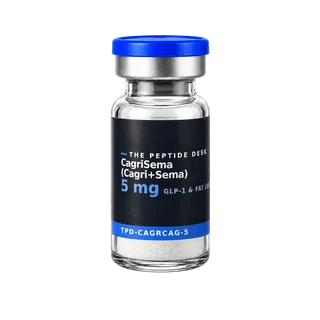
CagriSema vial
The CagriSema vial (lyophilized powder, contains both compounds).
-
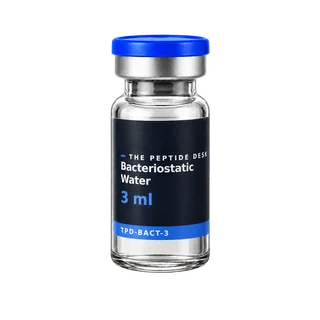
Water and supplies
Bacteriostatic water, U-100 insulin syringes, alcohol swabs.
Reconstitution
Use the peptide calculator. Since both compounds are in the same vial, the calculator always shows the total of both compounds: 1mg in the calculator is 0.5mg cagrilintide plus 0.5mg semaglutide. A 10mg vial with 2ml water gives 5mg per ml. Just add the water to the vial and let it dissolve.
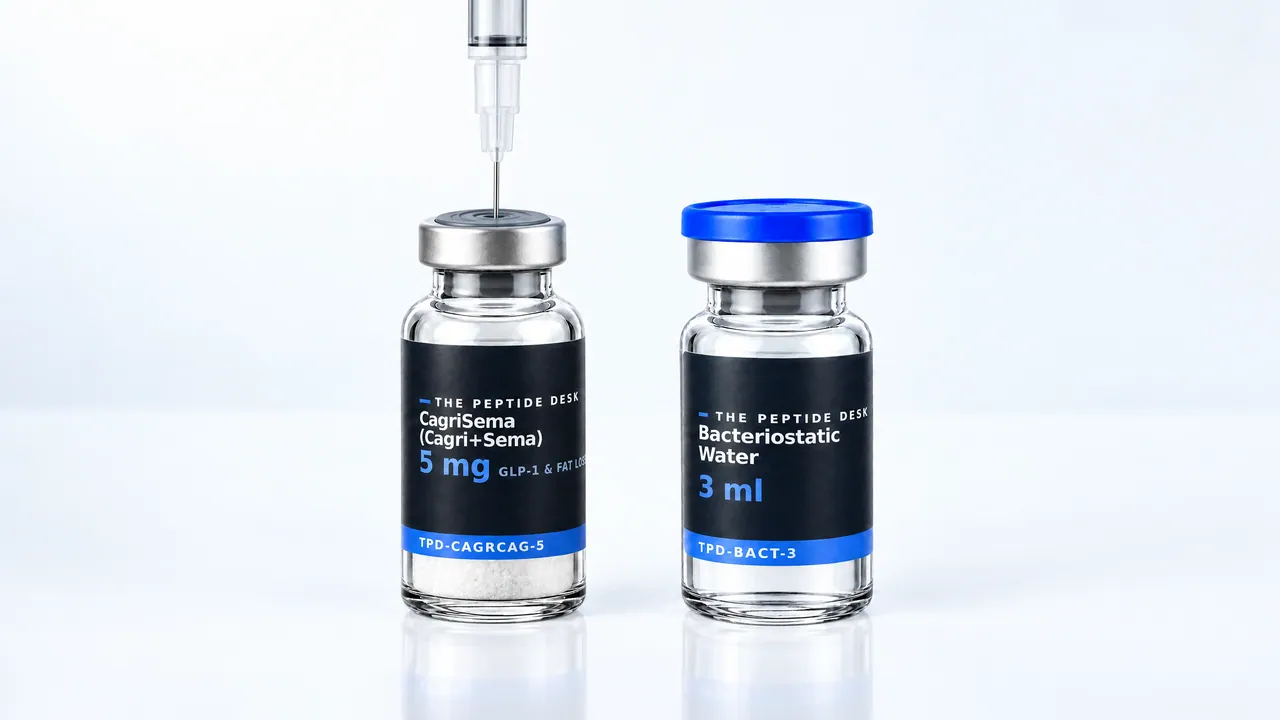
Step by step
Dissolving the powder
Four steps, the same for every vial size.
- 1Wipe the cap
Clean the rubber stopper with an alcohol swab.
- 2Add BAC water
Just add it, it does not matter if it hits the powder directly.
- 3Swirl or shake
Until everything has dissolved, both are fine.
- 4Draw up
With the U-100 insulin syringe.
Dosing
Dosing
Dosing, titration and syringe
Loading the dosing information …
- Getting started and stepping up, drawn as a staircase
- Units on the U-100 syringe for every step
- How long one vial lasts
Injection
The injection is subcutaneous, into the fat layer under the skin. Common spots are the abdomen (keep about two finger-widths clear of the navel), the front and the inner side of the thigh, or the back of the upper arm.
The short version:
Injection
Where and at what angle
Pick a spot or switch the angle. Subcutaneous means: into the fat layer, not the muscle.
Rotate the spot each time, never the same one twice in a row.
Rule of thumb: where there is more fat under the skin, insert straight at 90 degrees. In lean people with little fat, 45 degrees, so the needle stays in the fat layer. Simplified diagram.
-
Clean the spot with an alcohol swab and let it dry
-
Pinch up a small fold of skin
-
Insert the needle: at 90 degrees where there is more fat under the skin, at 45 degrees in lean people with little fat
-
Inject slowly, wait a moment, then withdraw
-
Put the needle straight into the sharps container
Rotate the site each time so the tissue does not get irritated. Never the same spot twice in a row.
CagriSema is injected once a week.
What the research shows
The phase 3 study REDEFINE 1 (NEJM, 2025) compared CagriSema with the individual compounds and placebo in 3,417 adults with overweight or obesity: after 68 weeks weight fell by 20.4 percent on average with CagriSema, versus 3.0 percent on placebo. According to the manufacturer it was 14.9 percent with semaglutide alone and 11.5 percent with cagrilintide alone. When taken as planned the manufacturer reports 22.7 percent for CagriSema (16.1 and 11.8 percent for the single compounds). That is strong evidence that the combination beats each of the two compounds alone.
Study results
What the trials measured
Interactive: switch tabs, tap points, show or hide arms. Arms are named relative to each other, no dosing advice.
Body weight after 68 weeks2
Mean change in percent, 3,417 participants without diabetes
Combination and placebo in the first group are also in the trial abstract (-20.4 and -3.0 percent). The values of the single compounds and the second analysis come from the manufacturer's announcement of 20 Dec 2024.
Research status
Where the research stands
From the design of the amylin analogue to the large phase 3 programmes REDEFINE and REIMAGINE: registered trials of the combination with status, participants and results. As of 26 Oct 2026. 12
- Preclinical Design of cagrilintide, cell assays and animals
- Phase 1 9 trials, 7 completed
- Phase 2 5 trials, 5 completed
- Phase 3 18 trials, 10 completed
- Approval not yet
Show all 23 phase 2 and 3 trials on a timelineHide timeline
NCT04982575 · 92 participants, started Aug 2021, primary endpoint reached Jul 2022.
Registry entry ↗ · Results: Frias et al., The Lancet, 2023
NCT05016882 · 698 participants, started Aug 2021, primary endpoint reached Dec 2024. Tests several agents.
Registry entry ↗ · Results not yet in PubMed
NCT06131372 · 626 participants, started Apr 2024, primary endpoint reached Sept 2025.
Registry entry ↗ · Results not yet in PubMed
NCT06409130 · 270 participants, started May 2024, primary endpoint reached Nov 2025. Tests several agents.
Registry entry ↗ · Results not yet in PubMed
NCT06797869 · 142 participants, started Jan 2025, primary endpoint reached Jun 2026.
Registry entry ↗ · Results not yet in PubMed
REDEFINE 1 · NCT05567796 · 3,400 participants (planned), started Nov 2022, primary endpoint planned Oct 2024.
Registry entry ↗ · Results: Garvey et al., New England Journal of Medicine, 2025, Novo Nordisk, Unternehmensmitteilung vom 20.12.2024
REDEFINE 2 · NCT05394519 · 1,200 participants, started Feb 2023, primary endpoint reached Jan 2025.
Registry entry ↗ · Results: Davies et al., New England Journal of Medicine, 2025
REDEFINE 3 · NCT05669755 · 7,101 participants, started Mar 2023, primary endpoint planned Sept 2027.
REDEFINE 5 · NCT05813925 · 331 participants, started Apr 2023, primary endpoint reached Jan 2025.
Registry entry ↗ · Results: Yamauchi et al., The Lancet Diabetes & Endocrinology, 2026
REDEFINE 6 · NCT05996848 · 300 participants, started Aug 2023, primary endpoint reached Jan 2025.
Registry entry ↗ · Results not yet in PubMed
REIMAGINE 2 · NCT06065540 · 2,734 participants, started Sept 2023, primary endpoint reached Nov 2025.
Registry entry ↗ · Results: Buse et al., The Lancet Diabetes & Endocrinology, 2026
NCT06131437 · 809 participants, started Nov 2023, primary endpoint reached Dec 2025.
Registry entry ↗ · Results not yet in PubMed
NCT06221969 · 1,024 participants, started Jan 2024, primary endpoint reached Mar 2026.
Registry entry ↗ · Results not yet in PubMed
REIMAGINE 1 · NCT06323174 · 189 participants, started Mar 2024, primary endpoint reached Oct 2025.
Registry entry ↗ · Results not yet in PubMed
REIMAGINE 3 · NCT06323161 · 274 participants, started Mar 2024, primary endpoint reached Sept 2025.
Registry entry ↗ · Results not yet in PubMed
NCT06388187 · 300 participants, started Jun 2024, primary endpoint reached Apr 2026.
Registry entry ↗ · Results not yet in PubMed
REIMAGINE 5 · NCT06534411 · 1,023 participants, started Nov 2024, primary endpoint reached Jun 2026.
Registry entry ↗ · Results not yet in PubMed
NCT06780449 · 400 participants (planned), started Feb 2025, primary endpoint planned Aug 2028.
NCT07011667 · 609 participants, started Jun 2025, primary endpoint planned Mar 2027.
NCT07253285 · 460 participants (planned), started Jan 2026, primary endpoint planned Mar 2030.
NCT07564414 · 2,500 participants (planned), started May 2026, primary endpoint planned Feb 2028.
REIMAGINEYOUNG · NCT07282613 · 80 participants (planned), started Aug 2026, primary endpoint planned Sept 2029.
NCT07817251 · 210 participants (planned), started Sept 2026, primary endpoint planned Jun 2027.
Bar: start to primary endpoint (planned for running trials). Green = completed, blue = progress until 26 Oct 2026. Phase 1: 9 trials on safety and pharmacokinetics, not shown as bars.
Side effects
- Mainly gastrointestinal: nausea, fullness, constipation or diarrhea, especially when dosing up.
- A slow ease-in keeps this small.
- See the individual entries for semaglutide and cagrilintide.
Tolerability
Gastrointestinal effects and side effects
Out of 100 participants per group, how many had the event over 68 weeks.
| Event | Placebo | Combination (CagriSema) |
|---|---|---|
| Gastrointestinal, REDEFINE 11 | 40% | 80% |
| Gastrointestinal, REDEFINE 23 | 34% | 73% |
| Side effects overall, REIMAGINE 25 | 71% | 87% |
Gastrointestinal effects were nausea, vomiting, diarrhoea, constipation or abdominal pain, mostly mild to moderate and temporary according to the trials.135
Storage
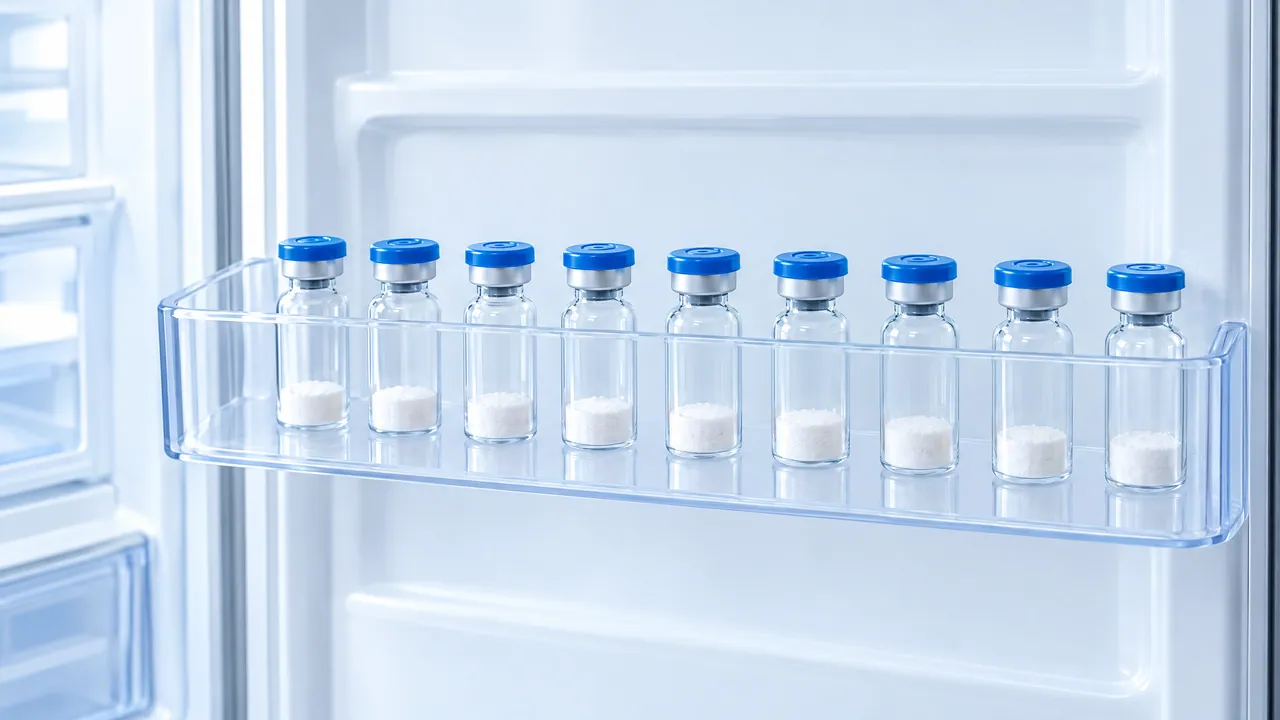
Before mixing the powder is robust, normal room temperature (around 20 to 25 degrees) is fine, ideally kept in the dark. After mixing, keep in the fridge (2 to 8 degrees), do not freeze. It stays good there for at least 4 to 6 months with barely any loss of potency, in practice considerably longer. Swirl or shake to mix, both are fine.
Shelf life
How long it keeps
Robust, no fridge needed.
At least 4 to 6 months with barely any loss of potency.
- Keep it dark
- Dissolved: 2 to 8 degrees
- Note the mixing date on the vial