This information is for research and educational purposes only. No medical recommendations. Products are not approved for human use. For health questions, consult a doctor.

Lexicon

Adamax

A modified Semax (N-acetyl-Semax-adamantane). Meant to act longer and reach the brain better, but experimental.

4 min read 5 sources

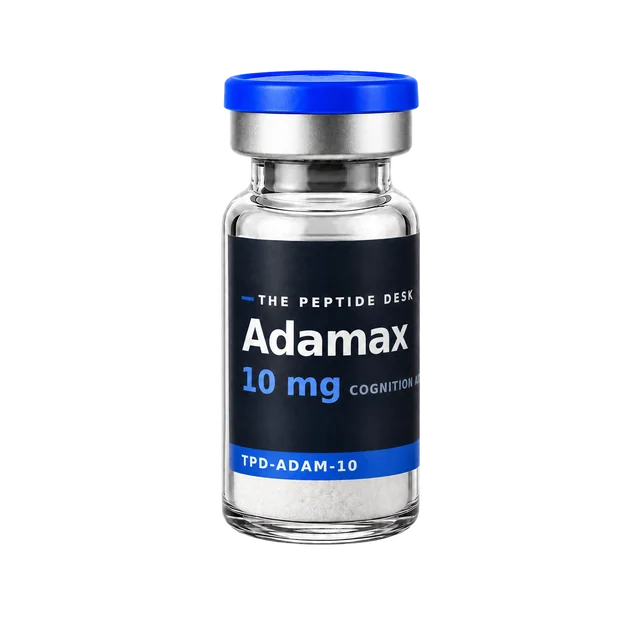
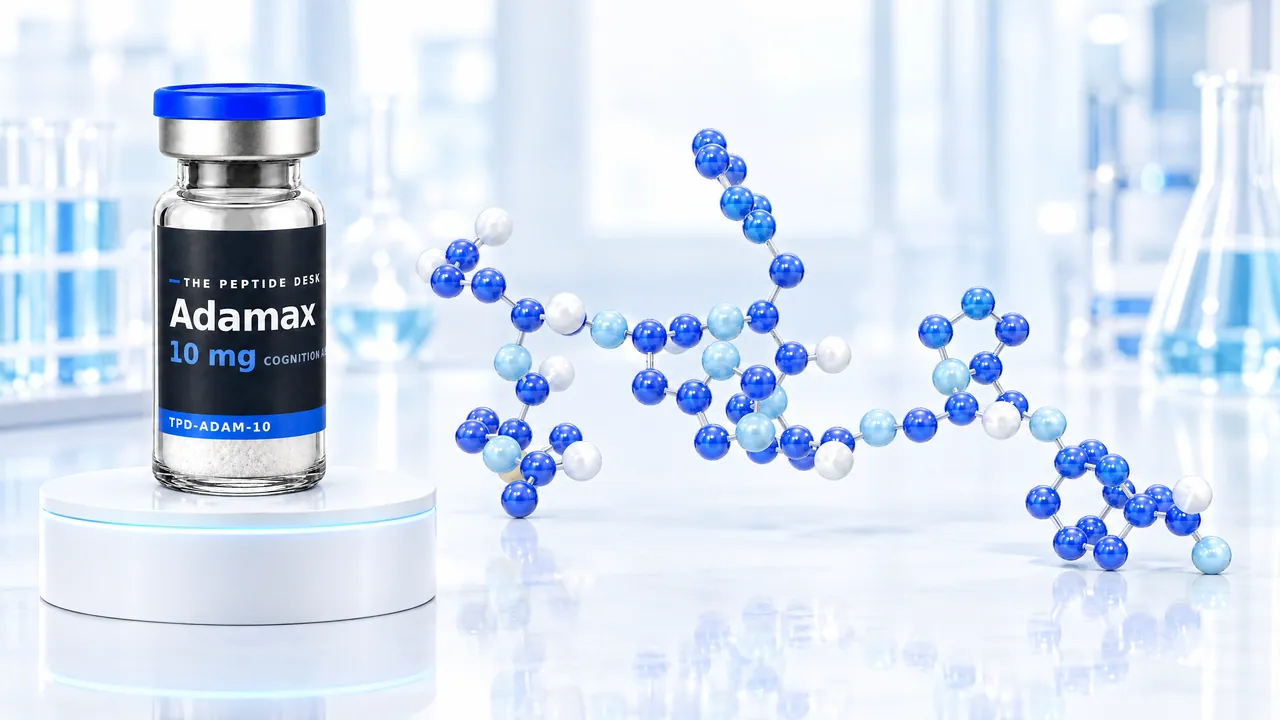
Adamax vial with white powder and the black TPD label on a white round podium, next to a long blue and white 3D molecule model in a bright lab with glass flasks
No study on Adamax · not approvedLab tested in the shop

Summary

At a glance

Sources checked on 26 Oct 2026

Published studies on Adamax
0 studies

PubMed search for Adamax and Semax, as of 26 Oct 20263

Human trials in the registry
0 trials

neither Adamax nor Semax on ClinicalTrials.gov, as of 26 Oct 20264

Parent molecule Semax
7 amino acids

Met-Glu-His-Phe-Pro-Gly-Pro, derived from ACTH(4-7)1

BDNF after Semax (rats)
1.4 -fold

peak level in the hippocampus after a single dose of the parent molecule1

  • Adamax is described as a chemically modified Semax: N-acetyl-Semax with an additional adamantane group. There is no published study on Adamax itself.3
  • Semax is a peptide of seven building blocks derived from the hormone fragment ACTH(4-7). Everything assumed about Adamax rests on it.15
  • In rats a single dose of Semax raised the nerve growth factor BDNF in the hippocampus 1.4-fold and the activated receptor TrkB 1.6-fold.1
  • A change to the molecule is not automatically an improvement: in a lab study acetylated Semax bound copper differently and no longer protected nerve cells from copper damage.2
  • ClinicalTrials.gov lists no trial of Adamax or of Semax (as of October 2026). Everything here is research on the parent molecule, not a recommendation.4
Profile

Updated May 2026

Class
Semax derivative

N-acetyl-Semax-adamantane

Route
Nasal or subcutaneous
Frequency
Daily

rather in the morning

Form
Lyophilised powder

reconstituted with BAC water

Sizes
10 mg

1 size in the shop

Contents 16 sections
  1. At a glance
  2. What is Adamax?
  3. How it works
  4. What you need
  5. Reconstitution
  6. Use (nasal or subcutaneous)
  7. Dosing
  8. What the research shows
  9. Research status
  10. Side effects
  11. Practice
  12. Storage
  13. Related compounds
  14. FAQ
  15. Glossary
  16. Sources

Equipment

Equipment you need

For reconstitution and injection you need a bit of basic gear. Here are solid, cheap options:

As an Amazon associate we earn from qualifying purchases. Links open Amazon - no extra cost for you.

What is Adamax?

Adamax is a chemically modified Semax. Specifically it is N-acetyl-Semax with an additional adamantane group. These two changes are meant to address two weaknesses of normal Semax: the short duration of action and the limited uptake into the brain. In theory Adamax therefore acts longer and crosses the blood-brain barrier better.

Honestly up front: Adamax is a pure research peptide and not approved as a medicine anywhere. Like Semax it is used nasally or subcutaneously and comes as a freeze-dried powder you dissolve in bacteriostatic water.

Comparison

Semax and its derivatives

Peptides from the TPD lexicon with the Semax core, told apart by the changes in their names. Tap a card to open its entry.

Simplified by the names of the compounds. Studies exist only for the parent molecule Semax, not for the derivatives. 12

How it works

Because Adamax descends from Semax, the mechanism is essentially the same: it goes back to a fragment of the hormone ACTH and is linked to driving nerve growth factors like BDNF and to nootropic effects (focus, resilience under stress). The adamantane modification is meant to make the action more stable and longer.

Important: that is the theory, derived from the well-studied Semax. For Adamax itself this evidence does not exist in study form, more on that below.

Where it acts

Where the parent molecule Semax acted

Tap a point or a card. All from rat studies with Semax, not with Adamax.

  1. Brain (hippocampus)

    More BDNF and activated TrkB after Semax, plus more learned avoidance responses (rats)1

    TrkB

Known targets1

Compound PubChem CID 9811102 (Semax): one described target, More expression and activation with Semax (rats), no direct binding shown.

BDNF receptor TrkB
Gene
NTRK2
UniProt
Q16620
ChEMBL
CHEMBL4898
Action
More expression and activation with Semax (rats), no direct binding shown

Glass network of nerve cells behind a transparent glass wall, small blue chain molecules pass through and make the branches light up
The assumed action is derived from the parent molecule Semax. Symbolic image.

What you need

Depending on the route (nasal or subcutaneous) you need:

  • The Adamax vial with the freeze-dried powder
  • Bacteriostatic water to dissolve it
  • For nasal: a small nasal spray bottle or a dropper
  • For subcutaneous: U-100 insulin syringes
  • Alcohol swabs and, for injection, a sealable sharps container for used needles
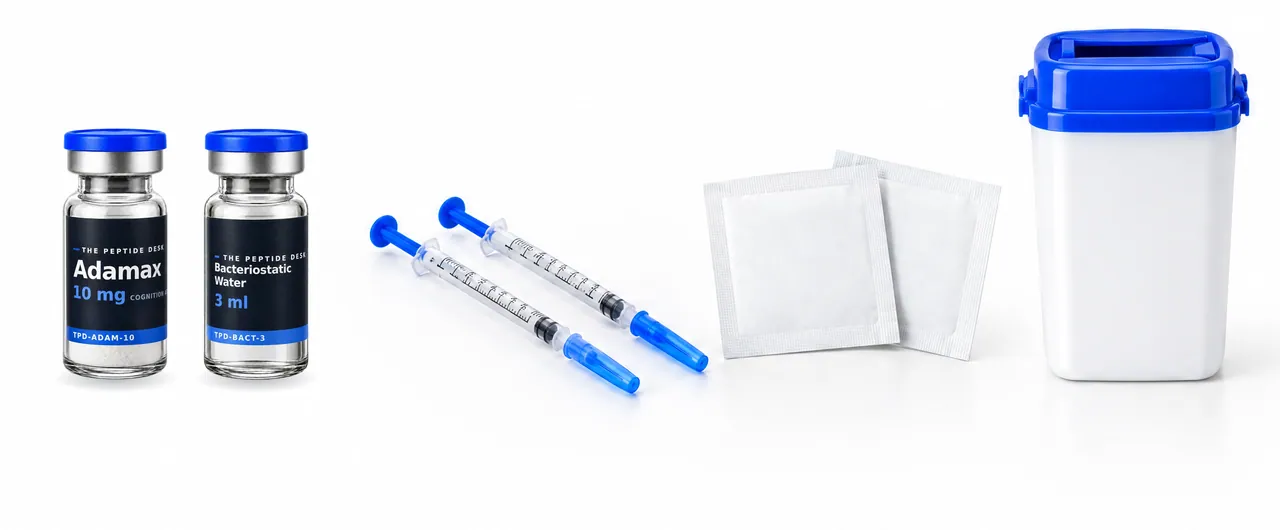
Adamax vial and bacteriostatic water at the same size with the black TPD label, next to two U-100 insulin syringes, two alcohol swabs and a sharps container with a blue lid
Supplies for injection. For nasal use a nasal spray bottle is added. Symbolic image.

Reconstitution

The powder is dissolved in bacteriostatic water. How much water you add sets the concentration and therefore how many units you draw on the insulin syringe for your dose.

Use the peptide calculator for this. You can use the same solution nasally as drops, in which case the concentration helps estimate the amount per drop.

When dissolving, just add the bac water, it does not matter if it hits the powder directly. Then swirl or shake until everything has dissolved, both are fine.
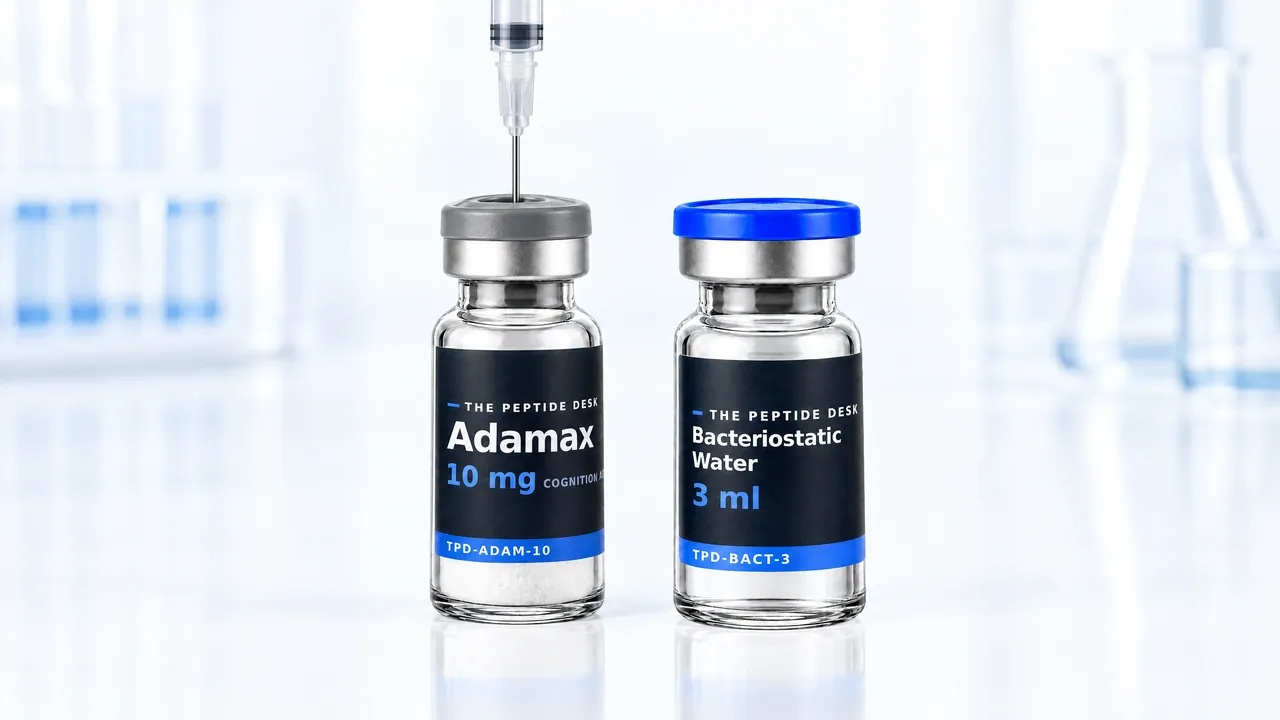
Step by step

Dissolving the powder

Four steps, the same for every vial size.

  1. 1Wipe the cap

    Clean the rubber stopper with an alcohol swab.

  2. 2Add BAC water

    Just add it, it does not matter if it hits the powder directly.

  3. 3Swirl or shake

    Until everything has dissolved, both are fine.

  4. 4Draw up

    With the U-100 insulin syringe.

Less water higher concentration fewer units on the syringe Example: 10 mg + 1 ml = 10 mg/ml

Use (nasal or subcutaneous)

Dosing. Loading the dosing information …

Dosing

Dosing

Dosing, titration and syringe

Loading the dosing information …

  • Getting started and stepping up, drawn as a staircase
  • Units on the U-100 syringe for every step
  • How long one vial lasts

What the research shows

This is the most honest part: on Adamax itself there are practically no published studies. The whole rationale rests on the parent molecule Semax, which is well studied (on BDNF, neuroprotection and cognition), plus the assumption that the chemical modification improves duration and brain penetration. Whether that really holds in humans is not proven in study form.

Below we therefore link a study on the parent molecule Semax, clearly labelled. Anyone who wants a solid data base is better served with Semax.

Study results

What the trials measured

Interactive: switch tabs, tap points, show or hide arms. Arms are named relative to each other, no dosing advice.

BDNF system in the hippocampus of rats1

Peak after a single dose of Semax, as a multiple of control

BDNF protein1
Control (baseline) 1.0-fold
Semax (parent molecule) 1.4-fold
Activated receptor TrkB1 Phosphorylation
Control (baseline) 1.0-fold
Semax (parent molecule) 1.6-fold
BDNF mRNA (exon III)1
Control (baseline) 1.0-fold
Semax (parent molecule) 3.0-fold
TrkB mRNA1
Control (baseline) 1.0-fold
Semax (parent molecule) 2.0-fold

Values from the abstract. Study with the parent molecule Semax in rats, not with Adamax. Whether Adamax acts similarly or more strongly has not been studied.

Bright shelves of an incubator with petri dishes, a frosted glass brain model in the middle
Studies exist only for the parent molecule Semax. Symbolic image.

Research status

Where the research stands

There is neither a registered trial nor a publication on Adamax. The parent molecule Semax is not listed on ClinicalTrials.gov either. As of 26 Oct 2026. 4

  1. Preclinical Only animal and cell studies with the parent molecule Semax
  2. Phase 1 no registered trial
  3. Phase 2 no registered trial
  4. Phase 3 no registered trial
  5. Approval not yet
Not approved. Adamax is a pure research peptide without studies of its own.3

So far there is no registered trial in humans. 4

Side effects

Because Adamax is related to Semax, a similar, rather mild profile is assumed: slight irritation of the nasal lining with nasal use, occasionally head pressure and with use too late in the day possibly worse sleep. Solid safety data specifically on Adamax are missing, though, which makes caution and a low start all the more important.

Practice

  1. Start very low, precisely because the data are thin.

  2. Rather in the morning and across the day, not late evening (likely activating like Semax).

  3. In phases rather than continuously.

  4. If you value proven effect, take Semax instead, that is the studied original.

Bright desk by a window with a glass of water, a small succulent in a pot and an open blank notebook

Storage

The undissolved powder is robust, normal room temperature (around 20 to 25 degrees) is fine, ideally kept in the dark. The reconstituted solution goes into the fridge (2 to 8 degrees) and stays stable there for at least 4 to 6 months with barely any loss of potency, in practice considerably longer. The bacteriostatic water brings a preservative that keeps the dissolved form stable for longer.

Shelf life

How long it keeps

Undissolved (powder) Room temperature, around 20 to 25 degrees, dark

Robust, no fridge needed. Best kept in the dark.

Dissolved (mixed) Fridge, 2 to 8 degrees

At least 4 to 6 months with barely any loss of potency. The bacteriostatic water brings a preservative.

  • Keep it dark
  • Dissolved: 2 to 8 degrees
  • Note the mixing date on the vial
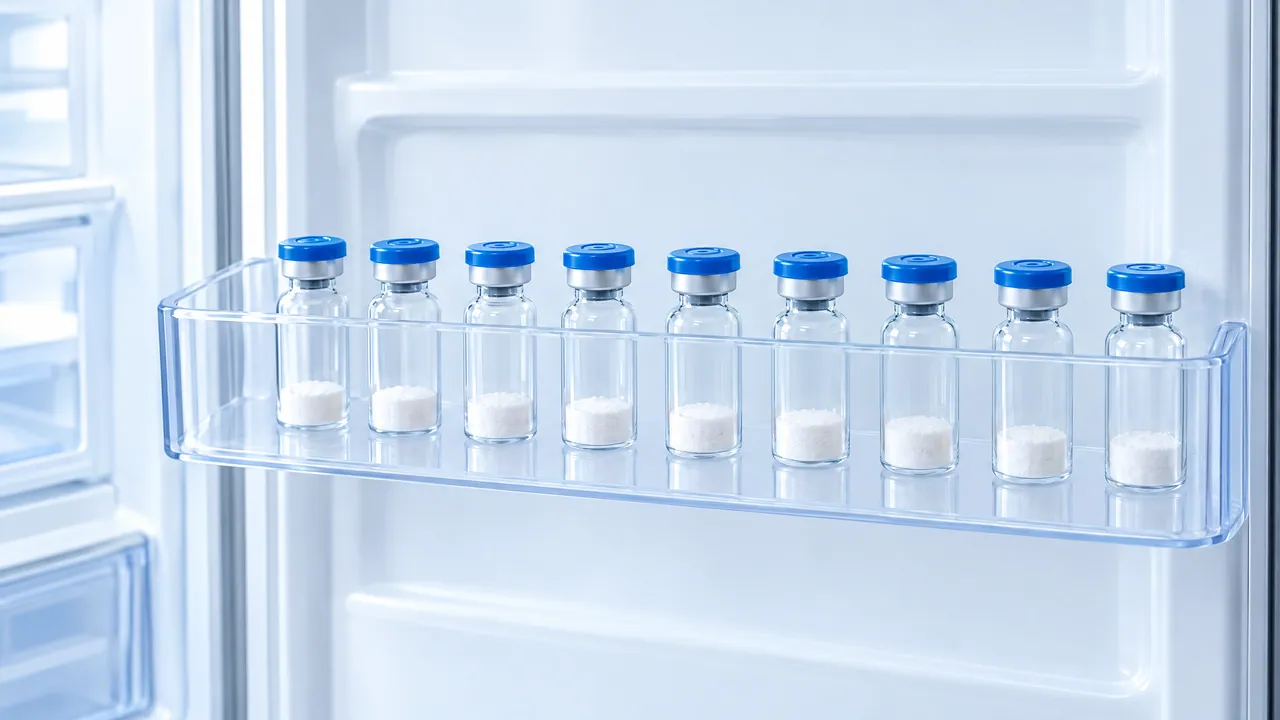
Nine vials with white powder and blue caps in the door shelf of a bright fridge
Powder dark at room temperature, once dissolved into the fridge (2 to 8 degrees), stable there for at least 4 to 6 months. Symbolic image.

Related

Related compounds

Same features, blends with Adamax or a different path: all in the TPD lexicon.

FAQ

Common questions about Adamax

Short answers, each backed by the sources below.

Are there studies on Adamax?

No. A PubMed search for Adamax and Semax returned no result on 26 October 2026 and ClinicalTrials.gov lists no trial. Everything said about Adamax is derived from the parent molecule Semax.34

How does it differ from Semax?

Semax is a peptide of seven building blocks (Met-Glu-His-Phe-Pro-Gly-Pro). Adamax is said to be the same peptide with an acetyl group at the start plus an additional adamantane group. Both are meant to improve duration and uptake into the brain. This has not been shown.15

What do the studies on the parent molecule Semax show?

In rats a single dose of Semax raised BDNF protein in the hippocampus 1.4-fold and the activated receptor TrkB 1.6-fold. The messenger RNA for BDNF rose 3-fold and that for TrkB 2-fold. The animals showed more learned avoidance responses.1

Does an acetyl group automatically make Semax better?

Not necessarily. In a lab study acetylated Semax bound copper differently from normal Semax. Unlike Semax it did not protect nerve cells in culture from copper damage, because the free end of the peptide was needed for that. A change to the molecule changes its properties. Only a measurement shows in which direction.2

Which side effects are known?

There are no solid data because Adamax has never been tested in a study. The mild profile described in the lexicon is taken from the parent molecule Semax and has not been shown for Adamax.34

Glossary

Terms explained briefly

Dotted words in the text open these explanations directly.

ACTH
Adrenocorticotropic hormone from the pituitary gland. Semax goes back to a short piece of it.
Adamantane
A cage-shaped framework of ten carbon atoms. According to its name it is attached to Semax in Adamax.
BDNF
Brain-derived neurotrophic factor: the body's own growth factor for nerve cells, important for learning and memory.
Blood-brain barrier
A tight boundary between blood and brain that keeps many substances out.
Hippocampus
Brain region with a central role in learning and memory.
Lyophilisate
Freeze-dried powder. Without water a peptide keeps much longer.
N-acetyl
A small acetyl group at the start of a peptide chain. It can change the breakdown, binding and action of a peptide.
Preclinical
Research before first use in humans, in cell cultures and animal models.
Semax
A peptide of seven building blocks derived from the hormone fragment ACTH(4-7). The parent molecule of Adamax and the only one of them with studies.
Subcutaneous
Into the fat layer just under the skin.
TrkB
Receptor on nerve cells that BDNF binds to. When activated it carries a phosphate group.

Evidence

Sources

Show all 5 sourcesHide sources 1 Studies1 Trial registry3 Database checked 26 Oct 2026

Studies

  1. Acetylated Semax: binding of copper and zinc, cell culture

    Magrì et al., Journal of Inorganic Biochemistry, 2016

    Checked 26 Oct 2026 via doi.org, Crossref, PubMed

Trial registry

  1. Search on ClinicalTrials.gov (no trial with Adamax or Semax)

    ClinicalTrials.gov, U.S. National Library of Medicine

    Checked 26 Oct 2026 via ClinicalTrials.gov API v2

Database

  1. Semax and the BDNF system in the rat hippocampus (PubMed record)

    Dolotov et al., Brain Research, 2006 (DOI 10.1016/j.brainres.2006.07.108)

    Checked 26 Oct 2026 via PubMed, doi.org, Crossref
  2. PubMed search for Adamax and Semax (0 results)

    PubMed, U.S. National Library of Medicine

    Checked 26 Oct 2026 via PubMed E-utilities
  3. Structure of Semax in PubChem

    PubChem, U.S. National Library of Medicine (CID 9811102)

    Checked 26 Oct 2026 via PubChem

In the shop

Adamax in the catalog

Sizes, prices and shipping times are on the product page.

To the product