This information is for research and educational purposes only. No medical recommendations. Products are not approved for human use. For health questions, consult a doctor.

Lexicon

BPC + TB + KPV Blend

The healing classic plus the anti-inflammatory component KPV, three compounds for repair and inflammation control.

2 min read 14 sources

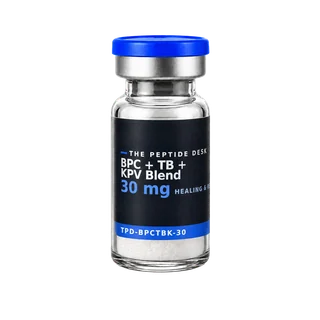
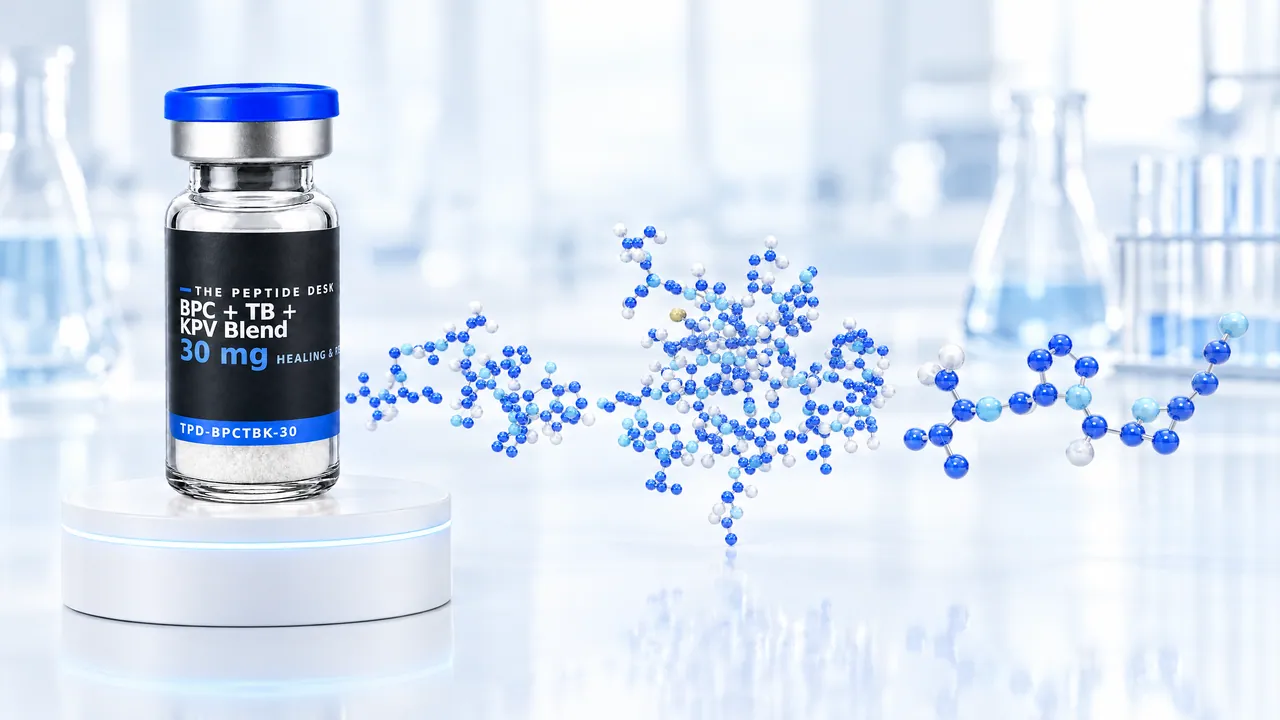
Vial of the BPC + TB + KPV Blend with white powder and the black TPD label on a white podium, next to three blue 3D peptide structures from large to small in a bright lab
KPV preclinical only · not approved

Summary

At a glance

Sources checked on 26 Oct 2026

On the ready-made blend
0 trials

no registered trial with two or three of the components together, as of 26 Oct 202613

KPV in humans
0 trials

no trial with KPV on ClinicalTrials.gov12

Corneal wounds closed
100 %

8 of 8 eyes after 60 hours with KPV drops, rabbits3

Wound closure after 7 days
+61 %

thymosin beta-4 in rats with skin wounds, against saline5

  • The blend takes BPC-157 and TB-500 and adds KPV, the tripeptide Lys-Pro-Val from the end of the hormone alpha-MSH. There is no study on the ready-made blend.131
  • KPV enters gut and immune cells via the transporter PepT1 and dampens the inflammation pathway NF-κB there even at nanomolar amounts. In two colitis models in mice it reduced inflammation.12
  • In animal studies BPC-157 promoted new blood vessels via VEGFR2, thymosin beta-4 sped up wound closure in rats by up to 61 percent. Together BPC-157 and TB-500 added no benefit for the Achilles tendon in rats.854
  • KPV has never been tested in humans. For BPC-157 there are three small human studies with 30 people in total, for thymosin beta-4 trials given into a vein.12107
  • None of the three components is approved. Everything here is the state of research, not a recommendation.1412
Profile

Updated May 2026

Class
Healing blend

BPC + TB + KPV

Use
Subcutaneous

in mg, a third each

Ratio
a third each

10+10+10

WADA
Banned

peptides

Sizes
30 mg

1 size in the shop

Contents 15 sections
  1. At a glance
  2. What is the BPC + TB + KPV Blend?
  3. How it works
  4. What you need
  5. Reconstitution
  6. Dosing
  7. Injection
  8. What the research shows
  9. Research status
  10. Side effects
  11. Storage
  12. Related compounds
  13. FAQ
  14. Glossary
  15. Sources

What is the BPC + TB + KPV Blend?

This blend takes the proven BPC-157 + TB-500 stack and adds KPV, an anti-inflammatory tripeptide. You also find all three individually in the lexicon. The idea: repair (BPC + TB) plus targeted inflammation dampening (KPV).

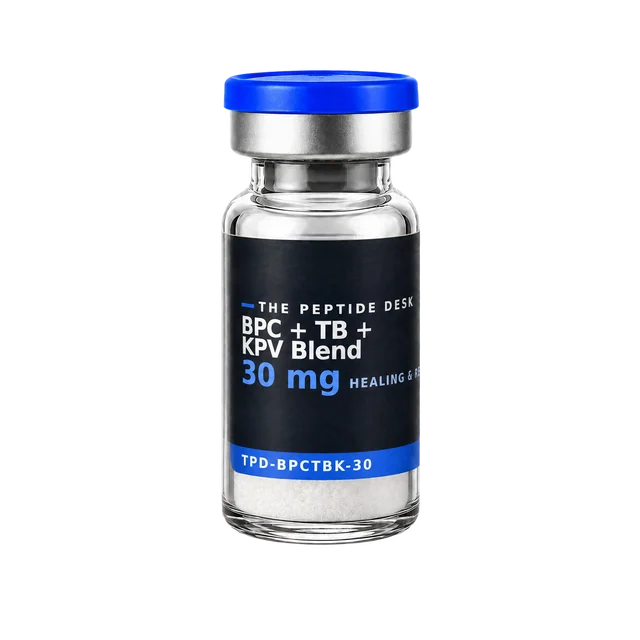
The 30mg vial holds a third each (10mg BPC + 10mg TB + 10mg KPV).

Comparison

Three compounds, alone and blended

The three-way blend next to the blend without KPV and the single compounds, as stated in the TPD lexicon. Tap a card to open its entry.

Simplified: no study has tested KPV together with BPC-157 or TB-500. For BPC-157 and TB-500 together a rat study found no added benefit. 413

How it works

BPC-157 and TB-500 cover structural repair and cell migration, KPV adds an anti-inflammatory action by dampening central inflammation signaling routes. Especially with injuries that have a strong inflammatory component, this is meant to support recovery.

The individual mechanisms are in the lexicon entries for BPC-157, TB-500 and KPV.

Where it acts

Components and where they act

Tap a point or a card. Colour = component. All sites from animal and cell studies on the single compound.

  1. Gut

    KPV taken up via PepT1, less inflammation in two colitis models (mice)1

    KPV
  2. Eye (cornea)

    All 8 corneal wounds closed after 60 hours with KPV drops (rabbits)3

    KPV
  3. Achilles tendon

    Better tendon tissue on their own, above all with TB-500, no added benefit together (rats)4

    BPC-157TB-500
  4. Skin and wounds

    Thymosin beta-4 sped up wound closure by up to 61 percent (rats)5

    TB-500
  5. Blood vessels

    BPC-157 promoted new vessels via VEGFR2 (cells and rats)8

    BPC-157
  6. Stomach

    BPC-157 protected the mucosa against alcohol and painkiller damage (rats)9

    BPC-157

Known targets1

Compound CHEMBL4297358: three described targets, type of action on each card.

Peptide transporter PepT1 (KPV)
Gene
SLC15A1
UniProt
P46059
ChEMBL
CHEMBL4605
Action
Transporter, carries KPV into gut and immune cells
VEGF receptor 2 (BPC-157)
Gene
KDR
UniProt
P35968
ChEMBL
CHEMBL279
Action
Increased and activated in vessel cells (Hsieh 2017)
Actin (thymosin beta-4)
Gene
ACTB
UniProt
P60709
ChEMBL
CHEMBL2062353
Action
Thymosin beta-4 binds free actin via the LKKTETQ motif (Philp 2003)
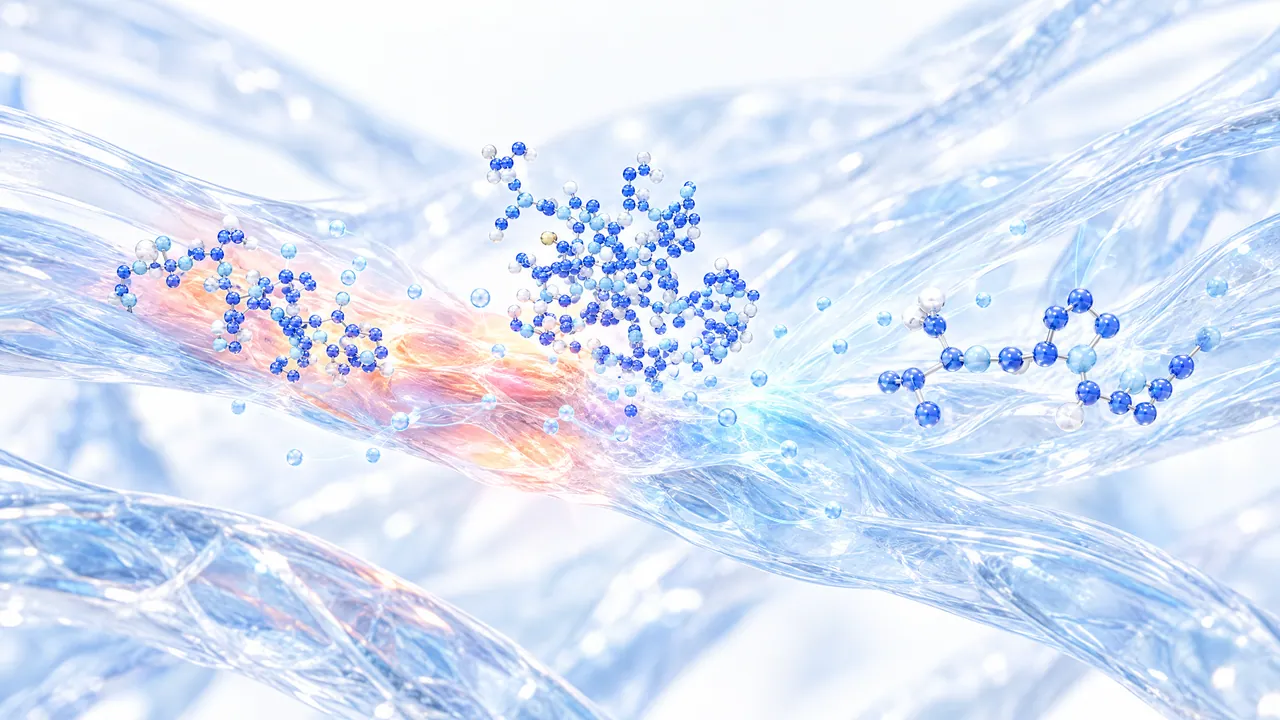
Translucent blue strands of tissue with a reddish glowing, inflamed spot, with three blue peptide structures from large to small above it
Repair plus dampened inflammation, that is the idea. Symbolic image.

What you need

Supplies

2 things, numbered as in the picture

Tick off what you already have. Vial and BAC water are our real shop photos at the same size.
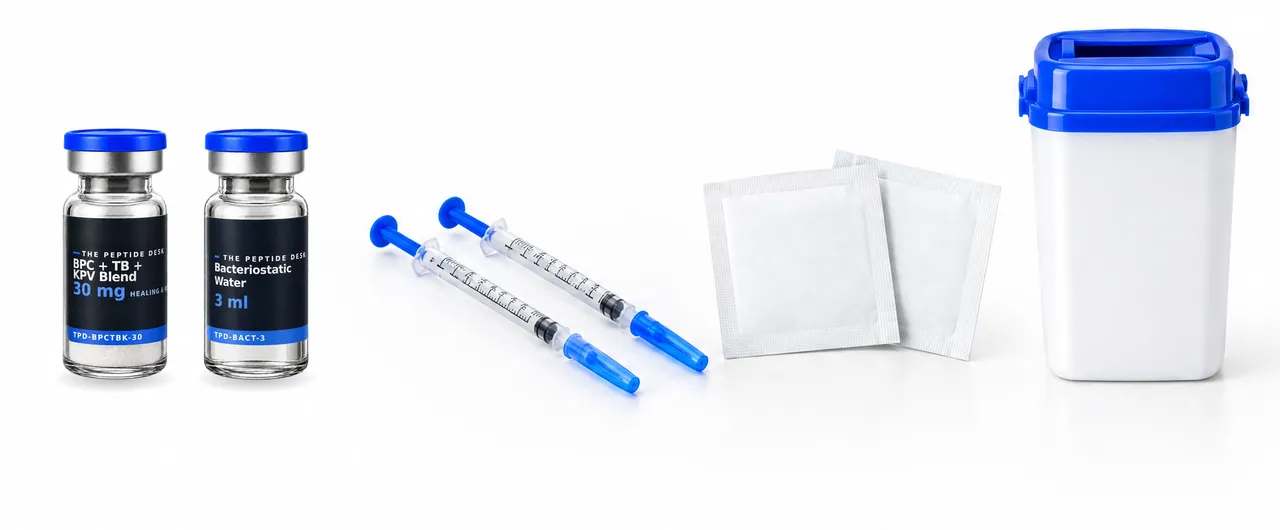
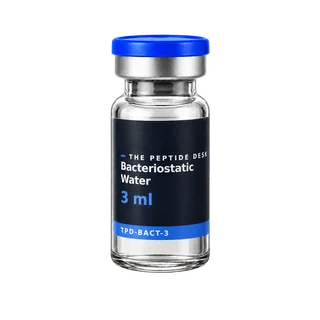
Vial of the BPC + TB + KPV Blend and bacteriostatic water at the same size with the black TPD label, next to two U-100 insulin syringes, two alcohol swabs and a sharps container with a blue lid
  1. Blend vial

    The blend vial (lyophilized powder, three compounds).

    In the shop
  2. Water and supplies

    Bacteriostatic water, U-100 insulin syringes, alcohol swabs.

    In the shop

Reconstitution

Use the peptide calculator. The values refer to the total amount. A 30mg vial with 3ml water gives 10mg per ml. Just add the water to the vial and let it dissolve.
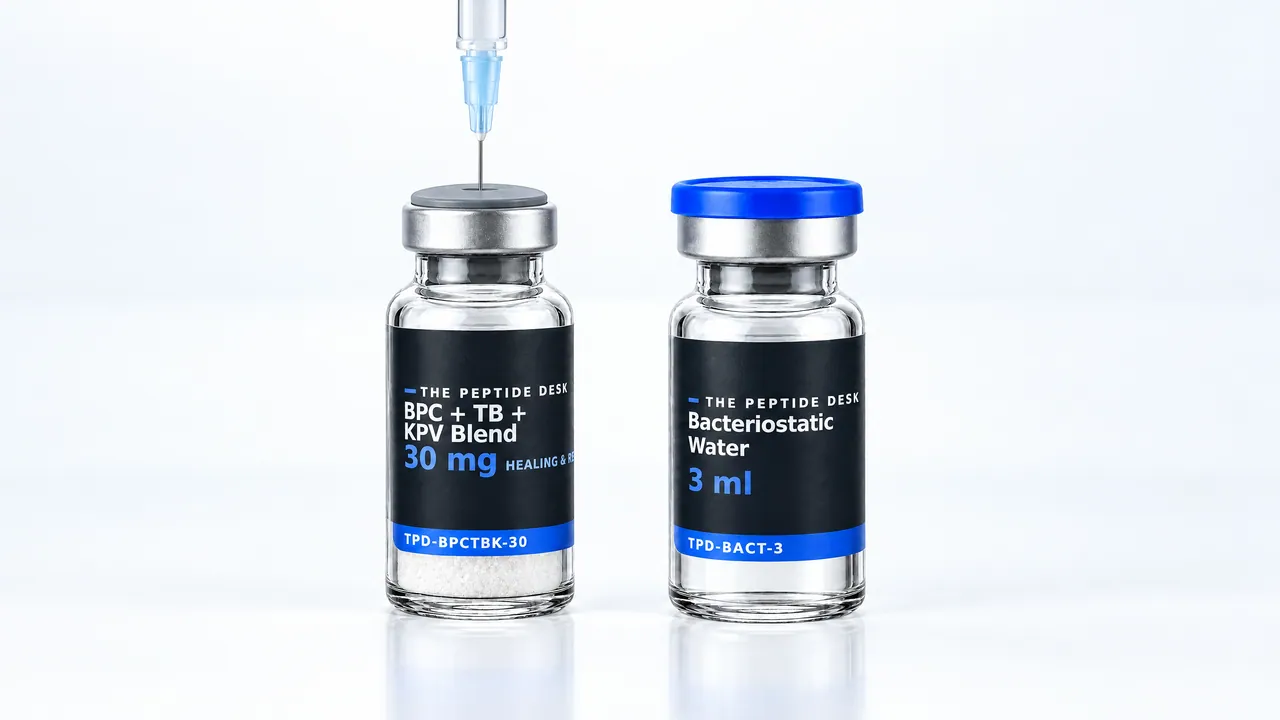
Step by step

Dissolving the powder

Four steps, the same for every vial size.

  1. 1Wipe the cap

    Clean the rubber stopper with an alcohol swab.

  2. 2Add BAC water

    Just add it, it does not matter if it hits the powder directly.

  3. 3Swirl or shake

    Until everything has dissolved, both are fine.

  4. 4Draw up

    With the U-100 insulin syringe.

Less water higher concentration fewer units on the syringe Example: 30 mg + 3 ml = 10 mg/ml

Dosing

Dosing

Dosing, titration and syringe

Loading the dosing information …

  • Getting started and stepping up, drawn as a staircase
  • Units on the U-100 syringe for every step
  • How long one vial lasts

Injection

The injection is subcutaneous, into the fat layer under the skin. Common spots are the abdomen (keep about two finger-widths clear of the navel), the front and the inner side of the thigh, or the back of the upper arm.

The short version:

Injection

Where and at what angle

Pick a spot or switch the angle. Subcutaneous means: into the fat layer, not the muscle.

Rotate the spot each time, never the same one twice in a row.

90°More fat under the skin

Rule of thumb: where there is more fat under the skin, insert straight at 90 degrees. In lean people with little fat, 45 degrees, so the needle stays in the fat layer. Simplified diagram.

  1. Clean the spot with an alcohol swab and let it dry

  2. Pinch up a small fold of skin

  3. Insert the needle: at 90 degrees where there is more fat under the skin, at 45 degrees in lean people with little fat

  4. Inject slowly, wait a moment, then withdraw

  5. Put the needle straight into the sharps container

Rotate the site each time so the tissue does not get irritated. Never the same spot twice in a row.

What the research shows

The components are individually described preclinically (KPV anti-inflammation: Dalmasso, 2008). For the fixed triple combination in humans there are no controlled studies, the benefit derives from the complementary mechanisms. This is mechanism-based, not study-proven for this exact mix.

Study results

What the trials measured

Interactive: switch tabs, tap points, show or hide arms. Arms are named relative to each other, no dosing advice.

Fully closed corneal wounds3

Share of eyes with a renewed surface after 60 hours, rabbits

Cornea after abrasion3 8 of 8 eyes with KPV, none with placebo
Without compound (comparison) 0%
KPV drops (rabbits) 100%

KPV as eye drops, not injected. When nitric oxide formation was blocked, the effect was lost.

Wound healing with thymosin beta-4 in rats5

More than in the saline control group, applied to the skin or into the abdominal cavity

New skin after 4 days5
Thymosin beta-4 (rats) 42%
New skin after 7 days5
Thymosin beta-4 (rats) 61%
Wound contraction after 7 days5
Thymosin beta-4 (rats) 11%

Study with full thymosin beta-4, not with the blend.

Participants by route10

All three published human studies on BPC-157 (review, search up to June 2026)

Knee pain, retrospective10
Into the knee 16%
Bladder inflammation, pilot study10
Into the bladder 12%
Safety, pilot study10
Into a vein 2%

None of the studies had a control group. There is no human study on KPV.
Glass model of the intestine and a glass tendon model on a light wooden table in front of a window
Studies exist only on the single components. Symbolic image.

Research status

Where the research stands

There is no registered trial on the blend or on KPV. Shown are trials on BPC-157 and thymosin beta-4. Thymosin beta-4 reached phase 3 as eye drops, which is not listed here. As of 26 Oct 2026. 11

  1. Preclinical KPV only in cell assays and animal models
  2. Phase 1 3 trials on components, 2 completed
  3. Phase 2 3 trials on components, 2 completed
  4. Phase 3 no registered trial
  5. Approval not yet
Not approved. KPV has only been studied preclinically, ChEMBL lists BPC-157 with phase 1 and thymosin beta-4 with phase 3 (eye drops) as the highest phase.12
Show all 4 trials on a timelineHide timeline 3 completed 1 running 0 with results
Phase 2
Without phase

Bar: start to primary endpoint (planned for running trials). Green = completed, blue = progress until 26 Oct 2026. Phase 1: 3 trials on safety and pharmacokinetics, not shown as bars.

Side effects

  • Generally well tolerated, mainly local reactions at the injection site.
  • Solid long-term human data are missing.

Tolerability

Side effects in the human studies on BPC-157

Out of 100 participants, how many had a treatment-related side effect. Three small BPC-157 studies without placebo, none with KPV or the blend.

0 of 100 Participants
Event Participants
Treatment-related side effects10 0%

Zero does not mean safe here. 40 healthy people tolerated thymosin beta-4 into a vein without serious side effects. There are no human data on KPV or the blend.10712

Storage

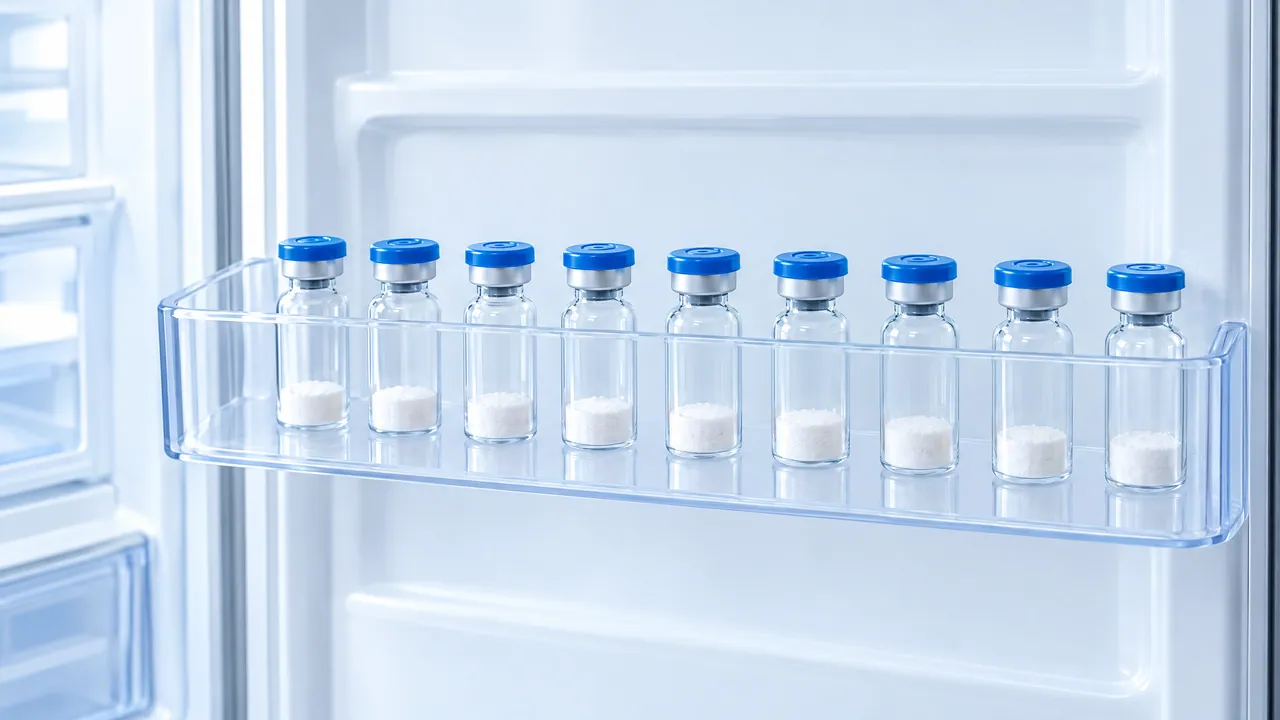
Before mixing the powder is robust, normal room temperature (around 20 to 25 degrees) is fine, ideally kept in the dark. After mixing, keep in the fridge (2 to 8 degrees), do not freeze. It stays good there for at least 4 to 6 months with barely any loss of potency, in practice considerably longer. Swirl or shake to mix, both are fine.

Shelf life

How long it keeps

Undissolved (powder) Room temperature, around 20 to 25 degrees, dark

Robust, no fridge needed.

Dissolved (mixed) Fridge, 2 to 8 degrees, do not freeze

At least 4 to 6 months with barely any loss of potency. The bacteriostatic water brings a preservative.

  • Keep it dark
  • Dissolved: 2 to 8 degrees
  • Note the mixing date on the vial
Nine vials with white powder and blue caps in the door shelf of a bright fridge
Powder dark at room temperature, once dissolved into the fridge (2 to 8 degrees), stable there for at least 4 to 6 months. Symbolic image.

Related

Related compounds

Same compounds or blends with BPC + TB + KPV Blend: all in the TPD lexicon.

FAQ

Common questions about BPC + TB + KPV Blend

Short answers, each backed by the sources below.

Are there studies on this blend?

No. As of 26 October 2026 ClinicalTrials.gov lists no trial with KPV and none with two of the three components together. Everything here comes from studies on the single compounds.1213

What is KPV supposed to add to the blend?

KPV is the last three building blocks of alpha-MSH. The transporter PepT1 carries it into gut and immune cells, where it inhibits the NF-κB and MAP kinase pathways even at nanomolar amounts. In colitis models in mice KPV in the drinking water reduced inflammation, also in animals without a functional MC1R. Whether it adds anything when injected together with BPC-157 and TB-500 has not been tested.12

Do BPC-157 and TB-500 work better together?

That is not established. In 32 rats with a repaired Achilles tendon each on its own was linked to better tendon tissue, above all TB-500. The combination gave no advantage over either alone. KPV was not part of this study.4

What do the studies on the single components show?

With KPV drops all 8 corneal wounds closed in rabbits within 60 hours, none with placebo. Thymosin beta-4 sped up wound closure in rats by up to 61 percent. BPC-157 promoted new blood vessels via the receptor VEGFR2. All animal and cell studies.358

Which human studies exist?

None on KPV. For BPC-157 three small studies with 30 people in total, all without a control group, plus a planned phase 1 trial. Thymosin beta-4 was tested into a vein in healthy adults and in phase 2 after heart attack.121011

Which side effects are known?

None for the blend. The three human studies on BPC-157 saw no treatment-related side effects, with very low certainty. 40 healthy people tolerated thymosin beta-4 into a vein without serious side effects. For KPV human data are missing entirely.10712

Glossary

Terms explained briefly

Dotted words in the text open these explanations directly.

Alpha-MSH
The body's own hormone of 13 building blocks that controls tanning and dampens inflammation. KPV is its last three building blocks.
Colitis
Inflammation of the colon, deliberately triggered in mice in research.
Lyophilisate
Freeze-dried powder. Without water a peptide keeps much longer.
NF-κB
A switch in the cell nucleus that turns on many genes for inflammatory messengers.
PepT1
Transporter that brings small peptides of two or three building blocks into the cell. Increased in the colon during bowel inflammation.
Preclinical
Research before first use in humans, in cell cultures and animal models.
Subcutaneous
Into the fat layer just under the skin.
Thymosin beta-4
The body's own peptide of 43 amino acids that binds free actin in cells. TB-500 is regarded as a fragment of it.
Tripeptide
A chain of exactly three amino acids. For KPV these are lysine, proline and valine.
VEGFR2
Receptor on vessel cells for the growth factor VEGF. It gives the start signal for new vessels.

Evidence

Sources

Show all 14 sourcesHide sources 10 Studies3 Trial registry1 Database checked 26 Oct 2026

Studies

  1. KPV uptake via PepT1 reduces gut inflammation (cells and mice)

    Dalmasso et al., Gastroenterology, 2008

    Checked 26 Oct 2026 via doi.org, Crossref, PubMed
  2. KPV in two colitis models in mice

    Kannengiesser et al., Inflammatory Bowel Diseases, 2008

    Checked 26 Oct 2026 via doi.org, Crossref, PubMed
  3. KPV drops and corneal wounds (rabbits)

    Bonfiglio et al., Experimental Eye Research, 2006

    Checked 26 Oct 2026 via doi.org, Crossref, PubMed
  4. BPC-157, TB-500 and both together in Achilles tendon healing (rats)

    Biçer et al., Joint Diseases and Related Surgery, 2026

    Checked 26 Oct 2026 via doi.org, Crossref, PubMed
  5. Thymosin beta-4 accelerates wound healing (rats)

    Malinda et al., Journal of Investigative Dermatology, 1999

    Checked 26 Oct 2026 via doi.org, Crossref, PubMed
  6. The actin-binding site of thymosin beta-4 promotes angiogenesis

    Philp et al., The FASEB Journal, 2003

    Checked 26 Oct 2026 via doi.org, Crossref, PubMed
  7. Thymosin beta-4 into a vein in 40 healthy adults

    Ruff et al., Annals of the New York Academy of Sciences, 2010

    Checked 26 Oct 2026 via doi.org, Crossref, PubMed
  8. BPC-157 promotes new vessel formation via VEGFR2 (cells and rats)

    Hsieh et al., Journal of Molecular Medicine, 2017

    Checked 26 Oct 2026 via doi.org, Crossref, PubMed
  9. Review of BPC-157 in the gastrointestinal tract

    Sikiric et al., Current Pharmaceutical Design, 2011

    Checked 26 Oct 2026 via doi.org, Crossref, PubMed
  10. Systematic review of all human studies on BPC-157

    Poolton et al., Acta Orthopaedica Belgica, 2026

    Checked 26 Oct 2026 via doi.org, Crossref, PubMed

Trial registry

  1. Trials on BPC-157 and thymosin beta-4 on the registry

    ClinicalTrials.gov, U.S. National Library of Medicine

    Checked 26 Oct 2026 via ClinicalTrials.gov API v2
  2. Registry search for KPV (no trial)

    ClinicalTrials.gov, U.S. National Library of Medicine

    Checked 26 Oct 2026 via ClinicalTrials.gov API v2
  3. Registry search for the components together (0 results)

    ClinicalTrials.gov, U.S. National Library of Medicine

    Checked 26 Oct 2026 via ClinicalTrials.gov API v2

Database

  1. BPC-157 and thymosin beta-4 in ChEMBL

    ChEMBL, EMBL-EBI (CHEMBL4297358, CHEMBL4594314)

    Checked 26 Oct 2026 via ChEMBL

In the shop

BPC + TB + KPV Blend in the catalog

Sizes, prices and shipping times are on the product page.

To the product