What is BTX-A?
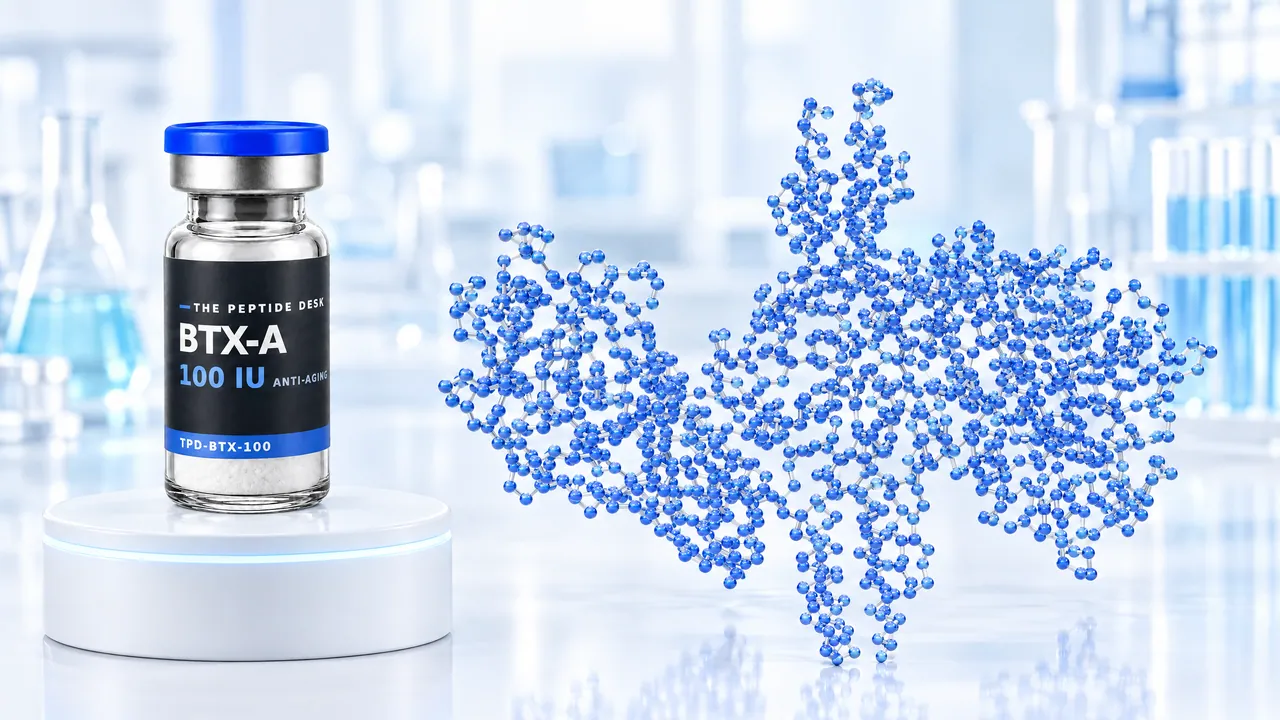
BTX-A is botulinum toxin type A, a neuromodulating protein produced by the bacterium Clostridium botulinum. In research it inhibits the release of the messenger acetylcholine at the motor end plate, the point where a nerve drives a muscle. The targeted muscle relaxes temporarily. This happens only around the application site.
It is one of the longest-studied compounds in aesthetic research. The first observations on expression lines date from the early 1990s. Large placebo-controlled studies followed in the early 2000s. There is also a broad literature on neurological questions.
BTX-A is not a short peptide like most products in the range but a large, sensitive protein. Potency is stated in International Units (IU), not milligrams. In the range it comes as lyophilized powder with 100 IU per vial.
This information is for research and educational purposes only. No medical advice.
Comparison
Same target, different route
What in the TPD lexicon acts at the same point or is meant for the skin. Tap a card to open its entry.
BTX-A is injected and cleaves SNAP-25. Snap-8 is applied to the skin and mimics part of SNAP-25, its effect is far less well documented. 1
How it works
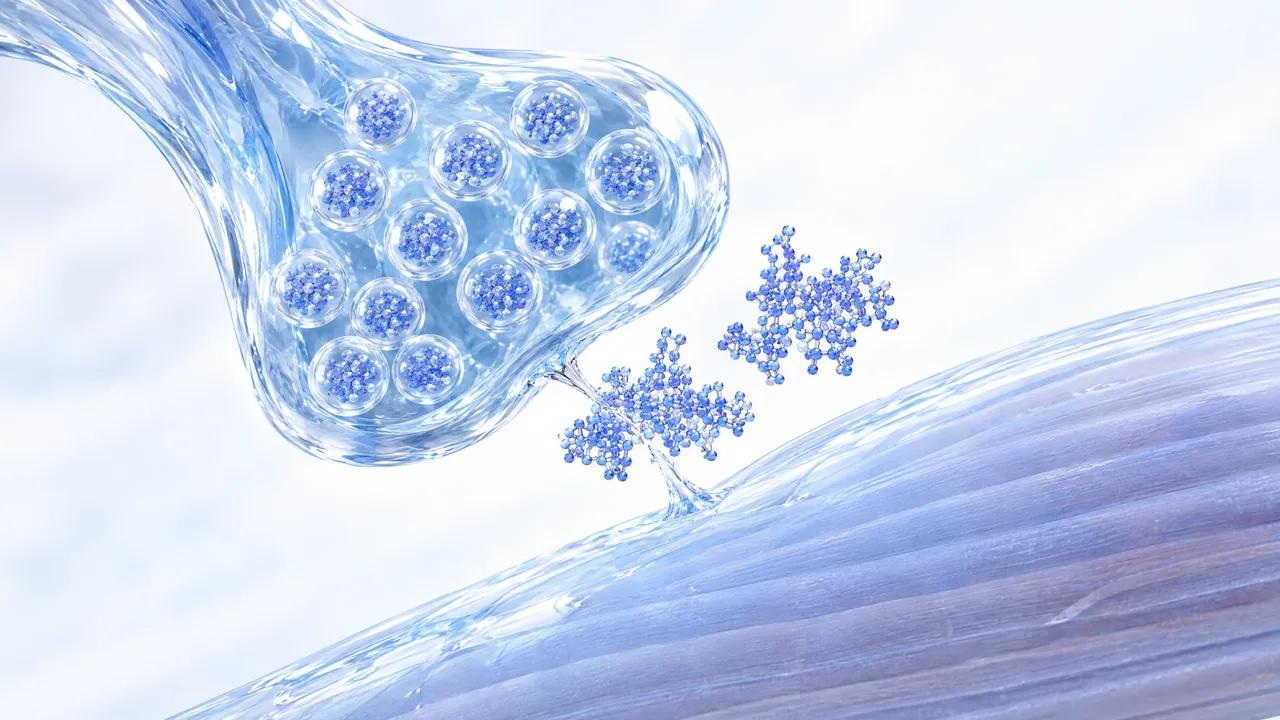
For a muscle to contract, the nerve ending releases acetylcholine. Small vesicles fuse with the cell membrane to do this, helped by a complex of several proteins. One of them is called SNAP-25.
BTX-A binds to the endings of motor nerves, is taken up there and cleaves SNAP-25 at a specific site. A paper in Nature showed this as early as 1993 (Blasi). Without intact SNAP-25 the nerve ending can no longer release acetylcholine, so the muscle gets no signal and stays relaxed.
The effect is not permanent. Over weeks to months the nerve endings build new connections, after which muscle activity returns. In the large placebo study the effect lasted until day 120 in many participants.
Where it acts
Where BTX-A acts
Tap a point or a card. Colour = target, grey = seen in studies. Effect only near the application site.
Targets in the ChEMBL database10
Compound CHEMBL4297862: one recorded mechanism, Is cleaved, BTX-A acts as a zinc-dependent enzyme.
- Gene
- SNAP25
- UniProt
- P60880
- ChEMBL
- CHEMBL2364159
- Action
- Is cleaved, BTX-A acts as a zinc-dependent enzyme
Use and dosing
Dosing
Dosing, titration and syringe
Loading the dosing information …
- Getting started and stepping up, drawn as a staircase
- Units on the U-100 syringe for every step
- How long one vial lasts
What the research shows
Blasi and colleagues (Nature 1993) showed that the compound acts as a zinc-dependent enzyme that selectively cleaves SNAP-25 and so blocks transmitter release at the synapse. That is still the basis on which its effect is explained.
Carruthers and colleagues (J Am Acad Dermatol 2002) tested BTX-A double-blind against placebo in moderate to severe frown lines between the eyebrows. Of 264 participants, 203 received the compound. Lines improved more than with placebo at every visit. For many the effect held until day 120. Drooping eyelids occurred in 5.4 percent, mostly mild.
Coté and colleagues (J Am Acad Dermatol 2005) analysed 1,437 reports to the US drug agency. Serious events mostly involved medical use with higher amounts. All 28 reported deaths fell into that group. In aesthetic use, lack of effect, injection site reactions and drooping lids were most common. The authors found many departures in amount, dilution, handling and storage. Thomas and colleagues (MMWR 2024) describe seven women who fell ill after applications outside medical settings. Four were hospitalized and two needed intensive care. In at least four cases the product was counterfeit.
Study results
What the trials measured
Interactive: switch tabs, tap points, show or hide arms. Arms are named relative to each other, no dosing advice.
Improvement 30 days after one treatment7
Share of participants in percent, phase 3 trial with 271 participants
Shares calculated from the participant numbers on the trial registry (for example 157 of 182 versus 50 of 89). An approved product was tested. Values apply only to this product and cannot be transferred to others.
Response over eight treatments8
Share with improvement when frowning according to the investigator, 796 participants, up to 30 months
BTX-A, day 30 after treatment: Treatment 1 +79.1%, Treatment 2 +79.8%, Treatment 3 +80.1%, Treatment 4 +80.3%, Treatment 5 +81.4%, Treatment 6 +81.2%, Treatment 7 +82.7%, Treatment 8 +89.6%. BTX-A, check 85 days after treatment: Treatment 1 +6.5%, Treatment 2 +16.6%, Treatment 3 +0.6%, Treatment 4 +0.6%, Treatment 5 +4.8%, Treatment 6 +8.8%, Treatment 7 +17.8%, Treatment 8 +29.2%.
Values from the trial registry, without a comparison group. At least 85 days passed between two treatments. The lower line shows that the effect had mostly worn off again by the next treatment.
Reported adverse events3
Number of reports (count) to the US drug agency, 1,437 in total
All 28 reported deaths concerned medical use, none cosmetic use. Reporting is voluntary and incomplete. The authors found many departures in amount, dilution, handling and storage.

Research status
Where the research stands
Botulinum toxin A has been approved for decades. The registry lists 61 phase 3 trials on frown lines alone with various products. Here is a selection from different years. As of 26 Oct 2026.
- Preclinical Mechanism in nerve cells clarified
- Phase 1 no registered trial
- Phase 2 no registered trial
- Phase 3 9 trials, 8 completed
- Approval in the US since 1989
Show all 9 phase 3 trials on a timelineHide timeline
NCT00430963 · 256 participants, started Oct 2006, primary endpoint reached Apr 2007.
Registry entry ↗ · Results not yet in PubMed
NCT00512135 · 801 participants, started Jun 2007, primary endpoint reached Dec 2009.
Registry entry ↗ · Results: ClinicalTrials.gov, NCT00512135
NCT00770211 · 271 participants, started Oct 2008, primary endpoint reached Mar 2009.
Registry entry ↗ · Results: ClinicalTrials.gov, NCT00770211
NCT01189760 · 917 participants, started Sept 2010, primary endpoint reached Mar 2011.
Registry entry ↗ · Results not yet in PubMed
NCT02261493 · 787 participants, started Oct 2014, primary endpoint reached Jun 2015.
Registry entry ↗ · Results not yet in PubMed
NCT03004248 · 2,691 participants, started Dec 2016, primary endpoint reached Oct 2018.
Registry entry ↗ · Results not yet in PubMed
NCT04225260 · 902 participants, started Jan 2020, primary endpoint reached Apr 2021.
Registry entry ↗ · Results not yet in PubMed
NCT06499688 · 529 participants, started Dec 2023, primary endpoint reached Mar 2024.
Registry entry ↗ · Results not yet in PubMed
NCT06937944 · 669 participants, started Apr 2025, primary endpoint planned Feb 2026.
Bar: start to primary endpoint (planned for running trials). Green = completed, blue = progress until 26 Oct 2026.
Side effects
BTX-A carries the strictest warning tier in the range. The gap between the amounts used in studies and a dangerous amount is small.
- Spread beyond the application site. Reported effects include drooping eyelids, double vision, dry mouth, difficulty swallowing and speaking, muscle weakness and even shortness of breath, sometimes only days after application.
- Local effects. In the controlled studies mainly headaches, injection site reactions and temporarily drooping eyelids.
- Use outside medical settings. This is where the reports show the most severe courses, often with counterfeit products.
- Exclusions in the literature. Disorders of neuromuscular transmission such as myasthenia gravis, pregnancy and breastfeeding.
- Loss of effect. Repeated applications at short intervals can trigger neutralizing antibodies, after which the effect wears off.
This classification does not replace medical advice. Risk and responsibility for any actual application lie entirely with the buyer.
Tolerability
Frequency after one treatment
Out of 100 participants per group, how many had the event after one treatment of frown lines (values from the trial registry).
| Event | Placebo | BTX-A, day 30 after treatment |
|---|---|---|
| Headache7 | 6% | 9% |
| Nasopharyngitis7 | 6% | 5% |
| Sinus headache7 | 1% | 4% |
| Sinusitis7 | 5% | 3% |
Shares calculated from the participant numbers on the registry (182 on the compound, 89 on placebo). Drooping eyelids occurred in 5.4 percent of those treated in another large study, mostly mild. The abstract gives no placebo value for it.72
Units and products
With BTX-A the number on the label says less than you might think. International Units are defined per product through its own biological assay. So 100 IU of one product do not automatically equal 100 IU of another.
For research this means that study figures only apply to the product the study used. Carrying values over from the literature can be off by a multiple. That is exactly why we give no units.
Storage
The storage rule for our peptides explicitly does not apply to BTX-A. It is not a short peptide but a large, sensitive protein. The benchmark is the prescribing information of comparable approved products.
- Not reconstituted: in the refrigerator at 2 to 8 °C, as the prescribing information of most approved products specifies. Do not leave it at room temperature for long.
- Reconstituting: The prescribing information describes dissolving in sterile, unpreserved 0.9 percent saline and gently swirling rather than shaking hard. The solution should be clear and colourless.
- Reconstituted: short shelf life only. The prescribing information requires prompt use, usually within 24 hours, refrigerated at 2 to 8 °C.
Studies suggest the effect lasts longer. In a double-blind study, vials reconstituted up to six weeks ahead and kept refrigerated worked just as well (Hexsel 2003). For facial use an expert consensus considers refrigerated storage for at least four weeks acceptable (Alam 2015). That is a summary of the research, not a release. Keep out of reach of children.