This information is for research and educational purposes only. No medical recommendations. Products are not approved for human use. For health questions, consult a doctor.

Lexicon

Matrixyl - Peptide Topical for Skin Firmness

Palmitoyl Pentapeptide-4: Research compound with matrikine signaling activity stimulating collagen synthesis in vitro.

2 min read 9 sources

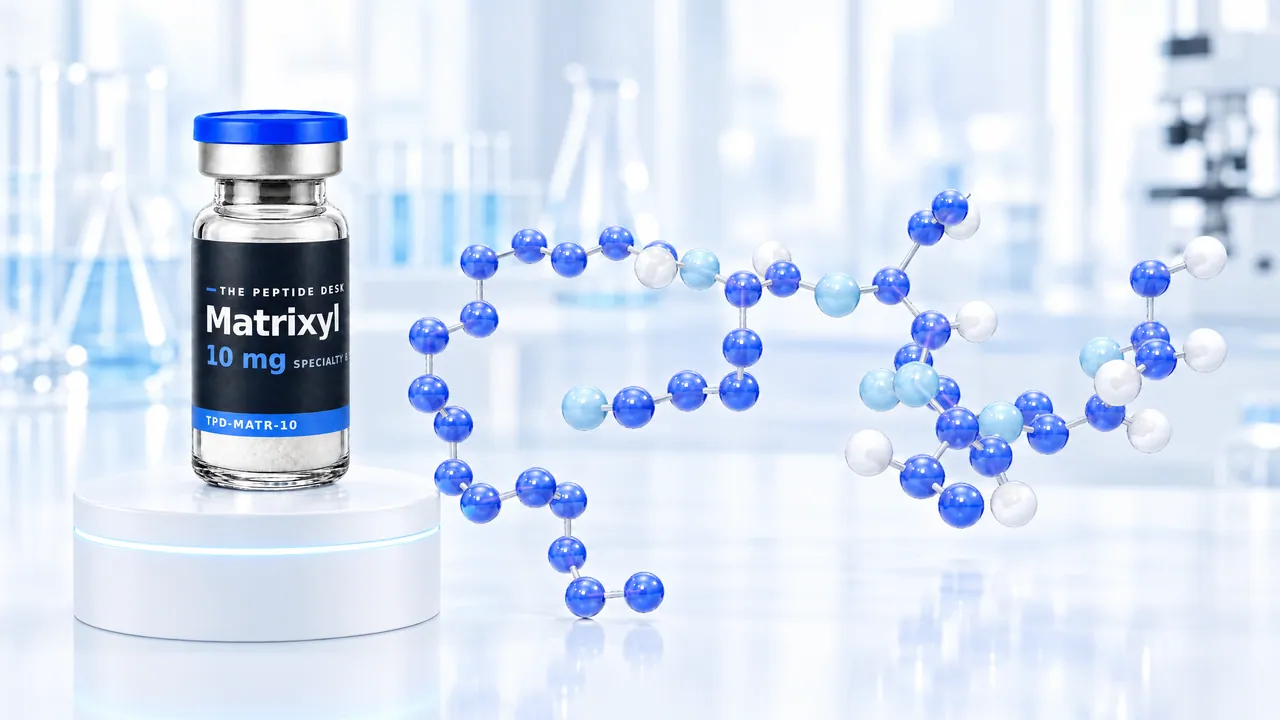
Matrixyl vial with white powder and the black TPD label on a white podium, next to a blue 3D peptide chain in a bright lab
Cosmetic ingredient, small skin studies · not approved

Summary

At a glance

Sources checked on 26 Oct 2026

Core of the molecule
5 amino acids

Lys-Thr-Thr-Lys-Ser from type I procollagen, in Matrixyl with attached palmitic acid3

Controlled facial study
93 women

12 weeks, one half of the face with, the other without the compound, double-blind1

Reached (skin model)
3 skin layers

Pal-KTTKS was found in the horny layer, epidermis and dermis of mice, KTTKS without palmitic acid in none5

Trials in the registry
0 trials

no trial with Matrixyl on ClinicalTrials.gov, as of 26 Oct 20268

  • Matrixyl is palmitoyl pentapeptide-4: the pentapeptide KTTKS from the blueprint of type I collagen, linked to the fatty acid palmitic acid. It is used in creams and serums. TPD carries it as powder in a vial for use on the skin, not for injection.39
  • In cell studies KTTKS stimulated connective tissue cells to make more collagen and fibronectin. A later study saw more collagen in fibroblasts from skin and cornea.34
  • In a double-blind study with 93 women over 12 weeks wrinkles and fine lines improved more on the half of the face with Matrixyl than on the half with placebo cream.1
  • Whether enough compound reaches the skin is the crux: in a mouse skin model pal-KTTKS reached all layers but was broken down quickly and did not pass all the way through.57
  • Matrixyl is a cosmetic ingredient with few independent studies. Everything here describes the state of research, not a recommendation.62
Profile

Updated June 2026

Class
Cosmetic Peptide Topical
Use
On the skin

powder in a 10mg vial, e.g. dissolved in a serum or cream, not for injection

Half-life
Topical absorption limited

stabilizes after penetration

Status
Cosmetic Research

non-prescription

Contents 12 sections
  1. At a glance
  2. What is Matrixyl?
  3. How it works
  4. Application and dosing
  5. What the research shows
  6. Research status
  7. Side effects
  8. Storage
  9. Related compounds
  10. FAQ
  11. Glossary
  12. Sources

What is Matrixyl?

Matrixyl is the trade name for Palmitoyl Pentapeptide-4 (Pal-KTTKS), a lipopeptide for cosmetic anti-aging applications. It is a synthetic mimic of the C-terminal propeptide sequence of type I procollagen and functions as a matrikine (signaling peptide). In finished cosmetics it is found in creams, serums and lotions.

We carry Matrixyl as a 10mg vial with freeze-dried powder. It is meant for use on the skin, for example dissolved in a serum or cream. Not for injection.

This information is for research and educational purposes only. No medical advice.

Comparison

Cosmetic peptides in the lexicon

How the peptides are classified according to the TPD lexicon. Tap a card to open its entry.

Signal peptide from the collagen blueprint Matrixyl - Peptide Topical for Skin Firmness
Copper peptide, focus on skin GHK-Cu Copper tripeptide AHK-CU Cosmetic peptide (acetyl octapeptide-3) Snap-8

2

How it works

Matrixyl binds to specific cellular receptors and stimulates fibroblast production of:

  • Collagen type I, III and IV
  • Fibronectin
  • Glycosaminoglycans (hyaluronic acid)

This mechanism aims to strengthen the skin's natural matrix and reduce visible signs of skin aging.

Where it acts

Where Matrixyl acted

Tap a point or a card. Grey = observed, no receptor is known.
  1. Facial skin

    Fewer wrinkles and fine lines than with placebo cream (93 women, 12 weeks)1

    Observed in trials
  2. Cornea (cell culture)

    Fibroblasts from skin and cornea made more collagen, depending on the amount4

    Observed in trials
Translucent, wavy light blue skin layers with enclosed bubbles, blue 3D peptide chains between them
Symbolic image.

Application and dosing

Dosing

Dosing, titration and syringe

Loading the dosing information …

  • Getting started and stepping up, drawn as a staircase
  • Units on the U-100 syringe for every step
  • How long one vial lasts
Hand touching a swirl of white cream on a light marble slab with water droplets and white flowers
Symbolic image.

What the research shows

A 12-week double-blind placebo-controlled split-face study in 93 women aged 35-55 (Robinson, 2005) showed a significant improvement in wrinkles and fine lines versus placebo with 3 ppm pal-KTTKS in a moisturizer, with good skin tolerability. A review (Schagen, 2017) counts palmitoyl pentapeptide-4 among the well-researched cosmetic peptides, while noting that for some peptides study results are sparse or have not been published in scientific journals. Overall evidence is classified as moderate: plausible mechanism, consistent in vitro data, statistically significant clinical results, but limited by few independent confirmatory trials.

Study results

What the trials measured

Interactive: switch tabs, tap points, show or hide arms. Arms are named relative to each other, no dosing advice.

How much compound arrived in the skin layers5

Micrograms per square centimetre, skin of hairless mice in a lab test

Horny layer5 Outermost layer of the skin
KTTKS without palmitic acid 0.0 µg/cm²
Pal-KTTKS (Matrixyl) 4.2 µg/cm²
Epidermis5 Living layer below the horny layer
KTTKS without palmitic acid 0.0 µg/cm²
Pal-KTTKS (Matrixyl) 2.8 µg/cm²
Dermis5 This is where collagen-making cells sit
KTTKS without palmitic acid 0.0 µg/cm²
Pal-KTTKS (Matrixyl) 0.3 µg/cm²

KTTKS without palmitic acid was not detectable in any layer (shown as 0). Neither form passed through the whole skin, both were broken down quickly in skin extracts, pal-KTTKS more slowly. Mouse model in the lab, not a human test.
A block of skin layers with a glossy, wavy surface and a light beige lower layer against a light background
Symbolic image.

Research status

Where the research stands

Matrixyl is an ingredient for cosmetics, not a medicine. ClinicalTrials.gov lists no trial, the facial study ran without a registry entry. As of 26 Oct 2026. 8

  1. Preclinical Cell studies and skin models
  2. Phase 1 no registered trial
  3. Phase 2 no registered trial
  4. Phase 3 no registered trial
  5. Approval not yet
No approval as a medicine and no registered trial. Matrixyl is used as an ingredient in skin care.8

So far there is no registered trial in humans. 8

Side effects

Matrixyl is generally well-tolerated. In clinical studies, occasional reports of redness or sensitivity with topical application were noted. No systemic toxicity was documented. Individual skin sensitivity may vary.

Storage

Store the vial with the powder at room temperature, dry and protected from light, refrigeration is not required. The compound is stable in pH-neutral or slightly acidic formulations. For a self-made mix with serum or cream there is no tested shelf-life information.
Related

Related compounds

A different path: all in the TPD lexicon.

FAQ

Common questions about Matrixyl - Peptide Topical for Skin Firmness

Short answers, each backed by the sources below.

What exactly is Matrixyl?

Palmitoyl pentapeptide-4, pal-KTTKS for short. The core is five amino acids (Lys-Thr-Thr-Lys-Ser) found in the precursor of type I collagen. The fatty acid palmitic acid is attached to it. Without it the peptide was found in no layer in the skin model, with it in all three.359

Is Matrixyl a medicine?

No. It is an ingredient for skin care, used in creams, serums and lotions. There is no approval as a medicine, ClinicalTrials.gov lists no trial (as of 26 October 2026).86

What did the human study show?

93 women aged 35 to 55 applied a moisturiser with Matrixyl to one half of the face for 12 weeks and the same cream without it to the other. Neither they nor the assessors knew which side was which. Wrinkles and fine lines improved significantly more with Matrixyl, measured by image analysis and rated by experts. The women themselves saw the same.1

Does the compound actually get into the skin?

That is the open question. In a mouse skin model pal-KTTKS reached the horny layer, the epidermis and a small amount the dermis, but did not pass all the way through. In skin extracts it was broken down quickly. Reviews name poor uptake through the skin as the main limit of such peptides and miss data on it.576

How does KTTKS work in cells?

KTTKS is the smallest piece of the end part of type I procollagen that strongly stimulated collagen and fibronectin production in connective tissue cells in cell studies. Pal-KTTKS raised collagen production in fibroblasts from skin and cornea, depending on the amount. No receptor of its own is known for it.34

How solid is the evidence?

Limited. The effect is well described in cells, but there are only a few clinical studies and hardly any data on uptake through the skin. A review still counts palmitoyl pentapeptide-4 among the better studied cosmetic peptides. For many other peptides results are sparse or not published at all.62

Glossary

Terms explained briefly

Dotted words in the text open these explanations directly.

Dermis
The layer below the epidermis with collagen, vessels and fibroblasts. This is where anti-wrinkle ingredients are meant to arrive.
Fibroblasts
Connective tissue cells that make collagen and other supporting substances of the skin.
Fibronectin
A protein in connective tissue that links cells to the collagen framework.
Lipopeptide
A peptide with an attached fatty acid. The fatty acid is meant to help get through the oily skin barrier.
Matrikine
A short fragment of connective tissue proteins that sends cells a signal, for example for repair.
Pentapeptide
A chain of exactly five amino acids. In Matrixyl that is KTTKS.
Placebo
Dummy preparation without active substance. Comparing against it shows what is due to the substance itself.
Procollagen
Precursor of collagen. When it is turned into collagen, end pieces are cut off, one of which contains KTTKS.
Split-face study
Each person gets the compound on one half of the face and the comparison product on the other. That compares within the same skin.

Evidence

Sources

Show all 9 sourcesHide sources 6 Studies1 Trial registry2 Database checked 26 Oct 2026

Studies

  1. Double-blind split-face study with 93 women over 12 weeks

    Robinson et al., International Journal of Cosmetic Science, 2005

    Checked 26 Oct 2026 via doi.org, Crossref, PubMed
  2. KTTKS from type I procollagen stimulates collagen and fibronectin (cell study)

    Katayama et al., Journal of Biological Chemistry, 1993

    Checked 26 Oct 2026 via doi.org, Crossref, PubMed
  3. Pal-KTTKS and collagen in fibroblasts from skin and cornea

    Jones et al., Molecular Pharmaceutics, 2013

    Checked 26 Oct 2026 via doi.org, Crossref, PubMed
  4. Stability and uptake of KTTKS and pal-KTTKS in the skin (mice)

    Choi et al., Biomolecules & Therapeutics, 2014

    Checked 26 Oct 2026 via doi.org, Crossref, PubMed, PubMed Central
  5. Review of KTTKS applied to the skin

    Abu Samah und Heard, International Journal of Cosmetic Science, 2011

    Checked 26 Oct 2026 via doi.org, Crossref, PubMed
  6. Review: skin uptake as the limit of anti-wrinkle peptides

    Mortazavi und Moghimi, International Journal of Cosmetic Science, 2022

    Checked 26 Oct 2026 via doi.org, Crossref, PubMed

Trial registry

  1. Search on ClinicalTrials.gov (no trial)

    ClinicalTrials.gov, U.S. National Library of Medicine

    Checked 26 Oct 2026 via ClinicalTrials.gov API v2

Database

  1. Review of anti-ageing peptides for the skin (not listed in PubMed)

    Schagen, Cosmetics, 2017

    Checked 26 Oct 2026 via doi.org, Crossref
  2. Structure of palmitoyl pentapeptide-4 in PubChem

    PubChem, U.S. National Library of Medicine (CID 9897237)

    Checked 26 Oct 2026 via PubChem