This information is for research and educational purposes only. No medical recommendations. Products are not approved for human use. For health questions, consult a doctor.

Lexicon

HCG

Acts in the body like LH, keeps the testes active and their size, the standard against testicular shrinkage on and after a cycle.

3 min read 8 sources

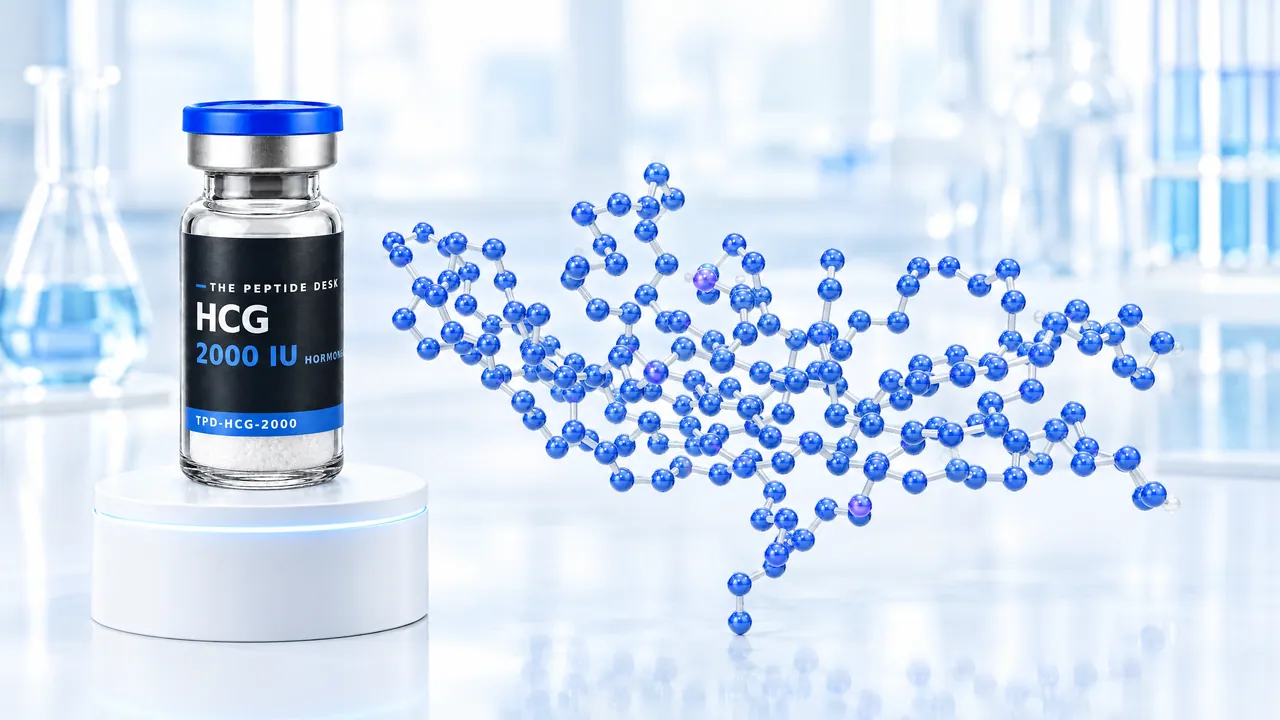
HCG vial with white powder and the black TPD label on a white podium, next to it a large network of blue spheres as a hormone molecule in a bright lab
Compound approved · since 1973

Summary

At a glance

Sources checked on 26 Oct 2026

Testicular testosterone without HCG
-94 %

healthy men on external testosterone, 3 weeks1

With the highest HCG dose
+26 %

testicular testosterone compared with baseline, same study1

Men without sperm
0 of 26

on testosterone therapy plus HCG, retrospective review2

Partners pregnant
9 of 26

same review, followed for 6.2 months on average2

Until the first sperm
7.1 months

median in 75 men with gonadotropin deficiency on gonadotropin therapy4

  • HCG (human chorionic gonadotropin) acts at the same receptor as LH, the signal from the pituitary to the testes. It has been approved as a medicine since 1973.68
  • In the Leydig cells it directly stimulates testosterone production. This also works when external testosterone shuts down the body's own LH release.61
  • In healthy men testicular testosterone fell by 94 percent on external testosterone. With HCG it stayed close to baseline or above it, depending on the dose.1
  • In a retrospective review of 26 men on testosterone therapy plus HCG, none became free of sperm. The partners of 9 men became pregnant.2
  • HCG only replaces the LH signal, not FSH. Everything here is the state of research, not a recommendation.1
Profile

Updated May 2026

How long does it stay in the body?

Share left after one dose, calculated with a half-life of ~30 hours

Half-life ~30 hours
After 60 hours: 25 %
Hour 30 · 50 %Hour 60 · 25 %Hour 90 · 12.5 %Hour 150 · 3.1 %

Simplified model without an absorption phase, half-life from the TPD lexicon. The lexicon gives 1 to 1.5 days, we calculate with the middle.

Class
Gonadotropin

LH analog

Use
Subcutaneous

in IU

Half-life
approx. 1 to 1.5 days
WADA
Banned in men

category S2

Sizes
2,000 to 10,000 IU

3 sizes in the shop

Contents 16 sections
  1. At a glance
  2. What is HCG?
  3. How it works
  4. What you need
  5. Mixing and units
  6. Dosing (in IU)
  7. Injection
  8. What the research shows
  9. Research status
  10. Side effects
  11. Practice
  12. Storage
  13. Related compounds
  14. FAQ
  15. Glossary
  16. Sources

What is HCG?

HCG (human chorionic gonadotropin) is a hormone that acts in the body very similarly to LH. LH is the signal that drives the testes to produce testosterone. That is exactly why HCG is used to keep the testes active and at their size, especially on and after a cycle when the body's own axis is suppressed.

Comparison

Other routes to testicular function

Where each compound acts, as stated in the TPD lexicon. Tap a card to open its entry.

How it works

HCG binds the LH receptors of the Leydig cells in the testes and triggers testosterone production there directly, bypassing the brain. This keeps the testes functional even when the brain is not sending its own LH because of external hormones.

That is why HCG helps against the typical testicular shrinkage on a cycle and eases recovery afterwards.

Where it acts

Where HCG acts

Tap a point or a card. Colour = receptor, grey = effect seen in trials.

  1. Testes (Leydig cells)

    Make testosterone, which was preserved in the testes on external testosterone1

    LHCGR
  2. Pituitary gland

    On external testosterone LH and FSH fell to 5 and 3 percent. HCG only replaces the LH signal1

    Observed in trials
  3. Skin and breast

    With HCG plus HMG and high testosterone, more acne and breast tenderness5

    Observed in trials

Targets in the ChEMBL database8

Compound CHEMBL1201509: one recorded mechanism, Agonist, acts like LH.

LH/HCG receptor
Gene
LHCGR
UniProt
P22888
ChEMBL
CHEMBL1854
Action
Agonist, acts like LH
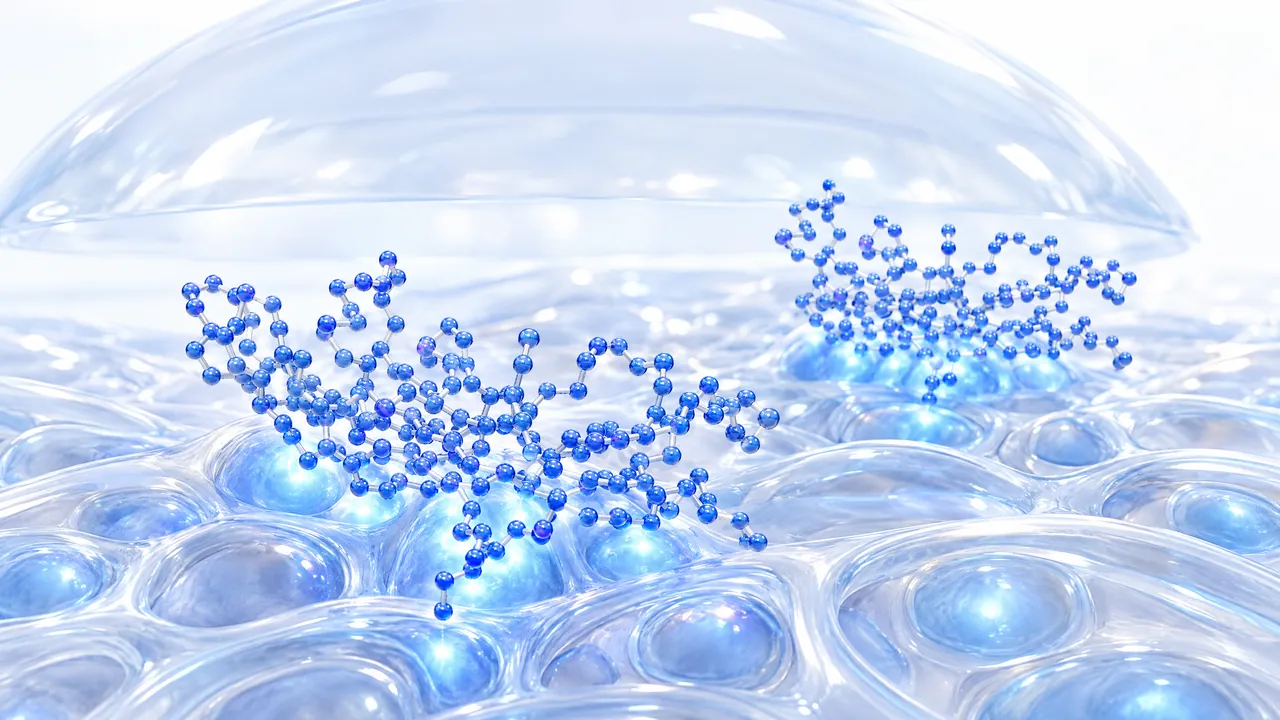
Translucent cells under a glass dome, with two networks of blue spheres docking onto them and lighting up
HCG docks onto the LH receptor of the Leydig cells. Symbolic image.

What you need

Supplies

3 things, numbered as in the picture

Tick off what you already have. Vial and BAC water are our real shop photos at the same size.
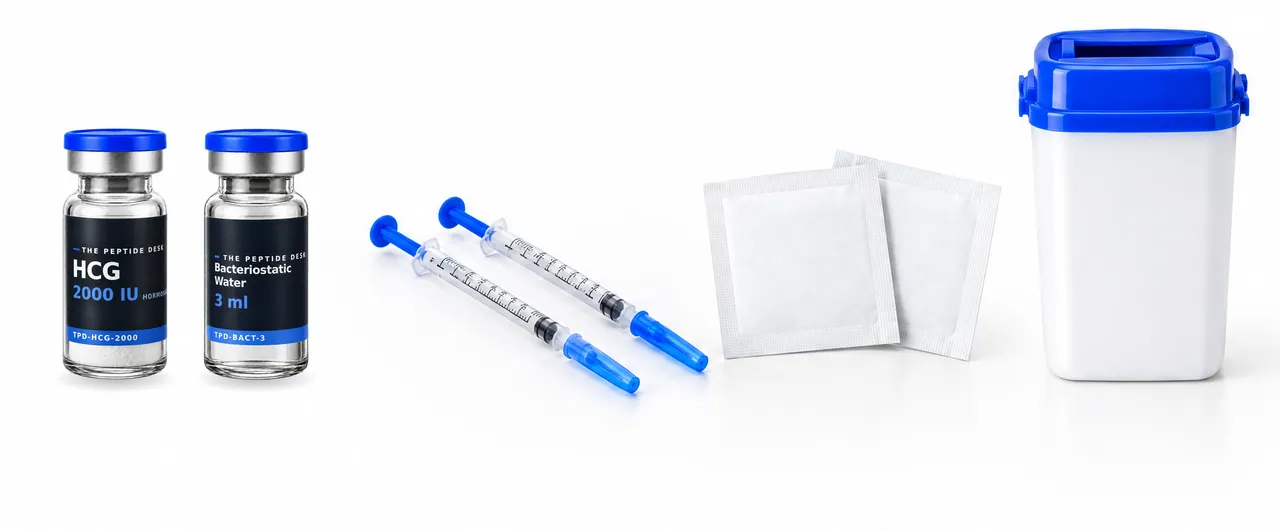
HCG vial and bacteriostatic water at the same size with the black TPD label, next to two U-100 insulin syringes, two alcohol swabs and a sharps container with a blue lid
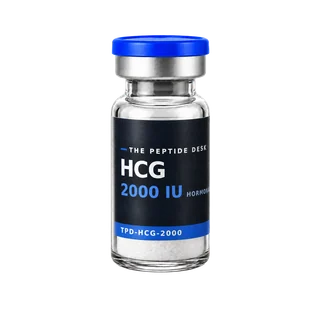
  1. HCG vial

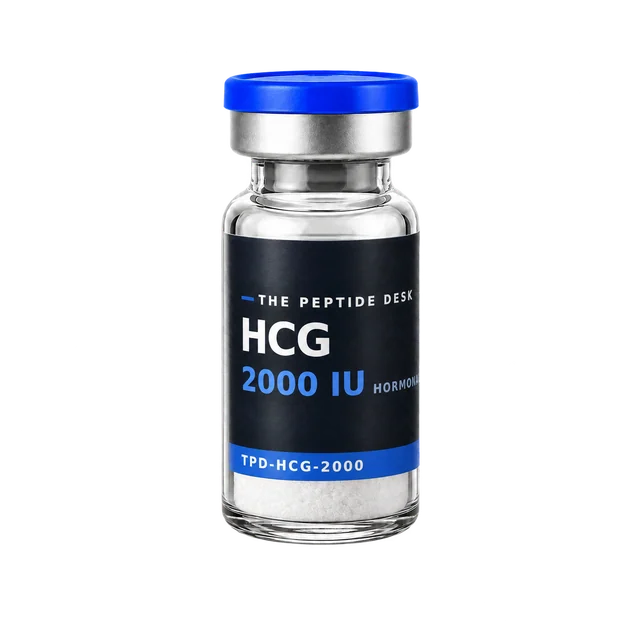
    The HCG vial (lyophilized powder, labeled in IU).

    In the shop
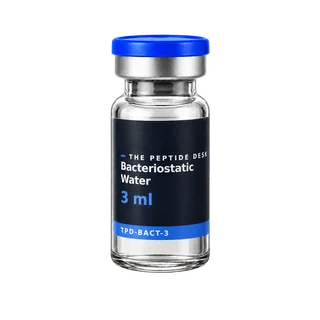
  2. Bacteriostatic water

    Bacteriostatic water for mixing.

    In the shop
  3. Syringes and swabs

    U-100 insulin syringes, alcohol swabs.

As an Amazon associate we earn from qualifying purchases. Links open Amazon - no extra cost for you.

Mixing and units

HCG is given in IU (international units), not in mg. Vials are usually labeled with their total IU (for example 5000 IU).

  • Example: a 5000 IU vial with 5ml bacteriostatic water gives 1000 IU per ml.
  • On a U-100 insulin syringe 1000 IU is then 100 units.
  • 250 IU is accordingly 25 units, 500 IU is 50 units.

Just add the water and let it dissolve.
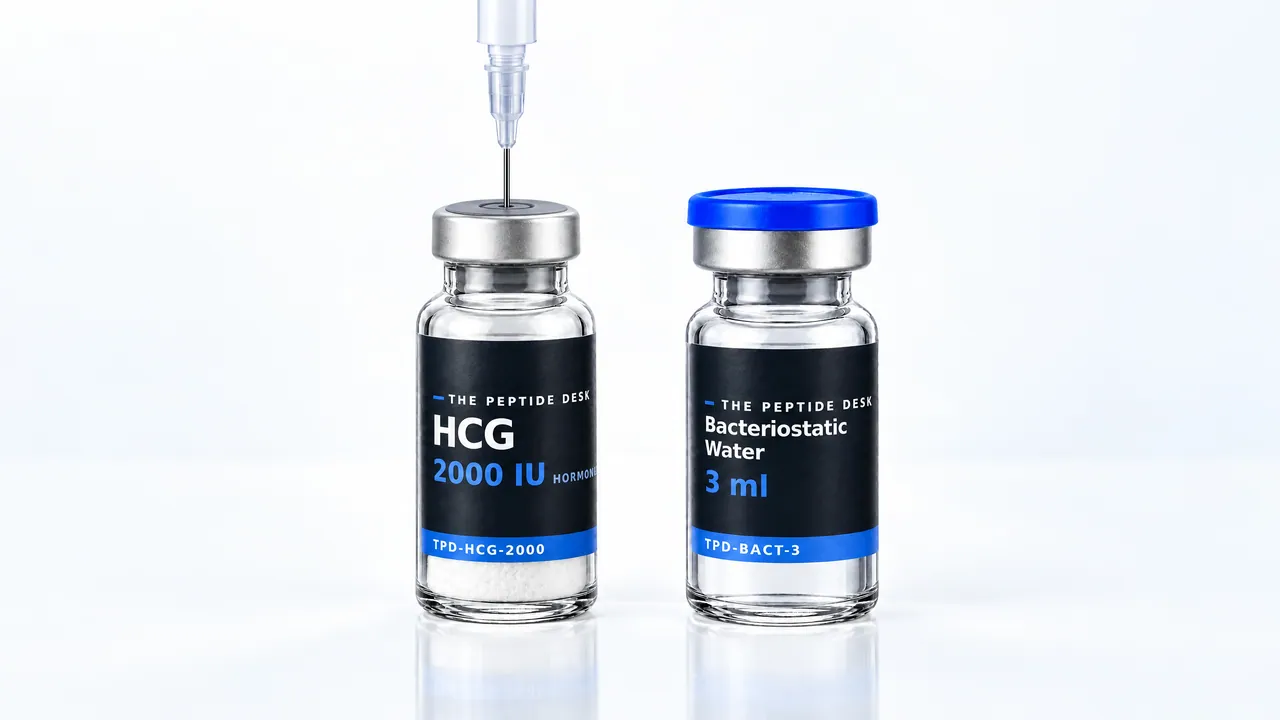
Step by step

Dissolving the powder

Four steps, the same for every vial size.

  1. 1Wipe the cap

    Clean the rubber stopper with an alcohol swab.

  2. 2Add BAC water

    Just add it, it does not matter if it hits the powder directly.

  3. 3Swirl or shake

    Until everything has dissolved, both are fine.

  4. 4Draw up

    With the U-100 insulin syringe.

Less water higher concentration fewer units on the syringe Example: 5,000 IU + 2 ml = 2,500 IU/ml

Dosing (in IU)

Dosing

Dosing, titration and syringe

Loading the dosing information …

  • Getting started and stepping up, drawn as a staircase
  • Units on the U-100 syringe for every step
  • How long one vial lasts

Injection

The injection is subcutaneous, into the fat layer under the skin. Common spots are the abdomen (keep about two finger-widths clear of the navel), the front and the inner side of the thigh, or the back of the upper arm.

The short version:

Injection

Where and at what angle

Pick a spot or switch the angle. Subcutaneous means: into the fat layer, not the muscle.

Rotate the spot each time, never the same one twice in a row.

90°More fat under the skin

Rule of thumb: where there is more fat under the skin, insert straight at 90 degrees. In lean people with little fat, 45 degrees, so the needle stays in the fat layer. Simplified diagram.

  1. Clean the spot with an alcohol swab and let it dry

  2. Pinch up a small fold of skin

  3. Insert the needle: at 90 degrees where there is more fat under the skin, at 45 degrees in lean people with little fat

  4. Inject slowly, wait a moment, then withdraw

  5. Put the needle straight into the sharps container

Rotate the site each time so the tissue does not get irritated. Never the same spot twice in a row.

Use the short insulin needle.

What the research shows

A retrospective review (Hsieh, 2013) of 26 men showed that low-dose HCG (500 IU every other day) added to testosterone therapy preserved sperm production. That supports its use to keep testicular function active while the body's own axis is suppressed.

Study results

What the trials measured

Interactive: switch tabs, tap points, show or hide arms. Arms are named relative to each other, no dosing advice.

Testosterone in the testes after three weeks1

Change from baseline, 29 healthy men, all on external testosterone

Testicular testosterone1 measured in testicular fluid by fine needle
External testosterone, no HCG -94%
Plus HCG, lowest dose -25%
Plus HCG, middle dose -7%
Plus HCG, highest dose +26%

Randomised trial: HCG or placebo every other day, plus weekly external testosterone. LH and FSH fell to 5 and 3 percent of baseline in all groups. Testicular testosterone rose linearly with the HCG dose. Whether this also secures sperm production was not tested in this trial.
Oval glass model on a stalk with many round tubules in cross-section inside it, in a bright room
Studies in healthy men and in men on testosterone therapy. Symbolic image.

Research status

Where the research stands

ClinicalTrials.gov lists a great many HCG trials, most of them on fertility treatment in women. Shown here are trials in men with testosterone deficiency, on testosterone or after anabolic steroids. Entries with unknown status are left out. As of 26 Oct 2026. 7

  1. Preclinical LH/HCG receptor on the Leydig cells
  2. Phase 1 1 trial, 1 completed
  3. Phase 2 1 trial, 1 completed
  4. Phase 3 3 trials, 2 completed
  5. Approval since 1973
0 participants in phase 3 Planned figures for running trials Approved as a medicine (ChEMBL: highest phase 4, first approval 1973). ChEMBL lists indications including infertility and hypogonadism. There is no approval for use alongside anabolic steroids.8
Show all 7 phase 2, 3 and 4 trials on a timelineHide timeline 5 completed 1 running 1 stopped early 0 with results
Phase 2
Phase 3
Phase 4

Bar: start to primary endpoint (planned for running trials). Green = completed, blue = progress until 26 Oct 2026, grey = stopped early. Phase 1: 1 trial on safety and pharmacokinetics, not shown as bars.

Side effects

  • Rise in estrogen (via more testosterone in the testes), with gyno risk at higher doses.
  • With high-dose continuous use the sensitivity of the testes can drop.
  • Mood swings, acne, local reactions.

Practice

  1. Dose low and regular, not rare and high.

  2. With an estrogen rise, consider an aromatase inhibitor (see anastrozole/exemestane).

  3. Banned in official competition for men (WADA S2).
Four white cubes, a glass of water and a bowl of lettuce, tomatoes, cucumber, pepper and carrots on a white table

Storage

Before mixing the powder is robust, normal room temperature (around 20 to 25 degrees) is fine, ideally kept in the dark. After mixing, keep in the fridge (2 to 8 degrees), do not freeze. It stays good there for at least 4 to 6 months with barely any loss of potency, in practice considerably longer. Swirl or shake to mix, both are fine.

Shelf life

How long it keeps

Undissolved (powder) Room temperature, around 20 to 25 degrees, dark

Robust, no fridge needed.

Dissolved (mixed) Fridge, 2 to 8 degrees, do not freeze

At least 4 to 6 months with barely any loss of potency, in practice considerably longer.

  • Keep it dark
  • Dissolved: 2 to 8 degrees
  • Note the mixing date on the vial
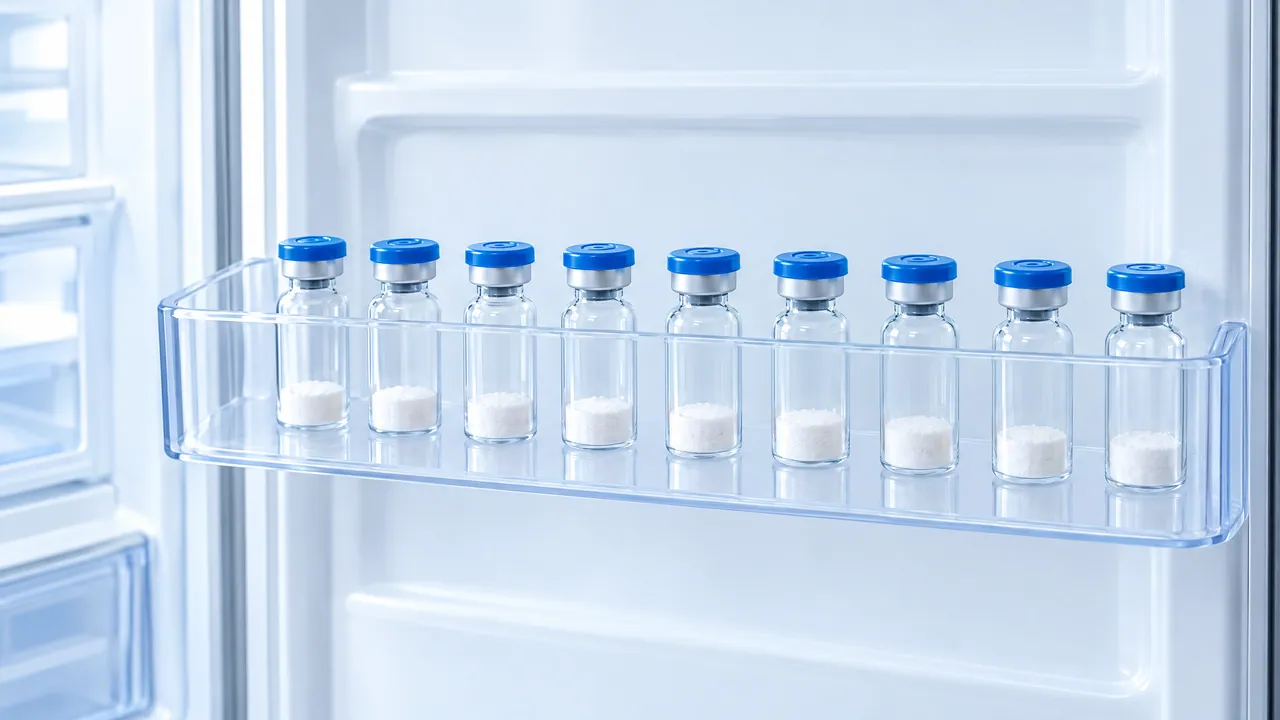
Nine vials with white powder and blue caps in the door shelf of a bright fridge
Powder dark at room temperature, once dissolved into the fridge (2 to 8 degrees), stable there for at least 4 to 6 months. Symbolic image.

Related

Related compounds

Same targets or a different path: all in the TPD lexicon.

FAQ

Common questions about HCG

Short answers, each backed by the sources below.

What is HCG and how is it related to LH?

HCG is a hormone from the placenta. It binds to the same receptor as LH, the LH/HCG receptor. In men this receptor sits on the Leydig cells in the testes. That is why HCG can replace the LH signal and directly trigger testosterone production in the testes.68

What happens in the testes on external testosterone?

External testosterone almost shuts down LH and FSH, in one trial they fell to 5 and 3 percent. As a result testosterone in the testes dropped by 94 percent. With added HCG, by contrast, it stayed close to baseline and in the highest dose group it was 26 percent above.1

Does HCG preserve fertility on testosterone?

There are signs from a retrospective review of 26 men on testosterone therapy plus HCG: semen values stayed unchanged for more than a year, none became free of sperm and the partners of 9 men became pregnant. There was no comparison group without HCG. HCG was injected into the muscle there.2

Under the skin or into the muscle?

In studies with recombinant HCG, bioavailability under the skin and into the muscle was 40 to 50 percent in both cases. In men with a suppressed hormone axis, testosterone rose comparably after a dose into the vein, into the muscle or under the skin.3

How long does it take to produce sperm with gonadotropin deficiency?

In 75 men with gonadotropin deficiency on gonadotropin therapy, the median time was 7.1 months to the first sperm and 28.2 months to a pregnancy. 38 men became fathers. Larger testes at the start and no previous testosterone treatment predicted a faster response.4

Is HCG approved?

Yes, as a medicine since 1973, among other uses in infertility and hypogonadism. It is not approved for use alongside anabolic steroids. A small trial of HCG plus letrozole after anabolic steroid misuse was stopped early.87

Which side effects are known?

The cited studies give no frequencies. According to the entry, more testosterone in the testes can also raise oestrogen. In a study with HCG plus HMG, acne and breast tenderness tended to occur with high testosterone.5

Glossary

Terms explained briefly

Dotted words in the text open these explanations directly.

Aromatase inhibitor
Substance that slows the conversion of testosterone into oestrogen.
Azoospermia
No sperm in the ejaculate.
Bioavailability
Share of a substance that actually reaches the blood after dosing, compared with a dose into the vein.
FSH
Follicle-stimulating hormone. In men important for sperm maturation. HCG does not replace it.
HCG
Human chorionic gonadotropin: a hormone from the placenta that acts at the same receptor as LH.
Hypogonadism
Too little sex hormone. Hypogonadotropic means the cause lies in the brain or pituitary, which send too little LH and FSH.
IU
International unit. HCG is given by its activity in IU, not in milligrams.
Leydig cells
Cells in the testes that make testosterone. The LH/HCG receptor sits on them.
LH
Luteinising hormone from the pituitary. In men the signal to the Leydig cells to make testosterone.
Lyophilisate
Freeze-dried powder. Without water a hormone keeps much longer.
Subcutaneous
Into the fat layer just under the skin.
Testicular testosterone
Testosterone directly in the testes. It is far above the blood level and is needed for sperm production.

Evidence

Sources

Show all 8 sourcesHide sources 6 Studies1 Trial registry1 Database checked 26 Oct 2026

Studies

  1. HCG at three doses preserves testicular testosterone on external testosterone

    Coviello et al., Journal of Clinical Endocrinology & Metabolism, 2005

    Checked 26 Oct 2026 via doi.org, Crossref, PubMed
  2. HCG alongside testosterone therapy preserves sperm production (retrospective, 26 men)

    Hsieh et al., Journal of Urology, 2013

    Checked 26 Oct 2026 via doi.org, Crossref, PubMed
  3. Pharmacokinetics of recombinant HCG in healthy volunteers

    Trinchard-Lugan et al., Reproductive BioMedicine Online, 2002

    Checked 26 Oct 2026 via doi.org, Crossref, PubMed
  4. Sperm production on gonadotropin therapy in 75 men

    Liu et al., Journal of Clinical Endocrinology & Metabolism, 2009

    Checked 26 Oct 2026 via doi.org, Crossref, PubMed
  5. HCG plus HMG versus gonadorelin pump in congenital gonadotropin deficiency

    Zhang et al., American Journal of Men's Health, 2019

    Checked 26 Oct 2026 via doi.org, Crossref, PubMed
  6. Review: the LH/HCG receptor

    Ascoli et al., Endocrine Reviews, 2002

    Checked 26 Oct 2026 via doi.org, Crossref, PubMed

Trial registry

  1. HCG trials in men on ClinicalTrials.gov

    ClinicalTrials.gov, U.S. National Library of Medicine

    Checked 26 Oct 2026 via ClinicalTrials.gov API v2

Database

  1. Mechanism, target and approval in ChEMBL

    ChEMBL, EMBL-EBI (CHEMBL1201509)

    Checked 26 Oct 2026 via ChEMBL

In the shop

HCG in the catalog

Sizes, prices and shipping times are on the product page.

To the product