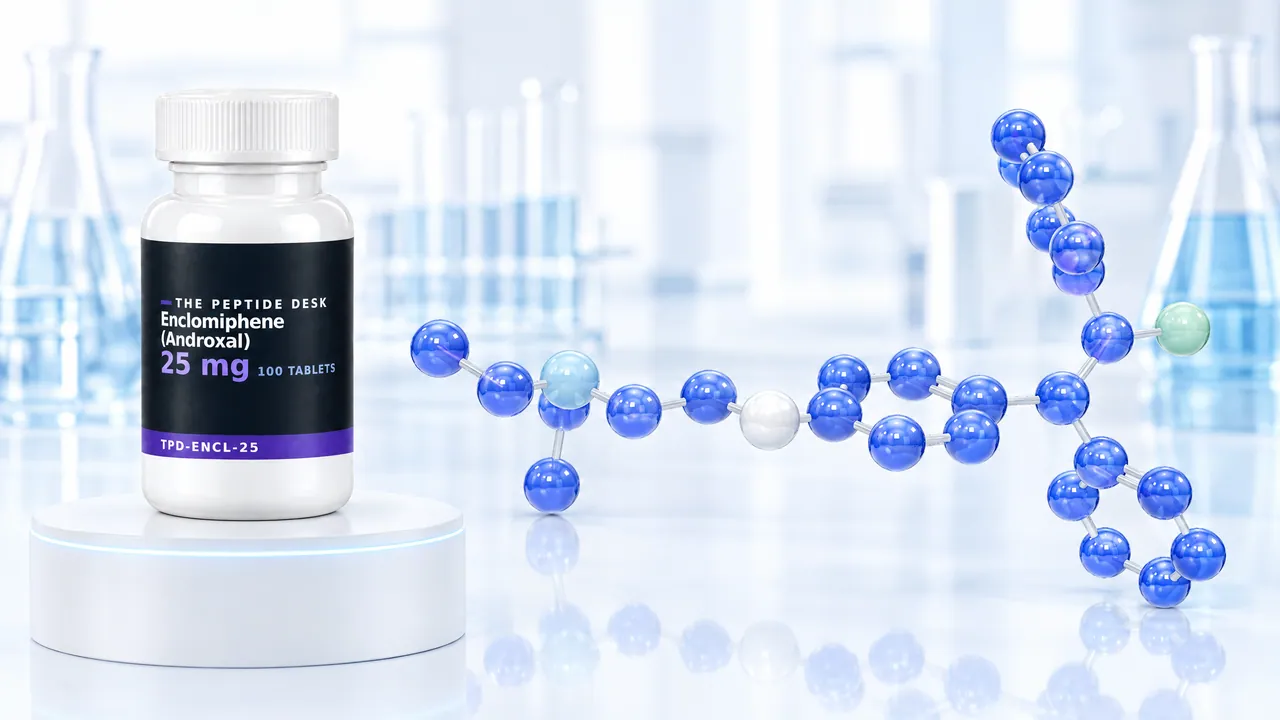
What is Enclomiphene?
Clomiphene consists of two isomers: zuclomiphene (long-acting, estrogenic) and enclomiphene (short-acting, anti-estrogenic). Enclomiphene is the isolated, "clean" trans-isomer of clomiphene - it keeps the HPTA-stimulating effect but drops the estrogenic, mood-lowering part (the zuclomiphene).
This information is for research and educational purposes only. No medical advice.
How it works
Like clomiphene, enclomiphene blocks the estrogen receptors in the hypothalamus and thereby drives LH and FSH up - boosting the body's own testosterone production. The difference: without the long-acting zuclomiphene, estrogenic side effects (mood, vision) occur less often. The substance also clears faster.
Where it acts
Where enclomiphene acts
Tap a point or a card. Colour = receptor, grey = observed in trials.
Targets in the ChEMBL database7
Compound CHEMBL954: one recorded mechanism, Modulator, direct binding.

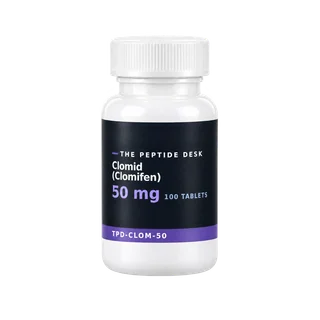
Enclomiphene vs Clomid
- Enclomiphene: cleaner profile, fewer mood and vision side effects, shorter half-life - also popular as an ongoing TRT alternative because fertility is preserved.
- Clomid: cheaper and more widely available, but with the estrogenic zuclomiphene part.
Comparison
Stimulate or replace own testosterone
Compounds around the hormone axis, as described in the TPD lexicon. Tap a card to open its entry.
Simplified: enclomiphene and clomiphene stimulate own production via LH and FSH, testosterone from outside suppresses it. In the trials enclomiphene kept sperm in the normal range, the gel did not. 34
Dosing
Dosing
Dosing, titration and syringe
Loading the dosing information …
- Getting started and stepping up, drawn as a staircase
- Units on the U-100 syringe for every step
- How long one vial lasts
What the research shows
Wiehle et al. showed in several studies (BJU International 2013, Fertility and Sterility 2014) that enclomiphene reliably raises testosterone in secondary hypogonadism while - unlike topical testosterone - preserving sperm production. That makes it an interesting option when fertility is a concern.
Study results
What the trials measured
Interactive: switch tabs, tap points, show or hide arms. Arms are named relative to each other, no dosing advice.
Testosterone in the blood25
In ng/dl, men with secondary hypogonadism
In the 6-week trial enclomiphene and gel did not differ significantly, the gel varied more and suppressed LH. In the meta-analysis testosterone did not differ between the modulators and testosterone gel.
Control hormones versus placebo5
Mean difference in U/l, meta-analysis of randomised trials
On testosterone gel LH and FSH fall, on enclomiphene they rise. The two phase 3 trials also showed this after 16 weeks.
Sperm after switching from testosterone gel4
Share of men with more than 20 million sperm per ml after 3 months
Percentages calculated from the case numbers in the abstract, very small trial with 12 men. After 6 months 6 of 6 with enclomiphene, 2 of 5 with gel. In the phase 3 trials sperm concentration stayed in the normal range with enclomiphene and fell markedly with gel.

Research status
Where the research stands
Enclomiphene has nine completed phase 3 trials in men with secondary hypogonadism, yet there is no approval. As of 26 Oct 2026. 8
- Preclinical Modulator at estrogen receptor alpha
- Phase 1 9 trials, 9 completed
- Phase 2 1 trial, 1 completed
- Phase 3 9 trials, 9 completed
- Approval not yet
Show all 10 phase 2 and 3 trials on a timelineHide timeline
NCT01270841 · 83 participants, started Jan 2011, primary endpoint reached Dec 2011. Tests several agents.
Registry entry ↗ · Results: Wiehle et al., Fertility and Sterility, 2014
NCT00962637 · 194 participants, started Mar 2006, primary endpoint reached May 2007. Tests several agents.
Registry entry ↗ · Results not yet in PubMed
ZA-003Ext · NCT01067365 · 104 participants, started Mar 2006, primary endpoint reached May 2007.
Registry entry ↗ · Results not yet in PubMed
NCT01534208 · 499 participants, started May 2012, primary endpoint reached Oct 2013.
Registry entry ↗ · Results not yet in PubMed
NCT01532414 · 151 participants, started Aug 2012, primary endpoint reached Mar 2013.
Registry entry ↗ · Results not yet in PubMed
NCT01619683 · 300 participants, started Sept 2012, primary endpoint reached Sept 2014.
Registry entry ↗ · Results not yet in PubMed
NCT01739595 · 181 participants, started Nov 2012, primary endpoint reached Sept 2013.
Registry entry ↗ · Results not yet in PubMed
NCT01739582 · 300 participants (planned), started Nov 2012, primary endpoint reached Apr 2014.
Registry entry ↗ · Results not yet in PubMed
NCT01993225 · 120 participants, started Jan 2014, primary endpoint reached Aug 2014. Tests several agents.
Registry entry ↗ · Results not yet in PubMed
NCT01993212 · 120 participants, started Jan 2014, primary endpoint reached Sept 2014. Tests several agents.
Registry entry ↗ · Results not yet in PubMed
Bar: start to primary endpoint (planned for running trials). Green = completed, blue = progress until 26 Oct 2026. Phase 1: 9 trials on safety and pharmacokinetics, not shown as bars.
Side effects
- Overall milder than Clomid due to the missing zuclomiphene.
- Rarely headache, nausea.
- Visual disturbances much rarer than with clomiphene.
Storage
Store dry and protected from light. Out of reach of children.