What is LGD-3033?
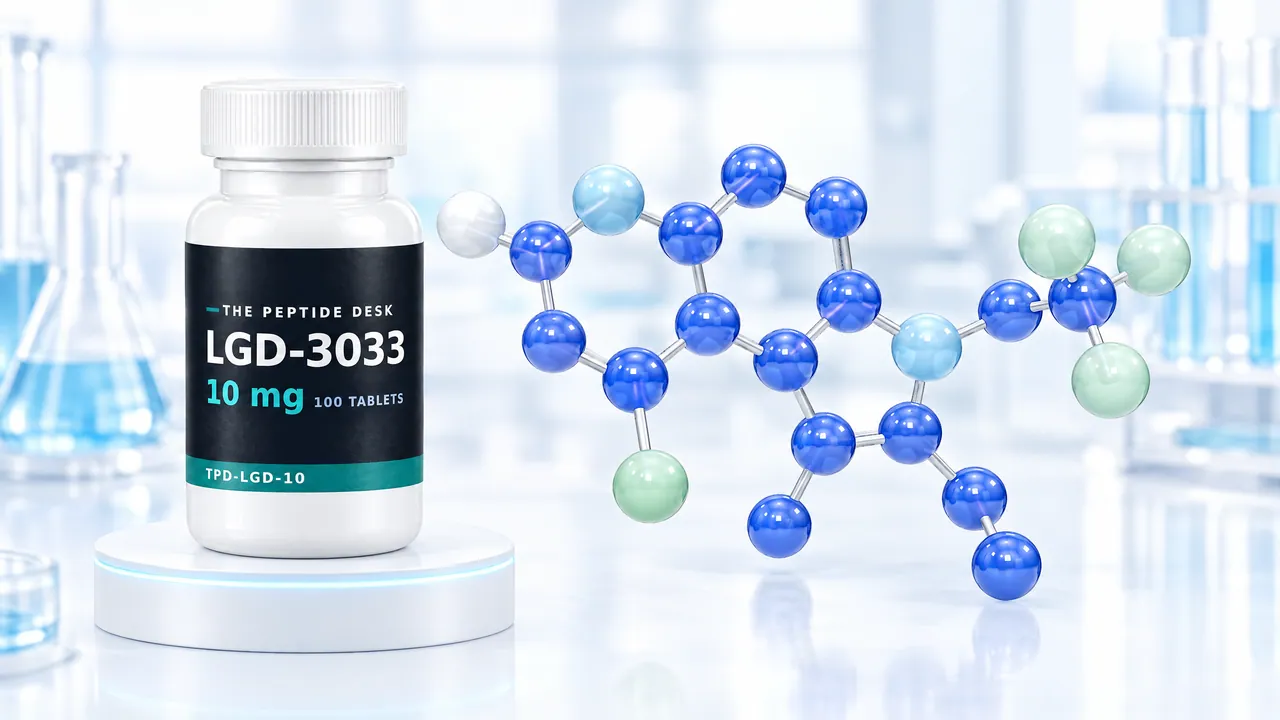
LGD-3033 is a non-steroidal selective androgen receptor modulator (SARM) from the research of Ligand Pharmaceuticals, the company that also developed LGD-4033. In the scientific literature the compound is called LGD-3303. The PubChem database lists both spellings under the same molecule, so the studies in this entry run under LGD-3303.
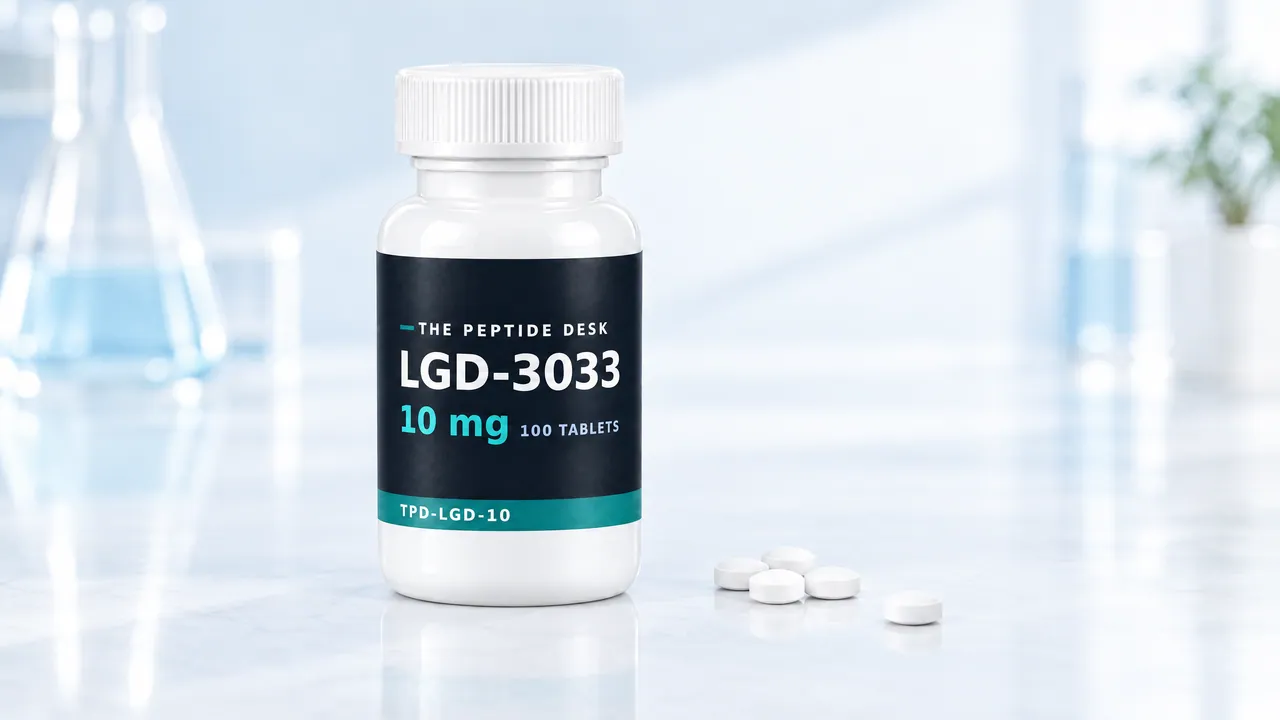
It was studied in rats between 2008 and 2010, looking at muscle wasting, bone loss and female libido. Clinical development in humans never took place. In the range LGD-3033 comes as a tablet with 10 mg.
This information is for research and educational purposes only. No medical advice.
Comparison
Compounds at the androgen receptor
SARMs and one steroid for comparison, as described in the TPD lexicon. Tap a card to open its entry.
All act on the androgen receptor. Whether LGD-3303 acts tissue-selectively in humans has not been studied, the data come from rats only. 15
How it works
LGD-3303 binds the androgen receptor as a non-steroidal androgen and barely reacts with related nuclear receptors. It acted strongly on the levator ani muscle of castrated rats but only partly on the prostate and preputial gland. Even at high blood levels the prostate never grew above the level of intact animals.
The reason is interesting. Concentrations in prostate tissue were actually higher than in muscle. So the tissue preference does not come from distribution in the body but from how the molecule engages the receptor itself. LGD-3303 is not converted to estrogen and reaches the brain. As an androgen receptor agonist it would likely brake the body's own hormone axis.
Where it acts
Where LGD-3303 acted in rat studies
Tap a point or a card. Colour = androgen receptor. All from animal studies.
Known targets1
Compound PubChem CID 25195253: one described target, Agonist in muscle, only partial at prostate and preputial gland.
- Gene
- AR
- UniProt
- P10275
- ChEMBL
- CHEMBL1871
- Action
- Agonist in muscle, only partial at prostate and preputial gland

Use and dosing
Dosing
Dosing, titration and syringe
Loading the dosing information …
- Getting started and stepping up, drawn as a staircase
- Units on the U-100 syringe for every step
- How long one vial lasts
What the research shows
Vajda and colleagues (J Pharmacol Exp Ther 2009) studied LGD-3303 in castrated rats. It acted strongly on muscle and only partly on the prostate and preputial gland, whether swallowed or given as a continuous infusion. The authors conclude that the tissue preference arises at the receptor itself.
In a second paper (J Bone Miner Res 2009) LGD-3303 raised muscle weight in castrated rats above normal levels without bringing the prostate above half its normal weight. In female rats with bone loss after removal of the ovaries, bone density and muscle weight rose. Together with the osteoporosis drug alendronate the effects added up.
Kudwa and colleagues (Endocrinology 2010) gave LGD-3303 to female rats. In sexually experienced animals it strengthened the preference for males and mating behaviour. In inexperienced animals the preference fell. For context on the market: Van Wagoner and colleagues (JAMA 2017) found any SARM at all in only 52 percent of 44 SARM products bought online.
Study results
What the trials measured
Interactive: switch tabs, tap points, show or hide arms. Arms are named relative to each other, no dosing advice.
Prostate weight2
Share of the weight of untreated intact rats, after 14 days
According to the abstract the prostate never rose above 50 percent of normal weight even at high amounts, while the levator ani muscle grew above normal. The bar shows the upper limit, not a mean. Rats only, not studied in humans.
What SARM products bought online contained4
44 products, analysed in 2016, share in percent
LGD-3303 was not among the SARMs found (ostarine, LGD-4033 and andarine were). The analysis shows how uncertain content and amount of such products online were.

Research status
Where the research stands
Where the compound stands on the way from lab research to approval. As of 26 Oct 2026. 7
Side effects
Without human studies this list rests on the rat data and on what is known for SARMs as a class.
- Suppression of the testosterone axis. Expected for androgen receptor agonists. How strong it is with LGD-3303 has not been studied in humans.
- Liver. Liver injury has been described for SARMs in case reports.
- Lipids. Falling HDL is common with androgen receptor agonists.
- Prostate. In rats it stayed below normal levels. Human data are missing.
- Unknowns. Human pharmacokinetics, interactions and long-term effects have not been studied.
This classification does not replace medical advice.
Detection and competition
Under the WADA list LGD-3303 falls under S1.2 (other anabolic agents) and is banned at all times. Doping control labs have described its metabolites, among others in horse racing.
Anyone subject to testing should assume the compound will be detected. How long detection is possible in humans has not been published.
Storage
Store dry, at room temperature and protected from light, keep the tin closed. Do not keep it in the bathroom, the humidity there degrades tablets.
Keep out of reach of children and mind the expiry date. Do not decant tablets into unlabelled containers.