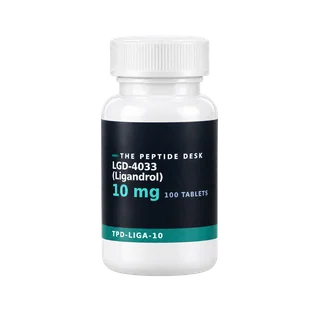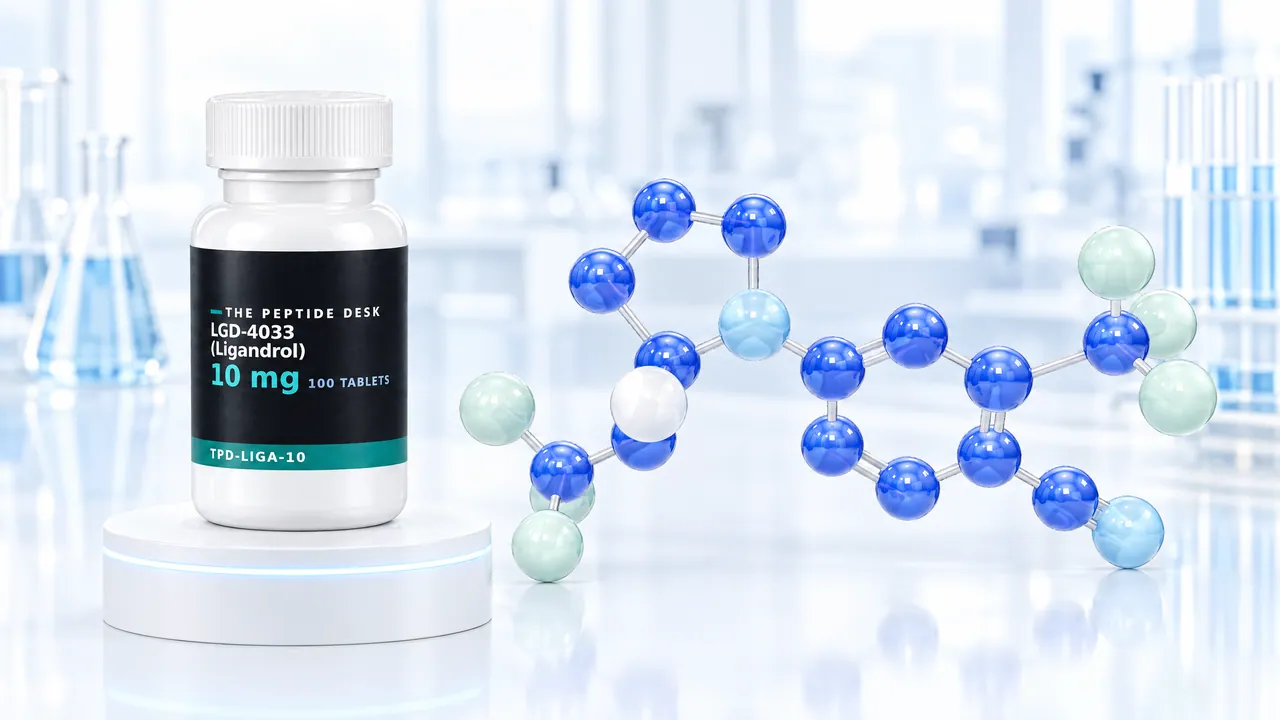
What is LGD-4033?
LGD-4033, known as Ligandrol, is a non-steroidal SARM with a bicyclic structure and high affinity for the androgen receptor. It was developed by Ligand Pharmaceuticals and later out-licensed to Viking Therapeutics.
Ligandrol is one of the few SARMs with a real, cleanly published phase 1 human study. That makes the data here more solid than for most other members of the class.
Comparison
Compounds at the androgen receptor
SARMs and one steroid for comparison, as described in the TPD lexicon. Tap a card to open its entry.
All act on the androgen receptor. SARMs also slow the body's own testosterone production, as the phase 1 study with LGD-4033 clearly showed. 71
How it works
LGD-4033 binds the androgen receptor with high affinity and activates it with tissue preference in muscle and bone. Preclinical models described strong selectivity for muscle and bone tissue.
Like the other SARMs it does not aromatize and is not reduced to DHT. The body's own testosterone production is suppressed dose-dependently, which the human study showed clearly.
Where it acts
Where LGD-4033 acted in studies
Tap a point or a card. Colour = androgen receptor, grey = observed.
- Muscle
Lean mass rose with the amount, after hip fracture up to 9.1% more than with placebo6
AR - Testes and hormone axis
Testosterone and SHBG fell with the amount, FSH only at the highest amount1
Observed in trials - Blood lipids
HDL and triglycerides fell in humans, values returned to baseline after stopping1
Observed in trials - Liver
Severe liver injury in a case report, liver values unchanged in the phase 1 study4
Observed in trials
Targets in the ChEMBL database7
Compound CHEMBL5170587: one recorded mechanism, Modulator, direct binding.
- Gene
- AR
- UniProt
- P10275
- ChEMBL
- CHEMBL1871
- Action
- Modulator, direct binding
How to take it
Oral, once daily.
- The long half-life means one dose per day is enough.
- With some water, with or without food.
- Research cycles often run over 8 weeks with a break afterwards.
Dosing
Dosing
Dosing, titration and syringe
Loading the dosing information …
- Getting started and stepping up, drawn as a staircase
- Units on the U-100 syringe for every step
- How long one vial lasts
What the research shows
The phase 1 study (Basaria, 2013) gave 76 healthy young men placebo or 0.1 to 1mg LGD-4033 for 21 days. Result: dose-dependent increase in lean mass, good tolerability over the short window, but measurable suppression of testosterone and lipid changes that reversed after stopping.
Long-term data and efficacy studies beyond 21 days are missing. The Solomon review (2019) places LGD-4033 in the broader SARM context.
Study results
What the trials measured
Interactive: switch tabs, tap points, show or hide arms. Arms are named relative to each other, no dosing advice.
Lean body mass after 12 weeks6
Change compared with placebo, in percent, people aged 65 and over after hip fracture
Values from the results posted in the registry (least squares means, placebo-adjusted). We found no publication in a journal. Function, strength and falls are not shown here.
Endurance and strength after 8 weeks3
Change compared with rats without ligandrol, in percent
Calculated by us from the mean values in the table (about 19 animals each, with and without training combined). The authors rate the drawbacks above the benefits.
Blood lipids and hormones after 8 weeks3
Change compared with rats without ligandrol, in percent
Calculated by us from the mean values in the tables. Cholesterol, triglycerides and FSH differed significantly, testosterone only as a trend.
What SARM products bought online contained5
44 products, analysed in 2016, share in percent
LGD-4033 was one of the three SARMs found in the products (along with ostarine and andarine).

Research status
Where the research stands
The phase 1 study in 76 young men (published 2013) is not in the registry. Only one phase 2 study after hip fracture is registered, with results posted there. As of 26 Oct 2026.
- Preclinical Cell and animal models on muscle and bone
- Phase 1 no registered trial
- Phase 2 1 trial, 1 completed
- Phase 3 no registered trial
- Approval not yet
Show all 1 phase 2 trial on a timelineHide timeline
NCT02578095 · 108 participants, started Oct 2015, primary endpoint reached Nov 2017.
Registry entry ↗ · Results not yet in PubMed
Bar: start to primary endpoint (planned for running trials). Green = completed, blue = progress until 26 Oct 2026.
Side effects
- Dose-dependent suppression of the testosterone axis, clearly measurable in the study.
- Falling HDL values.
- Occasional case reports of liver strain under SARM use outside studies.
- Water retention and mild bloat are reported anecdotally.
Tolerability
Side effects in the phase 2 study
Out of 100 participants per group, how many had the event over 12 weeks.
| Event | Placebo | Lowest study dose | Middle study dose | Highest study dose (2 mg) |
|---|---|---|---|---|
| At least one side effect6 | 36% | 38% | 31% | 64% |
| Serious event6 | 14% | 7% | 12% | 20% |
Calculated by us from the numbers in the registry (10 of 28, 11 of 29, 8 of 26, 16 of 25 and 4, 2, 3 and 5 serious events). Older people after hip surgery, many events relate to falls and illness. In the phase 1 study with young men side effects were equally frequent with the compound and placebo.61
Practice
-
5mg is a sensible start, not 10mg straight away.
-
Limit cycles and plan a real break for the axis afterwards.
-
Banned in official competition and detectable for weeks (WADA S1.2).
-
Check blood values before and after the cycle.

Storage
Store dry, cool and protected from light, out of reach of children. Keep the original container closed and mind the expiry date.