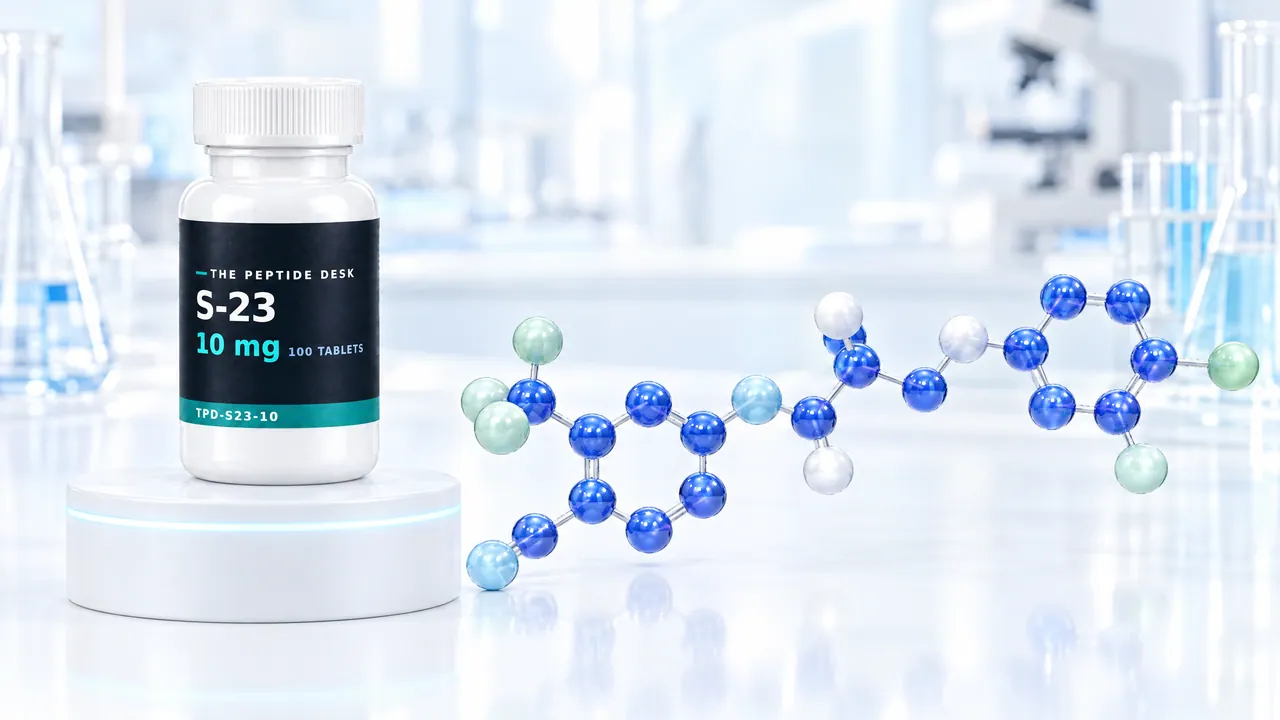
What is S-23?
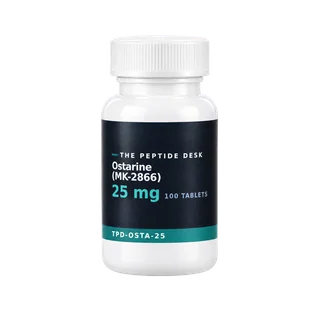
S-23 is a non-steroidal selective androgen receptor modulator (SARM) from the same chemical family as ostarine. It was developed at Ohio State University with an unusual goal: to serve as the oral component of a hormonal contraceptive for men. The idea was to brake the hormone axis through the androgen receptor so strongly that sperm production stops, while muscle and bone stay supplied.
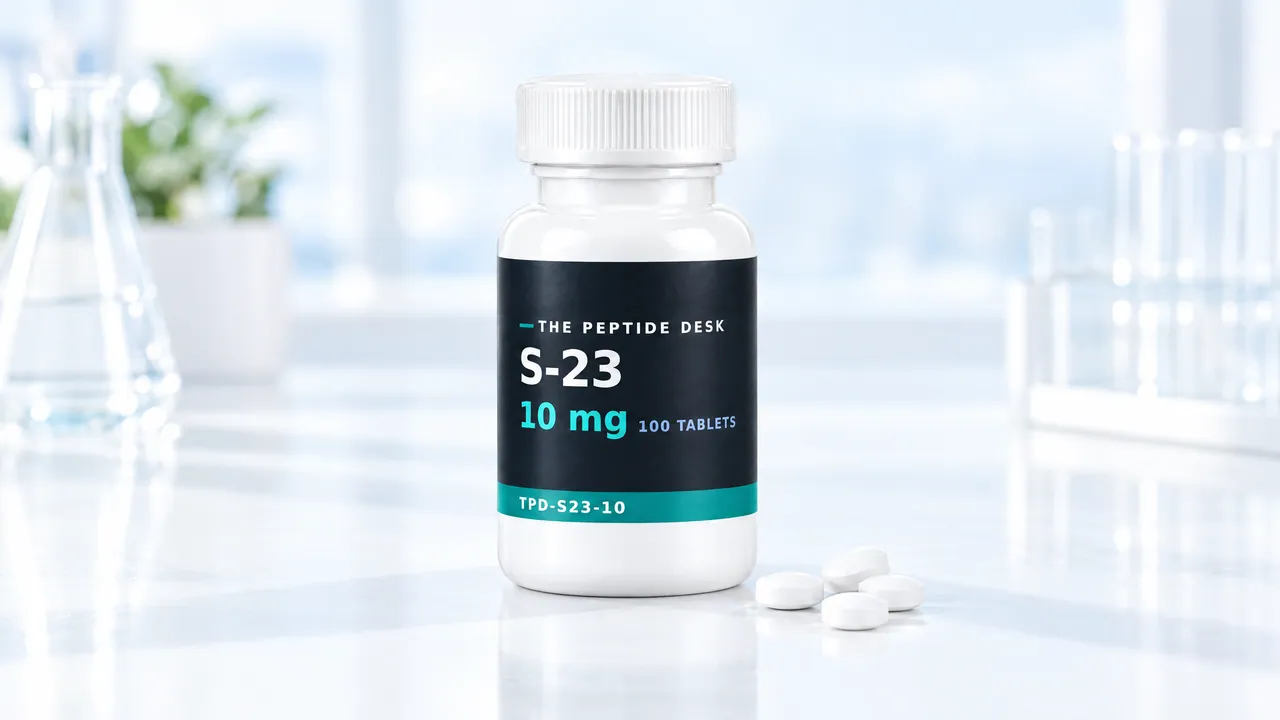
S-23 never got past the preclinical stage. There are no clinical studies in humans on its effects or safety. The human data that do exist come from doping control labs that studied single doses or microdoses to improve detection in urine. In the range S-23 comes as a tablet with 10 or 20 mg.
This information is for research and educational purposes only. No medical advice.
Comparison
At the androgen receptor in the lexicon
SARMs and testosterone use the same receptor, as stated in the TPD lexicon. Tap a card to open its entry.
Simplified: S-23 was developed specifically as a strong brake on the hormone axis, the other SARMs were not. 61
How it works
S-23 binds the androgen receptor very tightly and acts as a full agonist in cell assays, not just a partial activator like some other SARMs. In castrated rats the half-maximal effective dose in muscle was far lower than in the prostate. That tissue preference is what defines a SARM (Jones, Endocrinology 2008).
The other side of the same effect is feedback to the brain. The body senses a strong androgen signal and turns down LH and FSH, the two hormones that drive the testes to make testosterone and sperm. With S-23 this brake is not a side effect, it was the actual development goal.
S-23 is neither converted to estrogen nor reduced to DHT. Your own testosterone still drops because the axis is suppressed. In the rat study the animals had to be given estradiol as well to keep their sexual behaviour intact.
Where it acts
Where S-23 acted in animal experiments
Tap a point or a card. Colour = androgen receptor, grey = observed. All from experiments in rats.
Targets in the ChEMBL database6
Compound CHEMBL512283: one recorded mechanism, Full agonist, Ki 1.7 nM.
- Gene
- AR
- UniProt
- P10275
- ChEMBL
- CHEMBL1871
- Action
- Full agonist, Ki 1.7 nM

Use and dosing
Dosing
Dosing, titration and syringe
Loading the dosing information …
- Getting started and stepping up, drawn as a staircase
- Units on the U-100 syringe for every step
- How long one vial lasts
What the research shows
Jones and colleagues (Endocrinology 2008) tested S-23 as a contraceptive in male rats. Given alone for 14 days it lowered LH by more than half from 0.1 mg per day. Combined with estradiol, four of six animals in the 0.1 mg group had no sperm left in the testes and mating trials produced no pregnancies. After stopping, fertility returned completely, with a 100 percent pregnancy rate after 100 days. Bone density and lean mass rose along the way while fat mass fell.
Ameline and colleagues (J Pharm Biomed Anal 2022) gave one volunteer a single dose of about 8 mg and found S-23 in urine for up to 28 days. The authors note that nothing has been published on long-term effects. Alhalabi and colleagues (Biomed Chromatogr 2025) showed that even 1 to 50 micrograms stay detectable for days to weeks. In 2022 S-23 turned up in five positive doping samples.
Vignali and colleagues (J Xenobiot 2023) summarise SARM safety data in healthy adults: liver injury in case reports and rises in the liver enzyme ALT in clinical trials. No such studies exist for S-23 itself.
Study results
What the trials measured
Interactive: switch tabs, tap points, show or hide arms. Arms are named relative to each other, no dosing advice.
Fertility of male rats1
Up to 10 weeks of S-23 together with oestradiol, small group of 6 animals
Oestradiol alone did not change sperm production, it was needed to maintain the rats' sexual behaviour. Given alone, S-23 lowered LH by more than half.
Research status
Where the research stands
There is no study on S-23 on ClinicalTrials.gov. The data come from animal experiments and doping labs. As of 26 Oct 2026. 5
Side effects
Because human studies are missing, this list rests on the animal data and on what has been described for SARMs as a class.
- Suppression of the testosterone axis. The main finding in the research. LH and FSH drop sharply and your own testosterone falls. With S-23 a stronger brake should be expected than with milder SARMs.
- Fertility. In rats sperm production stopped. Recovery there took months. Whether and how fast it returns in humans has not been studied.
- Libido and mood. With low natural testosterone and no estradiol, loss of libido, low drive and erection problems are plausible. In the rat study estradiol was needed to keep sexual behaviour intact.
- Liver and lipids. Liver injury in case reports and falling HDL have been described for SARMs.
- Unknown long-term effects. There are no data.
This classification does not replace medical advice.
Detection and competition
Under the WADA list S-23 falls under S1.2 (other anabolic agents) and is banned in and out of competition. Detection windows are long: after a single tablet labs found the compound in urine for up to four weeks. Even microgram amounts for more than a week.
Anyone subject to doping control should know that contaminated supplements have also led to positive samples. That is exactly why labs now study how accidental intake can be told apart from deliberate use.
Storage
Store dry, at room temperature and protected from light, keep the tin closed. Do not keep it in the bathroom, the humidity there degrades tablets.
Keep out of reach of children and mind the expiry date. Do not decant tablets into unlabelled containers.