This information is for research and educational purposes only. No medical recommendations. Products are not approved for human use. For health questions, consult a doctor.

Lexicon

N-Acetyl-Epitalon-Amidate

The chemically stabilized form of epitalon, the telomerase-associated anti-aging peptide from the Khavinson program.

2 min read 9 sources

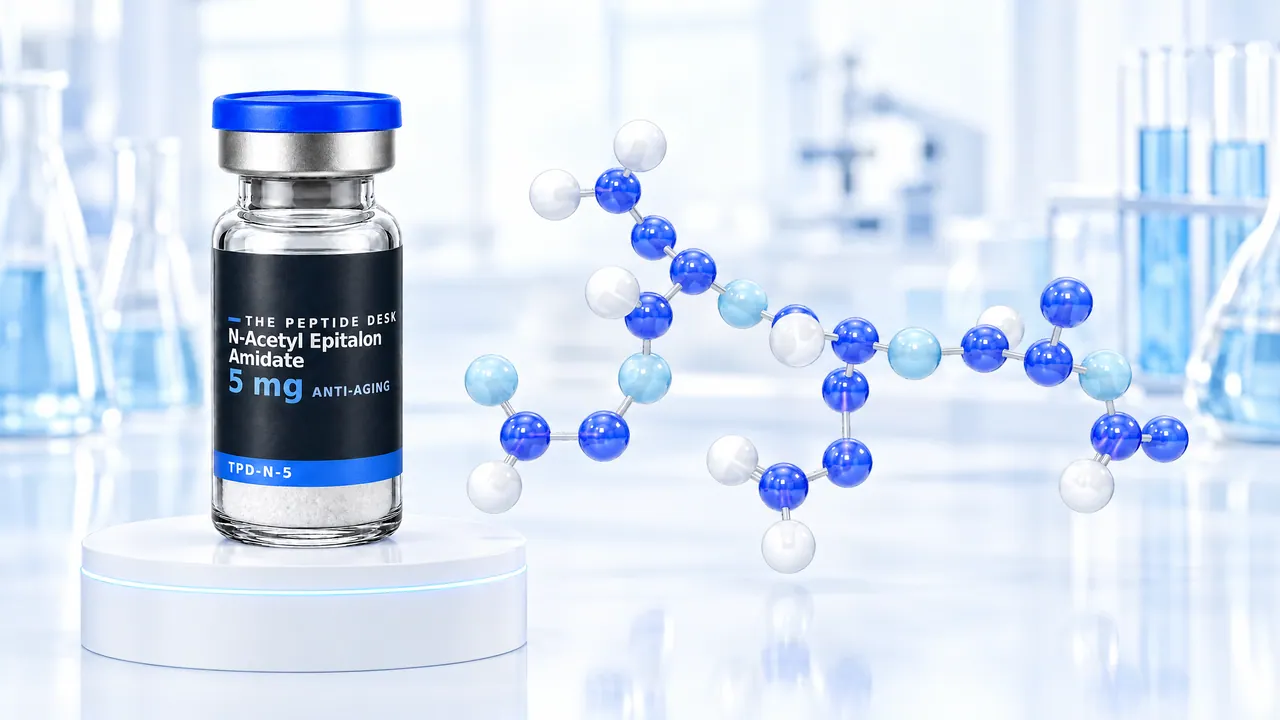
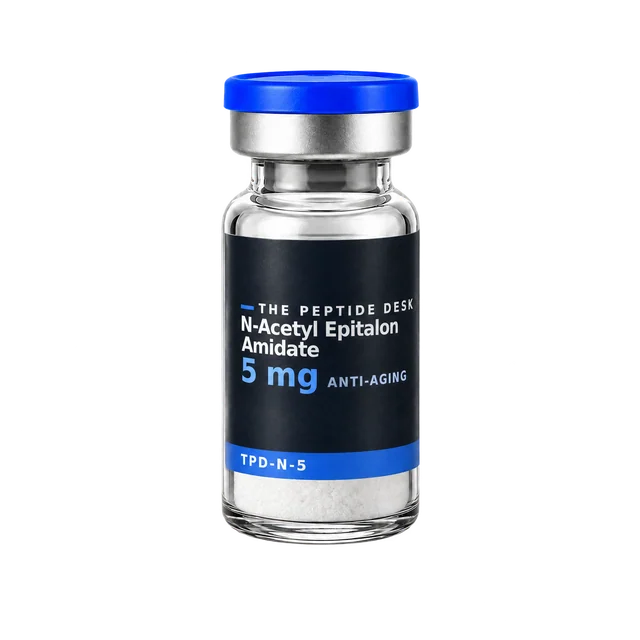
Vial with white powder, a blue cap and a black TPD label for N-Acetyl Epitalon Amidate on a white podium, next to it a chain of blue and white glass spheres as a molecule model in a bright lab
Preclinical, no study of its own · not approved

Summary

At a glance

Sources checked on 26 Oct 2026

Length
4 amino acids

Ala-Glu-Asp-Gly like epitalon, here with protected ends (acetyl at the front, amide at the back)7

Mean lifespan (epitalon, mice)
+13.5 %

Mice with the breast cancer gene HER-2/neu, injected from the second month of life4

Chromosome damage (epitalon, mice)
-17.1 %

in bone marrow, long-term dosing, mean lifespan stayed the same5

Studies on this form
0 trials

neither on ClinicalTrials.gov nor in PubMed, as of 26 Oct 20268

  • N-acetyl epitalon amidate is epitalon (Ala-Glu-Asp-Gly) with protected ends: an acetyl group at the front, an amide at the back. According to the entry this is meant to slow breakdown.79
  • This form has not been studied: there is not a single study on it. All findings come from epitalon itself.8
  • In human connective tissue cells epitalon activated telomerase and lengthened telomeres, a newer study confirmed this in normal cells.23
  • In mice with the breast cancer gene HER-2/neu the animals lived 13.5 percent longer on average. In a second mouse study mean lifespan stayed the same, the longest-lived lived longer.45
  • Almost all data come from one research line, large independent studies are missing. Everything here is preclinical research, not a recommendation.17
Profile

Updated May 2026

Class
Tetrapeptide

epitalon variant, stabilized

Use
Subcutaneous

in mg

Half-life
short

more stable than epitalon

Status
Data mostly from the Khavinson program
Sizes
5 to 10 mg

2 sizes in the shop

Contents 15 sections
  1. At a glance
  2. What is N-Acetyl-Epitalon-Amidate?
  3. How it works
  4. What you need
  5. Reconstitution
  6. Dosing
  7. Injection
  8. What the research shows
  9. Research status
  10. Side effects
  11. Storage
  12. Related compounds
  13. FAQ
  14. Glossary
  15. Sources

What is N-Acetyl-Epitalon-Amidate?

N-Acetyl-Epitalon-Amidate is the chemically stabilized form of epitalon (epithalon), which you also find individually in the lexicon. Acetyl and amidation make the molecule more resistant to breakdown, so it acts more predictably and somewhat longer than plain epitalon.

Epitalon comes from the Russian Khavinson program and is associated with telomerase activation and anti-aging.

Comparison

Short peptides from ageing research

Where the peptides act according to the TPD lexicon. Tap a card to open its entry.

7

How it works

Epitalon is a tetrapeptide (AEDG sequence) associated in models with the activation of telomerase, the enzyme that maintains the protective caps of the chromosomes (telomeres). Studies also described a regulation of the pineal gland and the melatonin rhythm. The acetylated variant is more stable in the body.

Details on the mechanism are in the epitalon entry.

Where it acts

Where epitalon acted in experiments

Tap a point or a card. Colour = target, grey = observed. All with epitalon, not with this form.

  1. Connective tissue cells

    Telomerase active, telomeres longer (epitalon, human cells in culture)2

    Telomerase
  2. Pineal gland

    More evening melatonin in old rhesus monkeys (epitalon)6

    Observed in trials
  3. Bone marrow

    17.1 percent less chromosome damage, less leukaemia (epitalon, mice)5

    Observed in trials

Known targets2

Compound PubChem CID 219042 (Epitalon): one described target, More active with epitalon in cell culture, direct binding not shown, not studied for this form.

Telomerase (TERT subunit)
Gene
TERT
UniProt
O14746
ChEMBL
CHEMBL2916
Action
More active with epitalon in cell culture, direct binding not shown, not studied for this form
Blue glass chromosome with brightly glowing ends, two molecule chains of blue and white glass spheres beside it
Linked in models to telomerase, which maintains the telomeres at the chromosome ends. Symbolic image.

What you need

Supplies

2 things, numbered as in the picture

Tick off what you already have. Vial and BAC water are our real shop photos at the same size.
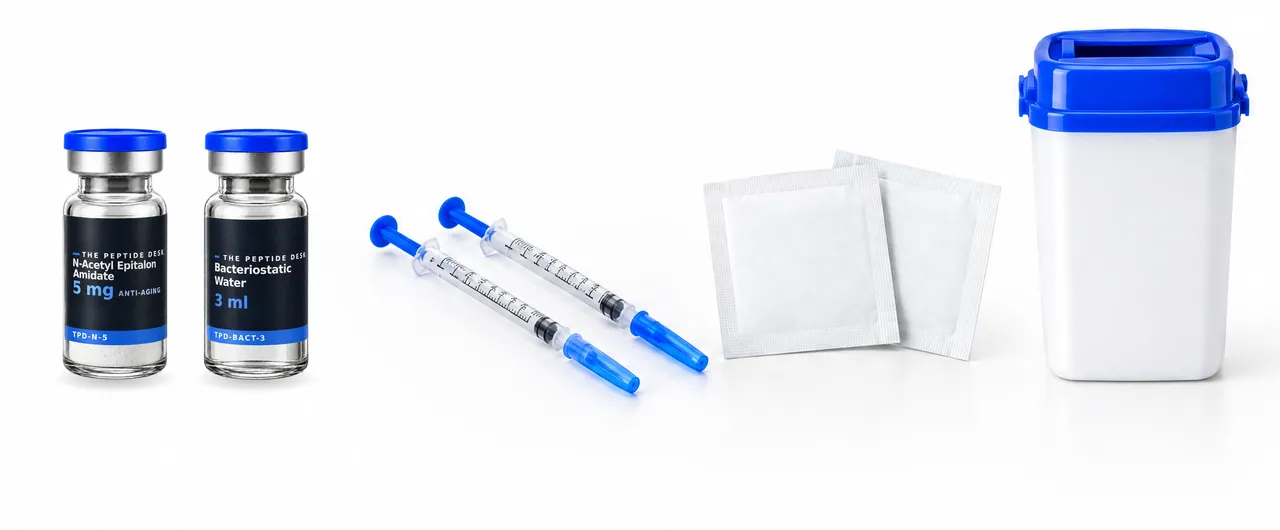
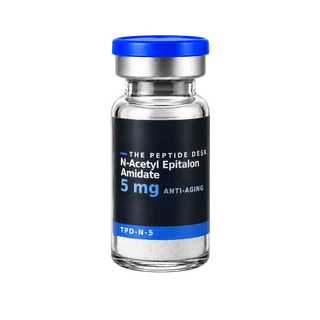
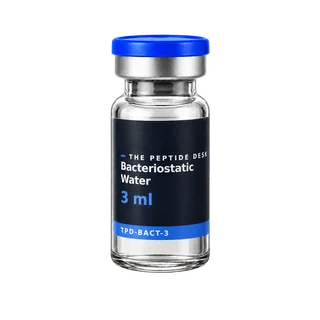
N-acetyl epitalon amidate vial and bacteriostatic water at the same size with the black TPD label, next to two U-100 insulin syringes, two alcohol swabs and a sharps container with a blue lid
  1. Vial

    The vial (lyophilized powder).

    In the shop
  2. Water and supplies

    Bacteriostatic water, U-100 insulin syringes, alcohol swabs.

    In the shop

Reconstitution

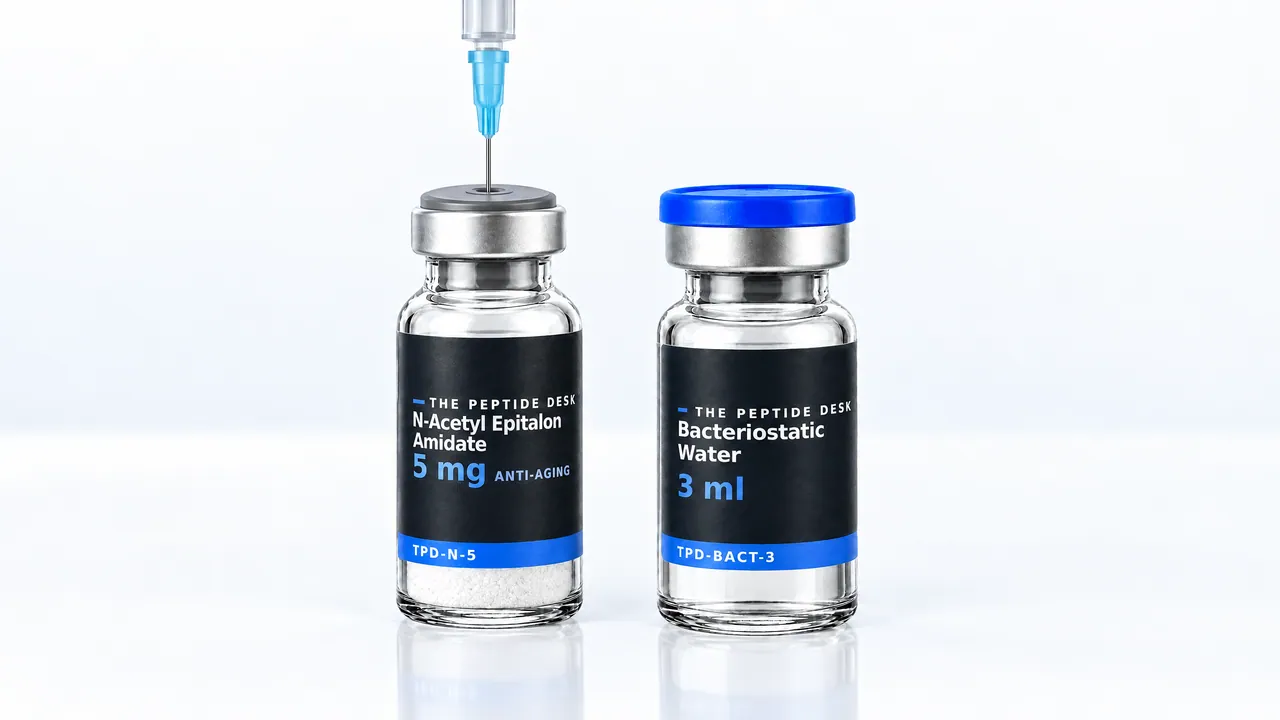
Use the peptide calculator. A 10mg vial with 2ml water gives 5mg per ml, 5mg is then 20 units on the U-100 syringe. Just add the water to the vial and let it dissolve.
Step by step

Dissolving the powder

Four steps, the same for every vial size.

  1. 1Wipe the cap

    Clean the rubber stopper with an alcohol swab.

  2. 2Add BAC water

    Just add it, it does not matter if it hits the powder directly.

  3. 3Swirl or shake

    Until everything has dissolved, both are fine.

  4. 4Draw up

    With the U-100 insulin syringe.

Less water higher concentration fewer units on the syringe Example: 10 mg + 2 ml = 5 mg/ml

Dosing

Dosing

Dosing, titration and syringe

Loading the dosing information …

  • Getting started and stepping up, drawn as a staircase
  • Units on the U-100 syringe for every step
  • How long one vial lasts

Injection

The injection is subcutaneous, into the fat layer under the skin. Common spots are the abdomen (keep about two finger-widths clear of the navel), the front and the inner side of the thigh, or the back of the upper arm.

The short version:

Injection

Where and at what angle

Pick a spot or switch the angle. Subcutaneous means: into the fat layer, not the muscle.

Rotate the spot each time, never the same one twice in a row.

90°More fat under the skin

Rule of thumb: where there is more fat under the skin, insert straight at 90 degrees. In lean people with little fat, 45 degrees, so the needle stays in the fat layer. Simplified diagram.

  1. Clean the spot with an alcohol swab and let it dry

  2. Pinch up a small fold of skin

  3. Insert the needle: at 90 degrees where there is more fat under the skin, at 45 degrees in lean people with little fat

  4. Inject slowly, wait a moment, then withdraw

  5. Put the needle straight into the sharps container

Rotate the site each time so the tissue does not get irritated. Never the same spot twice in a row.

What the research shows

The Khavinson program has published works on epitalon and related peptides over decades (overview: Khavinson, 2002), with effects on telomerase, the pineal gland and, in animal models, on lifespan. The read must stay honest: the data come mostly from one research line, large independent studies are missing.

Study results

What the trials measured

Interactive: switch tabs, tap points, show or hide arms. Arms are named relative to each other, no dosing advice.

Lifespan compared with mice without epitalon45

Change in percent, two long-term studies with epitalon

Mean lifespan4 Mice with the breast cancer gene HER-2/neu
Control 0.0%
Epitalon (not the acetylated form) +13.5%
Mean lifespan5 Female SHR mice, 54 per group
Control 0.0%
Epitalon (not the acetylated form) 0.0%
The longest-lived 10 percent5 Female SHR mice, 54 per group
Control 0.0%
Epitalon (not the acetylated form) +13.3%

Values from the abstracts, both studies from the same research line. In the SHR study epitalon did not change mean lifespan (shown as 0). All values apply to epitalon, the acetylated and amidated form was never tested.
Glass pineal gland and a frosted glass moon on a glass plate, circled by light trails
The data mostly come from one research group, large independent studies are missing. Symbolic image.

Research status

Where the research stands

There is no study on this modified form. The stages therefore only show the state of epitalon in cells and animals. As of 26 Oct 2026. 8

  1. Preclinical Epitalon in cell culture and animal studies
  2. Phase 1 no registered trial
  3. Phase 2 no registered trial
  4. Phase 3 no registered trial
  5. Approval not yet
Not approved and no study on this form. Epitalon itself is not approved either.8

So far there is no registered trial in humans. 8

Side effects

  • Well tolerated in the available reports, mainly local reactions.
  • Solid, independent safety data are limited.

Storage

Before mixing the powder is robust, normal room temperature (around 20 to 25 degrees) is fine, ideally kept in the dark. After mixing, keep in the fridge (2 to 8 degrees), do not freeze. It stays good there for at least 4 to 6 months with barely any loss of potency, in practice considerably longer. Swirl or shake to mix, both are fine.

Shelf life

How long it keeps

Undissolved (powder) Room temperature, around 20 to 25 degrees, dark

Robust, no fridge needed. Keeps for several months without trouble.

Dissolved (mixed) Fridge, 2 to 8 degrees, do not freeze

At least 4 to 6 months with barely any loss of potency. The bacteriostatic water brings a preservative.

  • Keep it dark
  • Dissolved: 2 to 8 degrees
  • Note the mixing date on the vial
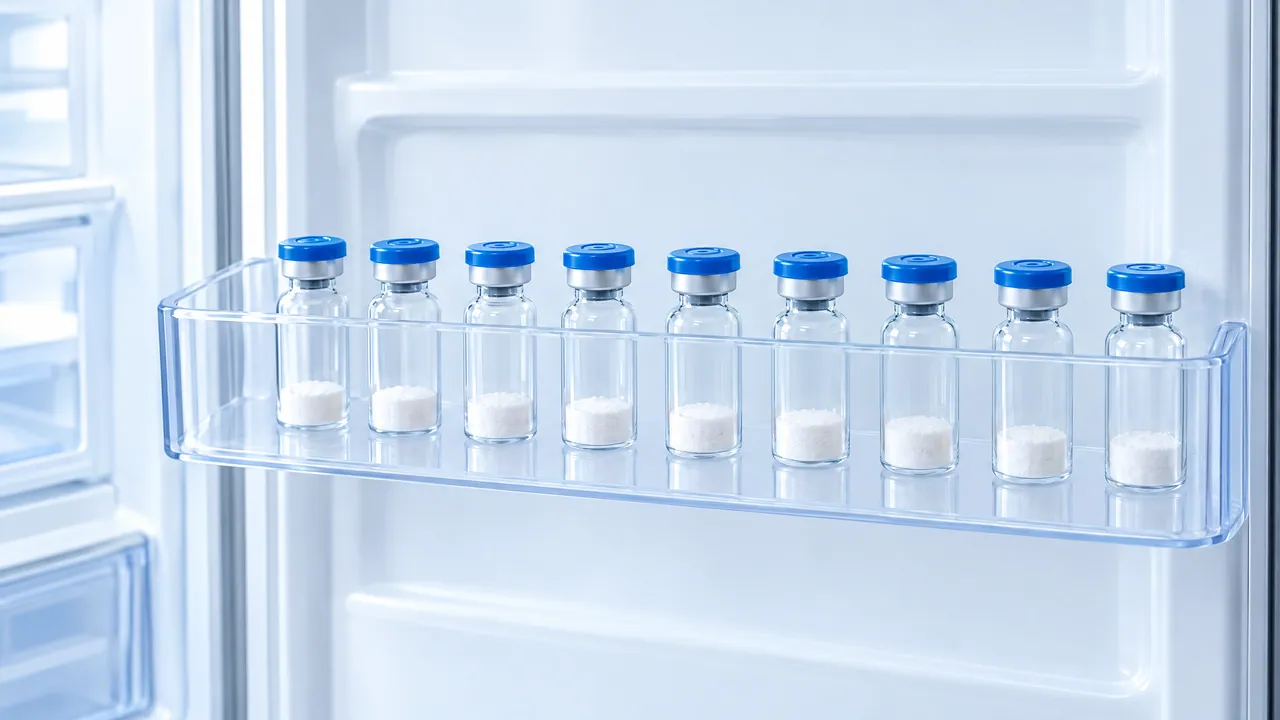
Nine vials with white powder and blue caps in the door shelf of a bright fridge
Powder dark at room temperature, once dissolved into the fridge (2 to 8 degrees), stable there for at least 4 to 6 months. Symbolic image.

Related

Related compounds

Same targets or a different path: all in the TPD lexicon.

FAQ

Common questions about N-Acetyl-Epitalon-Amidate

Short answers, each backed by the sources below.

Are there studies on N-acetyl epitalon amidate?

No. Neither PubMed nor ClinicalTrials.gov lists a paper on the acetylated and amidated form (as of 26 October 2026). All findings on this page come from epitalon itself and cannot simply be transferred.8

What do acetyl and amide change about the molecule?

They cap both ends of the chain of four amino acids. According to the entry this is meant to slow the breakdown of the molecule and make it act more evenly. This has not been measured for this form, there are no data on half-life or effect compared with epitalon.78

What do the cell studies with epitalon show?

In human connective tissue cells without active telomerase epitalon switched the enzyme on and lengthened the telomeres. A newer study from the UK also saw this in normal cells, depending on the amount. In breast cancer cells, by contrast, telomeres became longer via a different route (ALT).23

What do the animal studies with epitalon show?

In mice with the breast cancer gene HER-2/neu the animals lived 13.5 percent longer on average and had fewer breast tumours. In female SHR mice mean lifespan stayed the same, the longest-lived 10 percent lived 13.3 percent longer, chromosome damage in bone marrow fell by 17.1 percent. In old rhesus monkeys evening melatonin production rose.456

Where do the data come from?

Almost all from one Russian research line around Khavinson that has studied short peptides for decades. Independent confirmations are rare, one of them is the cell study from the UK from 2025. A review summarises the state after about 25 years of research.137

Which side effects are known?

There are no data for this form. In mice lifelong epitalon changed neither food intake nor body weight, the authors rate long-term dosing as safe. That cannot be transferred to humans. The entry mainly mentions reactions at the injection site.5

Glossary

Terms explained briefly

Dotted words in the text open these explanations directly.

Acetylation
A small acetyl group caps the start of the peptide chain. This is meant to slow enzymes that break peptides down from the end.
Amidation
The end of the peptide chain is capped as an amide instead of an acid. This too is meant to slow breakdown.
Lyophilisate
Freeze-dried powder. Without water a peptide keeps much longer.
Pineal gland
A small gland in the brain that makes melatonin at night and so controls the day-night rhythm.
Preclinical
Research before first use in humans, in cell cultures and animal models. Results cannot be transferred directly to humans.
Subcutaneous
Into the fat layer just under the skin.
Telomerase
An enzyme that lengthens the protective caps of chromosomes (telomeres). It is switched off in most body cells.
Telomeres
Protective caps at the ends of chromosomes. They get shorter with every cell division.
Tetrapeptide
A chain of exactly four amino acids. In epitalon these are alanine, glutamic acid, aspartic acid and glycine.

Evidence

Sources

Show all 9 sourcesHide sources 6 Studies1 Trial registry2 Database checked 26 Oct 2026

Studies

  1. Epitalon activates telomerase in human cells

    Khavinson et al., Bulletin of Experimental Biology and Medicine, 2003

    Checked 26 Oct 2026 via doi.org, Crossref, PubMed
  2. Epitalon and telomere length in normal and cancer cell lines

    Al-Dulaimi et al., Biogerontology, 2025

    Checked 26 Oct 2026 via doi.org, Crossref, PubMed
  3. Epitalon in mice with the breast cancer gene HER-2/neu

    Anisimov et al., Bulletin of Experimental Biology and Medicine, 2002

    Checked 26 Oct 2026 via doi.org, Crossref, PubMed
  4. Epitalon, ageing markers and lifespan in SHR mice

    Anisimov et al., Biogerontology, 2003

    Checked 26 Oct 2026 via doi.org, Crossref, PubMed
  5. Epitalon and melatonin in old rhesus monkeys

    Goncharova et al., Bulletin of Experimental Biology and Medicine, 2001

    Checked 26 Oct 2026 via doi.org, Crossref, PubMed
  6. Review of epitalon after about 25 years of research

    Araj et al., International Journal of Molecular Sciences, 2025

    Checked 26 Oct 2026 via doi.org, Crossref, PubMed

Trial registry

  1. Search on ClinicalTrials.gov (no trial on this form)

    ClinicalTrials.gov, U.S. National Library of Medicine

    Checked 26 Oct 2026 via ClinicalTrials.gov API v2

Database

  1. Review of peptides and ageing from the Khavinson programme (PubMed record)

    Khavinson, Neuro Endocrinology Letters, 2002 (ohne DOI)

    Checked 26 Oct 2026 via PubMed
  2. Structure of epitalon in PubChem

    PubChem, U.S. National Library of Medicine (CID 219042)

    Checked 26 Oct 2026 via PubChem

In the shop

N-Acetyl-Epitalon-Amidate in the catalog

Sizes, prices and shipping times are on the product page.

To the product