What is Letrozole?
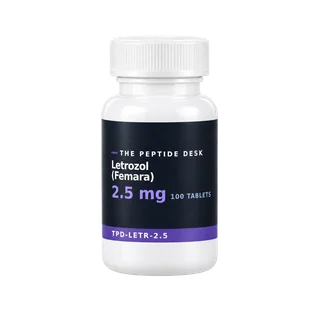
Letrozole (brand name Femara) is the most potent of the non-steroidal aromatase inhibitors. It lowers estradiol even more strongly than anastrozole: in a head-to-head study estradiol in the blood fell by 87.8 percent (anastrozole 84.9 percent) and estrogen production in the whole body by more than 99 percent (Geisler et al., 2002). That strength is both advantage and risk: letrozole can reverse active gynecomastia, but also crashes estradiol too low quickly if you are not careful.
This information is for research and educational purposes only. No medical advice.
Comparison
Lowering or blocking estrogen
Compounds around estrogen, as described in the TPD lexicon. Tap a card to open its entry.
Aromatase inhibitors lower the production of estrogen, receptor modulators such as tamoxifen and clomiphene block its effect at the receptor. 72
How it works
Like anastrozole, letrozole binds aromatase reversibly, just much more strongly. The near-complete estradiol suppression makes it the choice when other AIs are not enough - for example with already visible gynecomastia you want to push back.
Where it acts
Where letrozole acts
Tap a point or a card. Colour = aromatase, grey = observed in studies.
- Blood
Estradiol lowered by 87.8%, estrone sulfate by 98.0%2
Aromatase - Pituitary and ovary
In PCOS ovulation in 61.7% of cycles, with clomiphene 48.3%4
Observed in trials - Bone
More skeletal events than with tamoxifen, new osteoporosis 5.8% against 4.5% with placebo3
Observed in trials - Heart and blood lipids
More cardiac events and raised cholesterol than with tamoxifen1
Observed in trials
Targets in the ChEMBL database7
Compound CHEMBL1444: one recorded mechanism, Inhibitor, direct binding.
- Gene
- CYP19A1
- UniProt
- P11511
- ChEMBL
- CHEMBL1978
- Action
- Inhibitor, direct binding

Dosing
Dosing
Dosing, titration and syringe
Loading the dosing information …
- Getting started and stepping up, drawn as a staircase
- Units on the U-100 syringe for every step
- How long one vial lasts
What the research shows
The BIG 1-98 study (NEJM, 2005) compared letrozole with tamoxifen in postmenopausal breast cancer and showed significant superiority of letrozole in disease-free survival. That confirms the very strong estrogen lowering that makes letrozole so potent in research contexts.
Study results
What the trials measured
Interactive: switch tabs, tap points, show or hide arms. Arms are named relative to each other, no dosing advice.
How much estrogens fell2
Reduction from baseline, 12 women, 6 weeks of each drug
Postmenopausal women with breast cancer, both drugs in random order. For estrone and estrone sulfate letrozole was significantly stronger, for estradiol the difference was smaller.
Share free of recurrence13
Disease-free survival, estimated, in percent
In BIG 1-98 the risk of recurrence fell by 19 percent (hazard ratio 0.81) and the risk of distant recurrence by 27 percent. MA.17 was stopped early after the first interim analysis on the recommendation of the safety committee.
Letrozole against clomiphene in PCOS4
750 women, up to five cycles, in percent
Pregnancy losses did not differ (31.8 against 29.1 percent). Major congenital anomalies: 4 with letrozole, 1 with clomiphene, no statistical difference.

Research status
Where the research stands
Letrozole has been approved since 1997 and the registry lists about 900 trials with it. Here is a selection of large trials of letrozole itself, plus trials in men. As of 26 Oct 2026. 8
- Preclinical Inhibition of aromatase
- Phase 1 no registered trial
- Phase 2 no registered trial
- Phase 3 8 trials, 8 completed
- Approval in the USA since 1997
Show all 9 phase 3 and 4 trials on a timelineHide timeline
BIG 1-98 · NCT00004205 · 8,028 participants, started Mar 1998, primary endpoint reached Dec 2008. Tests several agents.
Registry entry ↗ · Results: BIG 1-98 Collaborative Group (Thürlimann et al.), New England Journal of Medicine, 2005
MA.17 · NCT00003140 · 5,187 participants, started Aug 1998, primary endpoint reached Aug 2003.
Registry entry ↗ · Results: Goss et al., New England Journal of Medicine, 2003
NCT00754845 · 1,918 participants, started Nov 2004, primary endpoint reached Dec 2015.
Registry entry ↗ · Results not yet in PubMed
NCT00138710 · 50 participants, started Aug 2005, primary endpoint reached Jan 2010.
Registry entry ↗ · Results not yet in PubMed
FACE · NCT00248170 · 4,172 participants, started Dec 2005, primary endpoint reached Sept 2014. Tests several agents.
Registry entry ↗ · Results not yet in PubMed
SOLE · NCT00553410 · 4,884 participants, started Aug 2007, primary endpoint reached Apr 2018.
Registry entry ↗ · Results not yet in PubMed
PPCOS II · NCT00719186 · 750 participants, started Feb 2009, primary endpoint reached May 2013. Tests several agents.
Registry entry ↗ · Results: Legro et al., New England Journal of Medicine, 2014
NCT02900105 · 28 participants, started Feb 2015, primary endpoint reached Mar 2017.
Registry entry ↗ · Results not yet in PubMed
HEPAROB · NCT02097680 · 30 participants, started Dec 2013, primary endpoint reached Jun 2015.
Registry entry ↗ · Results not yet in PubMed
Bar: start to primary endpoint (planned for running trials). Green = completed, blue = progress until 26 Oct 2026.
Side effects
- Estradiol crash: the main risk - joint pain, libido loss, lethargy, poor sleep.
- Lipids: very low estradiol worsens cholesterol markedly.
- Bone density: relevant with long-term use.
Tolerability
Side effects compared
Two large studies with numbers on side effects: letrozole against clomiphene in PCOS and against placebo after breast cancer.
| Event | Letrozole | Clomiphene |
|---|---|---|
| Hot flushes4 | 20% | 33% |
| Fatigue4 | 22% | 15% |
| Dizziness4 | 12% | 8% |
| New osteoporosis diagnosis3 | 6% | 0% |
In BIG 1-98 skeletal and cardiac events and raised cholesterol were more common with letrozole, thrombosis, endometrial cancer and bleeding with tamoxifen. In MA.17 hot flashes, joint and muscle pain were more common with letrozole.13
Storage
Store dry and protected from light. Out of reach of children.