This information is for research and educational purposes only. No medical recommendations. Products are not approved for human use. For health questions, consult a doctor.

Lexicon

5-Amino-1MQ

An NNMT inhibitor from metabolic research that lowered fat mass in animal models without curbing appetite.

2 min read 6 sources

Still from the explainer video about this entry
Preclinical · not approvedLab tested in the shop

No time to read it all? The video sums up the whole entry in about a minute, from how it works to the studies and storage.

Summary

At a glance

Sources checked on 26 Oct 2026

Body weight in 11 days
-5.1 %

Obese mice, injected under the skin, control group +1.4%1

Less abdominal fat
~35 %

Mass of epididymal fat tissue, same food intake1

Half-life (mice)
~7 hours

after injection under the skin, no build-up with repeated doses4

Human trials in the registry
0 trials

no trial with 5-Amino-1MQ on ClinicalTrials.gov, as of 26 Oct 20265

  • 5-Amino-1MQ is a small molecule that inhibits the enzyme NNMT. In fat cells this raised NAD+ and the methyl donor SAM while new fat formation fell.16
  • Obese mice lost 5.1 percent of body weight in 11 days and abdominal fat shrank by about 35 percent. Food intake stayed the same.1
  • In old mice NNMT inhibition helped muscle repair and raised grip strength, even more so together with exercise.34
  • In all these animal studies 5-Amino-1MQ was injected under the skin. In mice the half-life was then about 7 hours, with no build-up on repeated doses.14
  • ClinicalTrials.gov lists no human trial (as of October 2026). Everything here is preclinical research, not a recommendation.5
Profile

Updated May 2026

Class
NNMT inhibitor

small molecule

Use
Subcutaneous or oral

in mg

Half-life
short
Status
Preclinical

no human data

Sizes
5 to 50 mg

4 sizes in the shop

Contents 15 sections
  1. At a glance
  2. What is 5-Amino-1MQ?
  3. How it works
  4. What you need
  5. Reconstitution
  6. Dosing
  7. Injection
  8. What the research shows
  9. Research status
  10. Side effects
  11. Storage
  12. Related compounds
  13. FAQ
  14. Glossary
  15. Sources

What is 5-Amino-1MQ?

5-Amino-1MQ is a small molecule that inhibits the enzyme NNMT (nicotinamide N-methyltransferase). NNMT is active in fat tissue and influences energy metabolism. The idea: through the inhibition boost metabolism and promote fat loss.

Up front: the effects come from animal models, there is no human data. We carry it as an injection and as an oral variant.

Comparison

NNMT inhibition and NAD+ in the lexicon

Which entries target NNMT and which supply NAD+ directly, as stated in the TPD lexicon. Tap a card to open its entry.

Simplified: NNMT inhibition is meant to leave more NAD+ in the cell, NAD+ products supply it from outside. Neither is studied as a combination in humans. 12

How it works

By inhibiting NNMT, 5-Amino-1MQ shifts the methyl metabolism in fat cells and so raises the cellular NAD level. In mice this led to less fat mass and smaller fat cells, interestingly without the animals eating less.

Where it acts

Where 5-Amino-1MQ acted in experiments

Tap a point or a card. Colour = NNMT, grey = observed. All from cell and animal studies.

  1. Fat tissue

    NNMT inhibited, more NAD+ and SAM, less new fat formation1

    NNMT
  2. Blood lipids

    Total cholesterol about 30% lower in mice1

    Observed in trials
  3. Skeletal muscle

    Muscle stem cells more active, repair after injury better in old mice3

    NNMT
  4. Liver

    NNMT raised in obese mice, switching it off protected against obesity2

    Observed in trials

Known targets1

Compound PubChem CID 950107: one described target, Inhibitor, in cell assays.

Nicotinamide N-methyltransferase
Gene
NNMT
UniProt
P40261
ChEMBL
CHEMBL2346486
Action
Inhibitor, in cell assays
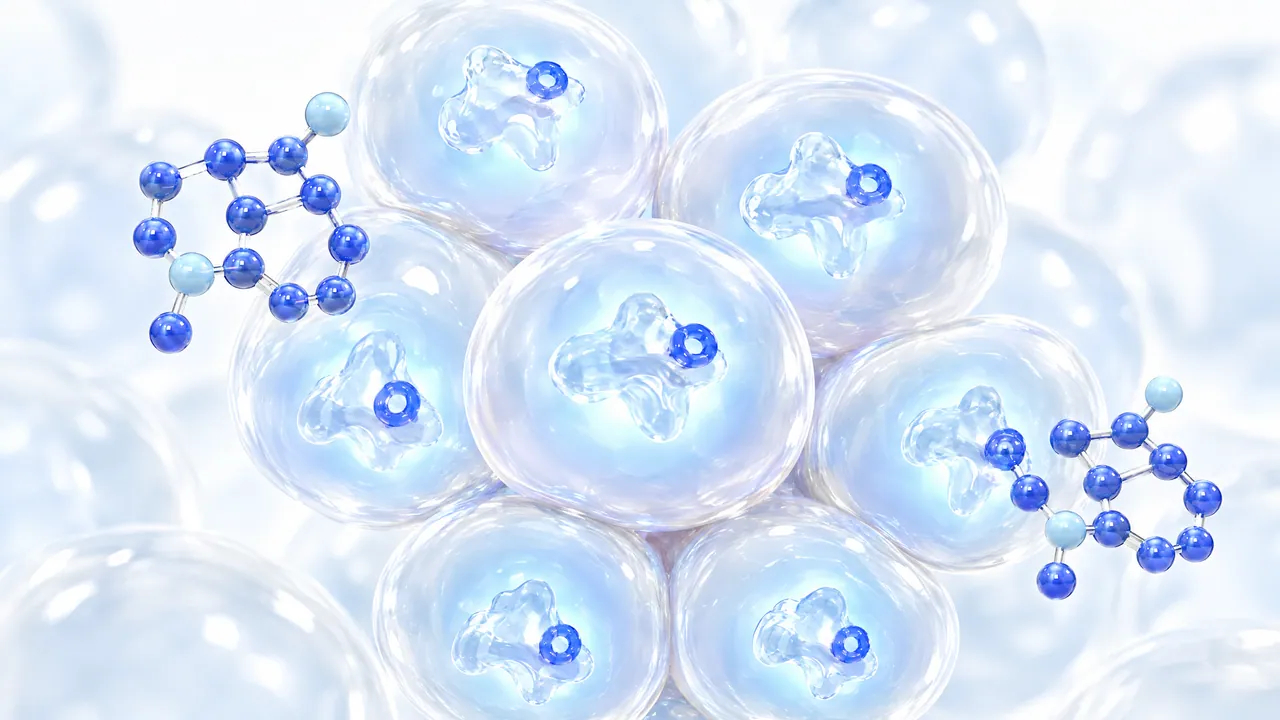
Cluster of pale glass spheres as fat cells, each holding a glass enzyme shape with a small blue ring, two blue double-ring molecules outside
5-Amino-1MQ inhibits NNMT in fat cells. Symbolic image.

What you need

Supplies

2 things, numbered as in the picture

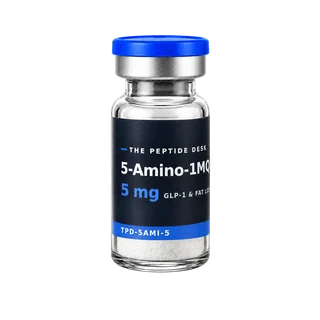
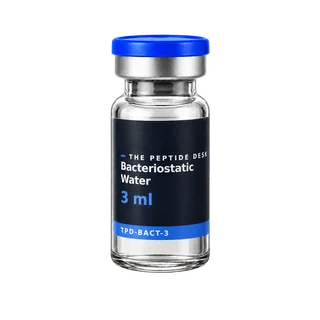
Tick off what you already have. Vial and BAC water are our real shop photos at the same size.
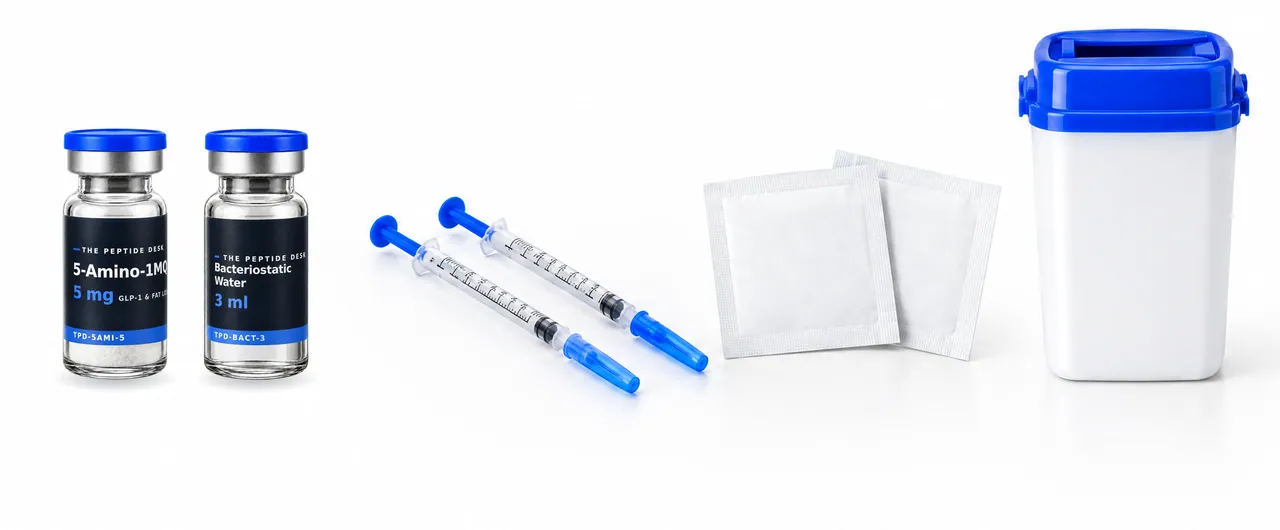
5-Amino-1MQ vial and bacteriostatic water at the same size with the dark TPD label and blue caps, next to them two insulin syringes, two alcohol swabs and a sharps container with a blue lid
  1. 5-Amino-1MQ vial

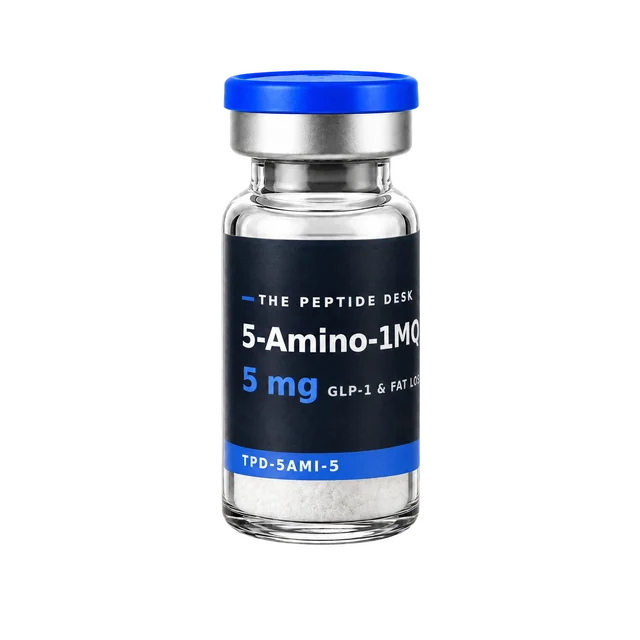
    The 5-Amino-1MQ vial (lyophilized powder).

    In the shop
  2. Water and supplies

    Bacteriostatic water, U-100 insulin syringes, alcohol swabs.

    In the shop

Reconstitution

Use the peptide calculator. A 10mg vial with 2ml water gives 5mg per ml. Just add the water to the vial and let it dissolve.
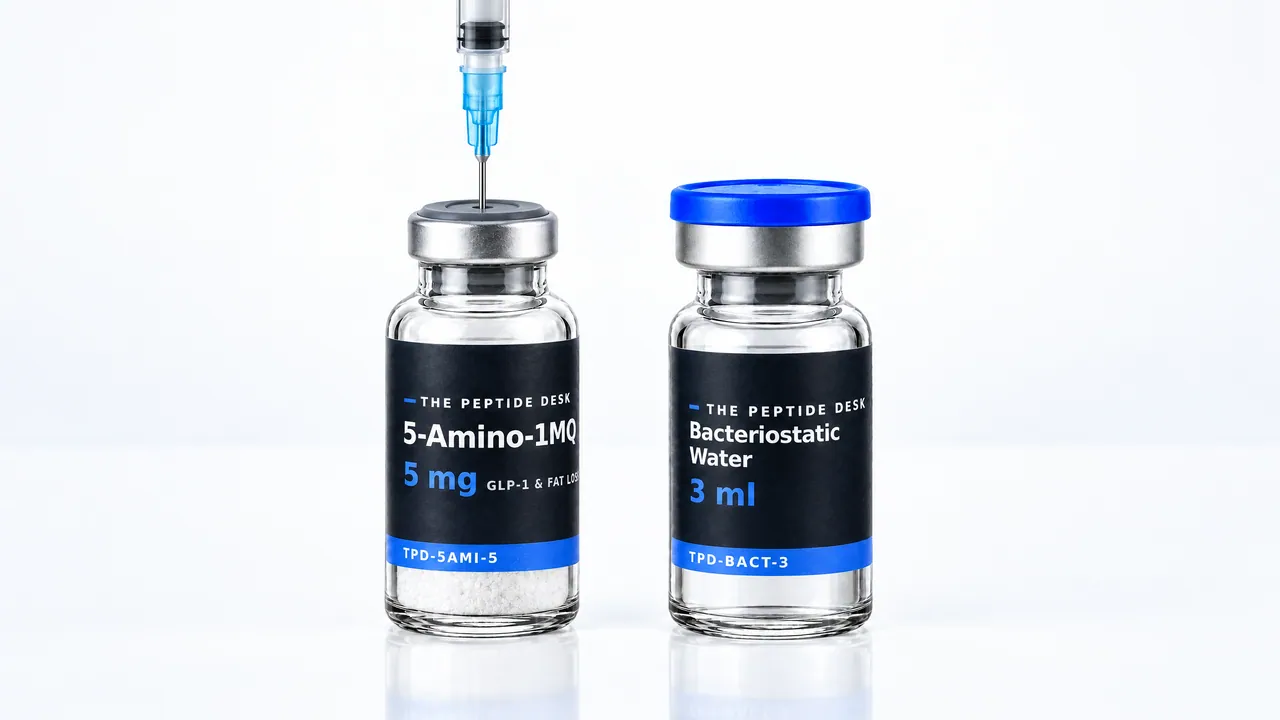
Step by step

Dissolving the powder

Four steps, the same for every vial size.

  1. 1Wipe the cap

    Clean the rubber stopper with an alcohol swab.

  2. 2Add BAC water

    Just add it, it does not matter if it hits the powder directly.

  3. 3Swirl or shake

    Until everything has dissolved, both are fine.

  4. 4Draw up

    With the U-100 insulin syringe.

Less water higher concentration fewer units on the syringe Example: 10 mg + 2 ml = 5 mg/ml

Dosing

Dosing

Dosing, titration and syringe

Loading the dosing information …

  • Getting started and stepping up, drawn as a staircase
  • Units on the U-100 syringe for every step
  • How long one vial lasts

Injection

The injection is subcutaneous, into the fat layer under the skin. Common spots are the abdomen (keep about two finger-widths clear of the navel), the front and the inner side of the thigh, or the back of the upper arm.

The short version:

Injection

Where and at what angle

Pick a spot or switch the angle. Subcutaneous means: into the fat layer, not the muscle.

Rotate the spot each time, never the same one twice in a row.

90°More fat under the skin

Rule of thumb: where there is more fat under the skin, insert straight at 90 degrees. In lean people with little fat, 45 degrees, so the needle stays in the fat layer. Simplified diagram.

  1. Clean the spot with an alcohol swab and let it dry

  2. Pinch up a small fold of skin

  3. Insert the needle: at 90 degrees where there is more fat under the skin, at 45 degrees in lean people with little fat

  4. Inject slowly, wait a moment, then withdraw

  5. Put the needle straight into the sharps container

Rotate the site each time so the tissue does not get irritated. Never the same spot twice in a row.

There is also an oral variant (own entry).

What the research shows

A study (Neelakantan, 2018) showed that 5-Amino-1MQ as an NNMT inhibitor lowered body weight and fat mass in obese mice without changing food intake. That is a clean preclinical basis but it is animal research, human studies are missing.

Study results

What the trials measured

Interactive: switch tabs, tap points, show or hide arms. Arms are named relative to each other, no dosing advice.

Fat and weight after 11 days1

Obese mice on a high-fat diet, 9 animals each, injected under the skin

Body weight1 Change from start
Without 5-Amino-1MQ (control) +1.4%
With 5-Amino-1MQ -5.1%
Abdominal fat (mass)1 compared with the control group
With 5-Amino-1MQ -35.0%
Total cholesterol1 compared with the control group
With 5-Amino-1MQ -30.0%

Values from the full text, fat and cholesterol as approximate figures (about 35 and 30 percent). Fat cells were more than 30 percent smaller and food intake did not differ. Given three times a day under the skin.

Less new fat formation in fat cells1

Fat storage in maturing fat cells (3T3-L1) compared with untreated cells

New fat formation1
Lower concentration -50%
Higher concentration -70%

Cell experiment, two concentrations. At the highest tested concentration cell viability fell slightly.
Grip strength of old mice43

Compared with old mice without exercise and without 5-Amino-1MQ, 8 weeks

Grip strength4
Exercise without 5-Amino-1MQ +20%
With 5-Amino-1MQ +40%
Exercise with 5-Amino-1MQ +60%
Muscle force after injury3 Peak torque, separate study
With 5-Amino-1MQ +70%

Approximate values from the abstracts. Given under the skin in both studies. The effects of 5-Amino-1MQ and exercise added up.

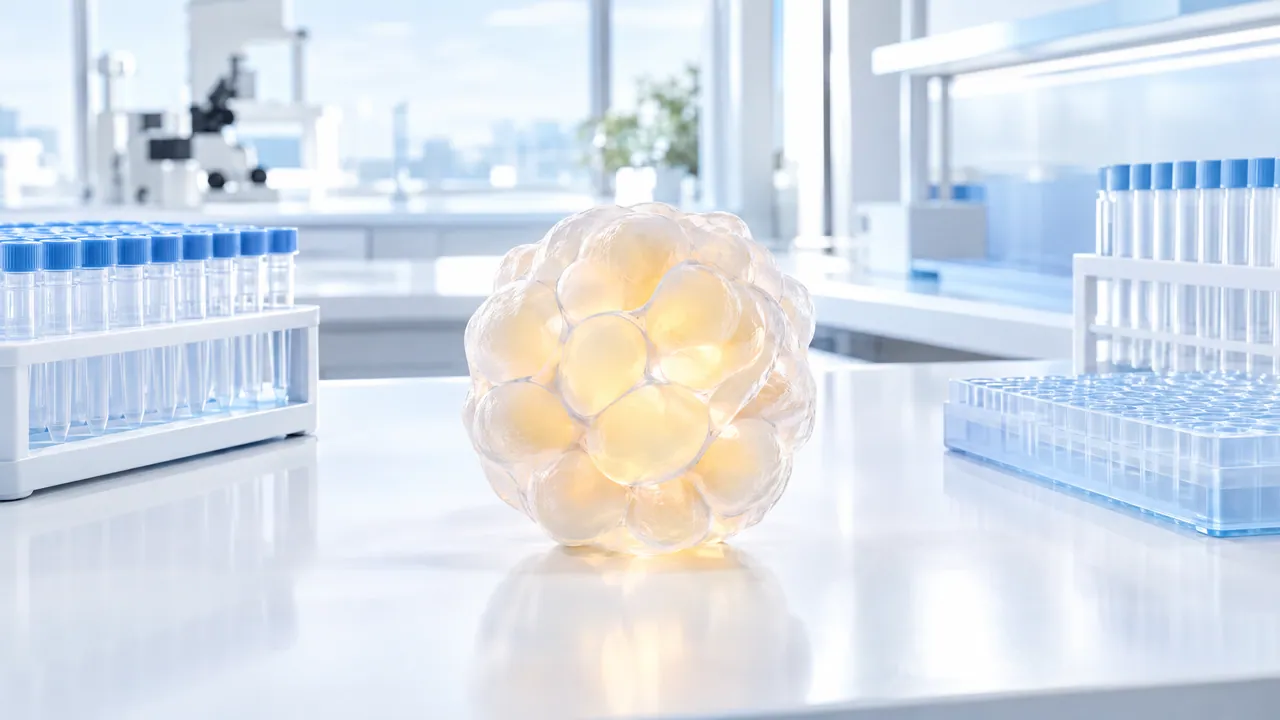
Bright lab bench with sample racks, in the centre a frosted glass piece of fat tissue glowing warmly from within
All data come from cell experiments and mice. Symbolic image.

Research status

Where the research stands

Where the compound stands on the way from lab research to approval. As of 26 Oct 2026. 5

  1. Preclinical Cell assays and mice, injected under the skin
  2. Phase 1 no registered trial
  3. Phase 2 no registered trial
  4. Phase 3 no registered trial
  5. Approval not yet
Not approved and no registered human trial. 5-Amino-1MQ has only been studied preclinically so far.5

So far there is no registered trial in humans. 5

Side effects

  • Solid human data are missing, so little is known about side effects.
  • Local reactions at the injection site.

Storage

Before mixing the powder is robust, normal room temperature (around 20 to 25 degrees) is fine, ideally kept in the dark. After mixing, keep in the fridge (2 to 8 degrees), do not freeze. It stays good there for at least 4 to 6 months with barely any loss of potency, in practice considerably longer. Swirl or shake to mix, both are fine.

Shelf life

How long it keeps

Undissolved (powder) Room temperature, around 20 to 25 degrees, dark

Robust, no fridge needed.

Dissolved (mixed) Fridge, 2 to 8 degrees, do not freeze

At least 4 to 6 months with barely any loss of potency. Swirling or shaking to mix are both fine.

  • Keep it dark
  • Dissolved: 2 to 8 degrees
  • Note the mixing date on the vial
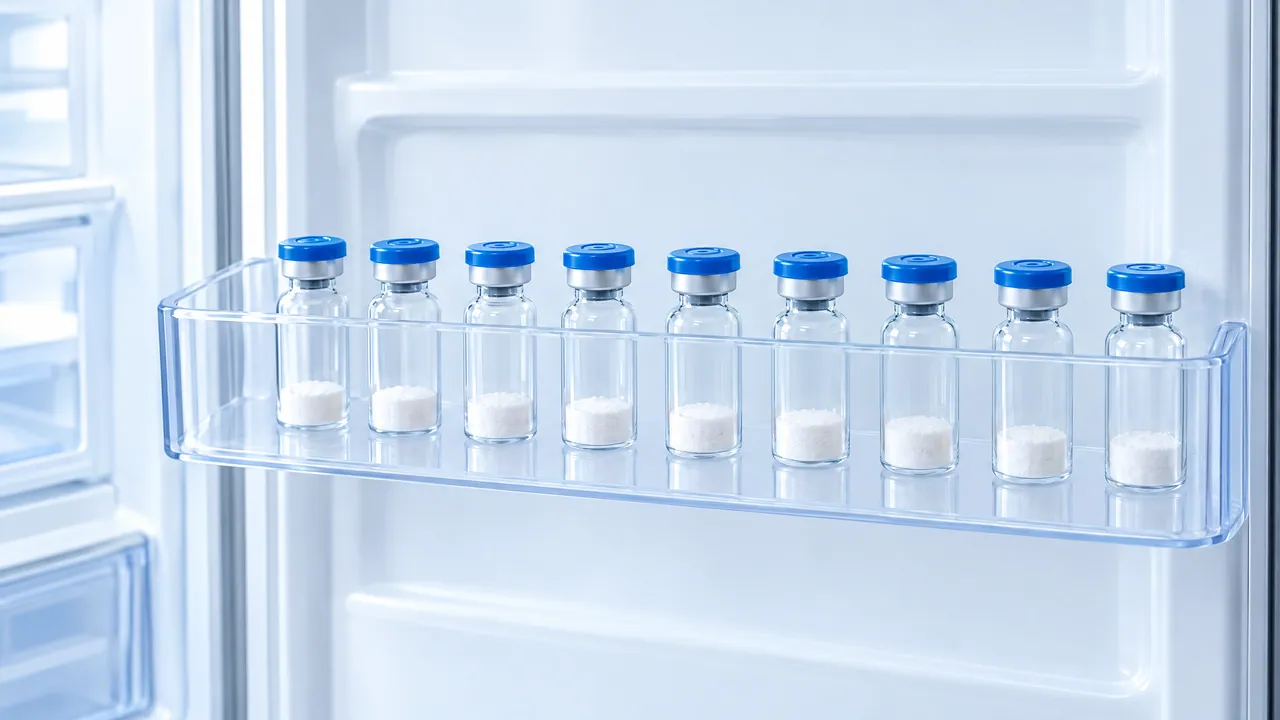
Nine vials with white powder and blue caps in the door shelf of a bright fridge
Powder dark at room temperature, once dissolved into the fridge (2 to 8 degrees), stable there for at least 4 to 6 months. Symbolic image.

Related

Related compounds

Blends with 5-Amino-1MQ or a different path: all in the TPD lexicon.

FAQ

Common questions about 5-Amino-1MQ

Short answers, each backed by the sources below.

How was 5-Amino-1MQ given in the studies?

In all published animal studies under the skin, the same route as this injection. In mice the compound reached the blood quickly, the half-life was about 7 hours and it did not build up with repeated doses. Its kinetics have not been studied in humans.14

Is 5-Amino-1MQ approved?

No. ClinicalTrials.gov lists no trial with 5-Amino-1MQ (as of 26 October 2026). All data come from cell experiments and mice.5

How does 5-Amino-1MQ work?

It inhibits the enzyme NNMT, which uses up nicotinamide (a precursor of NAD+) with a methyl group from SAM. In fat cells NAD+ and SAM rose and new fat formation fell. When NNMT was switched off in fat tissue and liver of mice, energy expenditure rose and the animals stayed leaner on a high-fat diet.12

What did the study in obese mice show?

After 11 days the treated mice had lost 5.1 percent of their weight while the control group had gained 1.4 percent. Abdominal fat was about 35 percent lighter, fat cells more than 30 percent smaller and cholesterol about 30 percent lower. Both groups ate the same amount.1

What about muscle?

In old mice muscle stem cells became more active after an injury, the cross-section of new fibres nearly twice as large and force about 70 percent higher. In a second study grip strength of old mice rose by about 40 percent, with exercise by about 60 percent. This has not been studied in humans.34

Which side effects are known?

There are no solid human data. In the mouse study the authors saw no observable side effects and no change in food intake. NNMT also occurs in the liver and other tissues, the consequences of long-term inhibition in humans are unknown.12

Glossary

Terms explained briefly

Dotted words in the text open these explanations directly.

Fat mass
Weight of fat tissue, measured separately from the rest of body weight.
Lyophilisate
Freeze-dried powder. Without water a compound keeps much longer.
Methyl metabolism
Transfer of small methyl groups, mainly from SAM. Among other things it controls which genes are active.
NAD+
Coenzyme for the cell's energy metabolism. It is built from precursors such as nicotinamide.
NNMT
Nicotinamide N-methyltransferase: enzyme that adds a methyl group to nicotinamide. In obesity it is raised in fat tissue.
Preclinical
Only studied in cells and animals, not yet in humans.
SAM
S-adenosylmethionine, the cell's main methyl group donor.
Small molecule
Compound of small size, not a peptide. Such substances can often be absorbed as a tablet.
Subcutaneous
Into the fat layer just under the skin. This is also how 5-Amino-1MQ was given in the mouse studies.

Evidence

Sources

Show all 6 sourcesHide sources 4 Studies1 Trial registry1 Database checked 26 Oct 2026

Studies

  1. NNMT inhibitors reverse obesity in mice

    Neelakantan et al., Biochemical Pharmacology, 2018

    Checked 26 Oct 2026 via doi.org, Crossref, PubMed, PubMed Central
  2. Switching off NNMT protects mice from obesity

    Kraus et al., Nature, 2014

    Checked 26 Oct 2026 via doi.org, Crossref, PubMed
  3. NNMT inhibitor and muscle repair in old mice

    Neelakantan et al., Biochemical Pharmacology, 2019

    Checked 26 Oct 2026 via doi.org, Crossref, PubMed, PubMed Central
  4. NNMT inhibition and exercise in old mice

    Dimet-Wiley et al., Scientific Reports, 2024

    Checked 26 Oct 2026 via doi.org, Crossref, PubMed, PubMed Central

Trial registry

  1. Search on ClinicalTrials.gov

    ClinicalTrials.gov, U.S. National Library of Medicine

    Checked 26 Oct 2026 via ClinicalTrials.gov API v2

Database

  1. Structure of 5-amino-1-methylquinolinium in PubChem

    PubChem, U.S. National Library of Medicine (CID 950107)

    Checked 26 Oct 2026 via PubChem

In the shop

5-Amino-1MQ in the catalog

Sizes, prices and shipping times are on the product page.

To the product