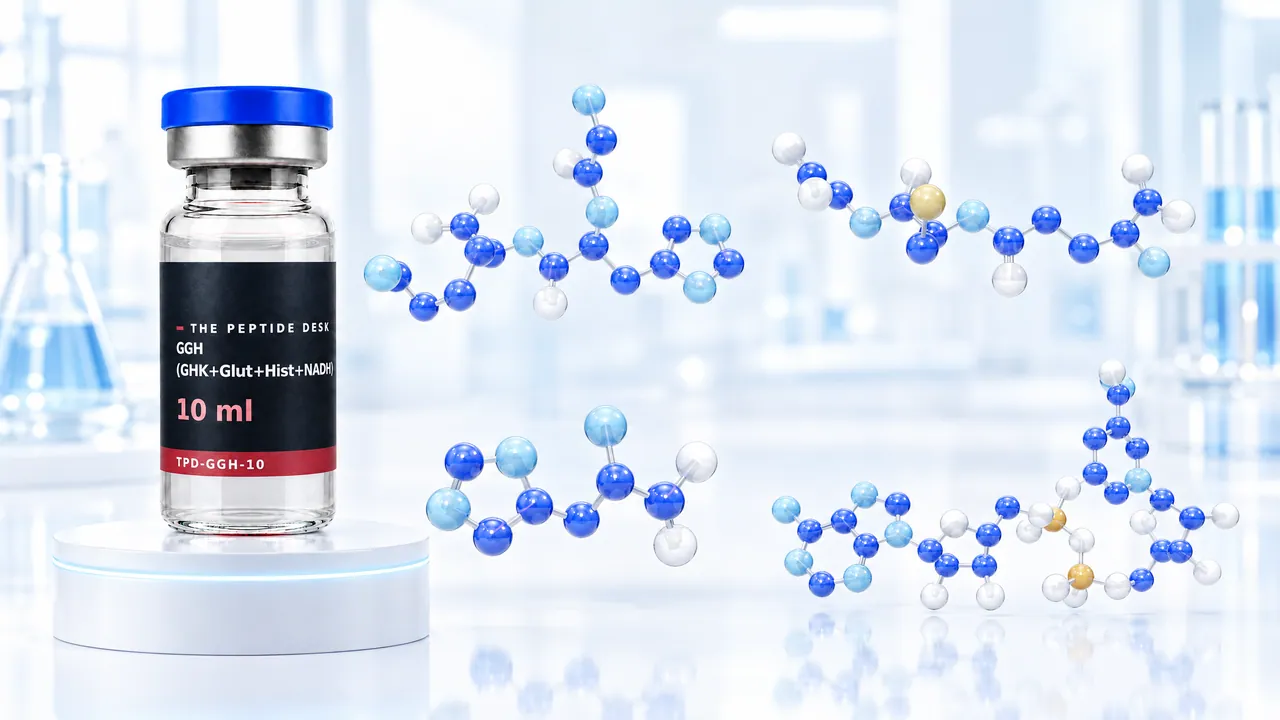
What is GGH?
GGH is a premium anti-aging blend combining four synergistic actives in a single vial: GHK (the copper tripeptide), glutathione (the body's master antioxidant), histidine (an essential amino acid with antioxidant function) and NADH (the reduced form of the energy coenzyme).
The idea: each active has a clear anti-aging effect on its own, in combination they complement each other. GHK stimulates collagen, glutathione neutralizes radicals, histidine protects cell membranes, NADH powers the mitochondria.
What the four components do
- GHK (glycine-histidine-lysine): tripeptide with copper binding. Stimulates collagen synthesis, promotes skin regeneration and wound healing.
- Glutathione: the body's most important antioxidant. Protects cells from oxidative stress, brightens skin, supports liver detox.
- Histidine: essential amino acid. Forms histamine in the body, protects red blood cells from oxidative damage, anti-inflammatory.
- NADH: the electron-rich form of NAD+. Drives the mitochondrial respiratory chain, raises cell energy.
Comparison
One component or four
Which GGH components each entry contains, as described in the TPD lexicon (GSH = glutathione, His = histidine). Tap a card to open its entry.
Simplified: more receptors does not automatically mean better, each path also brings its own effects.
How to take it
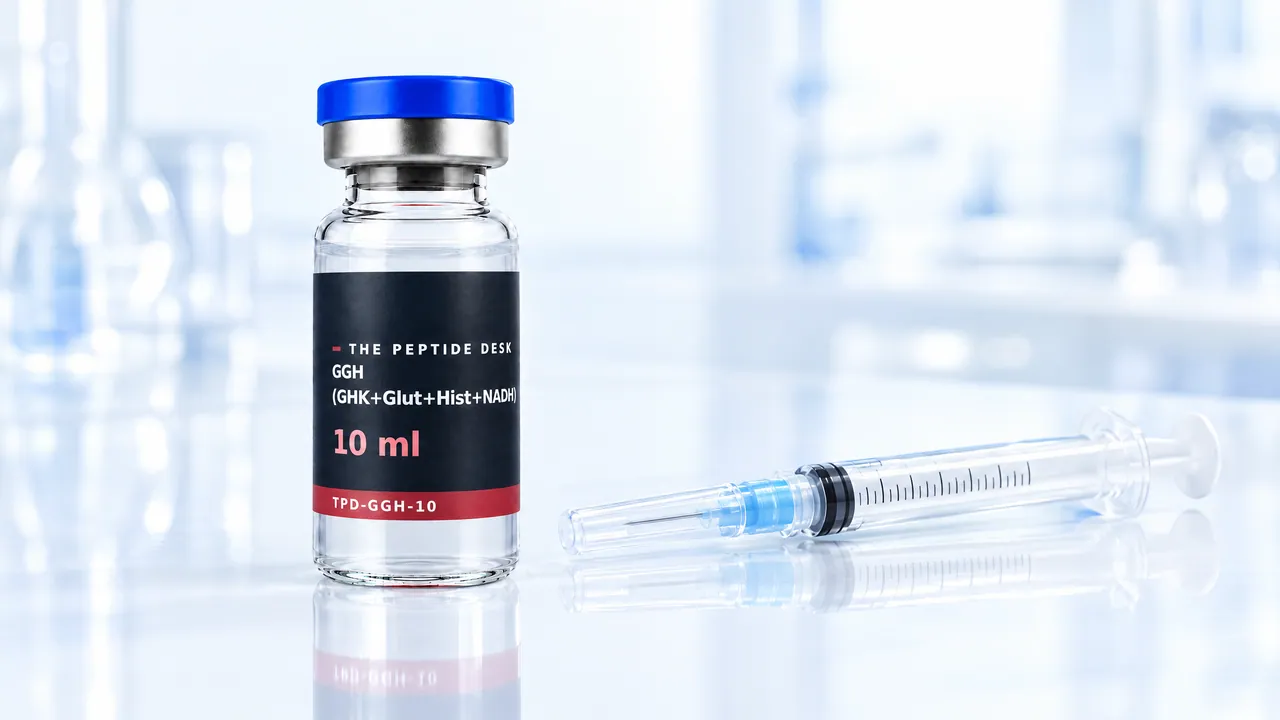
Subcutaneous injection with an insulin needle, ideally in the abdomen (keep clear of the navel) or the front and inner side of the thigh.
- Swirl or shake before each injection, both are fine.
- Draw the desired amount with a U-100 insulin syringe.
- 2-3x per week is enough thanks to cumulative effects across multiple mechanisms.
Topical use is theoretically possible but bioavailability is much worse than subcutaneous.
Dosing
Dosing
Dosing, titration and syringe
Loading the dosing information …
- Getting started and stepping up, drawn as a staircase
- Units on the U-100 syringe for every step
- How long one vial lasts
What GGH is researched for
- Skin structure: the GHK portion stimulates collagen and elastin in the dermis.
- Glow and brightening: glutathione is known for its skin-tone brightening effect.
- Oxidative stress: the antioxidant components (glutathione, histidine) reduce systemic stress.
- Cell energy: NADH improves mitochondrial function - some users report less fatigue.
Where it acts
Components and findings
Tap a point or a card. Colour = component (GSH = glutathione, His = histidine), data from studies on the single compound.
- Skin and wounds
GHK-Cu gel: foot ulcers closed by a median of 98.5%3
GHK - Cells and liver
Glutathione is the most abundant small thiol in the cell and protects against oxidative damage2
GSH - Brain (Parkinson's)
Intravenous glutathione: no significant difference from placebo5
GSH - Fatigue
Oral NADH: 31% responded, placebo 8%8
NADH
What the research shows
The single actives each have solid data sets:
- Pickart et al. 2015: comprehensive review on the molecular action of GHK-Cu on skin regeneration and anti-aging.
- Forman et al. 2009: review of glutathione as the cell's most abundant low-molecular-weight thiol, protecting against oxidative damage and keeping redox balance.
Studies on the exact GGH blend don't exist - the combination is based on the logic of the single actions.
Study results
What the trials measured
Interactive: switch tabs, tap points, show or hide arms. Arms are named relative to each other, no dosing advice.
Wound closure in diabetic foot ulcers3
Median closed wound area, randomised trial with gel on the wound
Minus = the ulcer grew. Ulcer infections: 7 percent with GHK-Cu gel against 34 percent with vehicle gel. Gel on the skin, not an injection and not the blend.
Skin lightening with intravenous glutathione6
Share with lightening, the only placebo study according to a systematic review (16 people each)
Difference not significant (p = 0.054). The review considers infusions not indicated because of missing efficacy and side effects. In a phase 3 trial with 185 cancer patients glutathione infusions did not protect against nerve damage from chemotherapy.
NADH in chronic fatigue8
Share with good response, 26 people, placebo and NADH one after the other (crossover)
8 of 26 on NADH, 2 of 26 on placebo. Oral NADH, small pilot study without severe side effects.
Research status
Where the research stands
There is no study on the blend itself. Shown are registered trials with glutathione as an infusion; for GHK and NADH the registry only lists trials with gels, serums or capsules. As of 25 Oct 2026. 11
- Preclinical Cell and animal studies on the components
- Phase 1 no registered trial
- Phase 2 no registered trial
- Phase 3 1 trial on components, 1 completed
- Approval not yet
Show all 3 trials on a timelineHide timeline
N08CA · NCT02311907 · 195 participants, started Dec 2009, primary endpoint reached Aug 2012.
Registry entry ↗ · Results: Leal et al., Cancer, 2014
NCT00889538 · 24 participants, started Apr 2009, primary endpoint reached Sept 2012. Tests several agents.
Registry entry ↗ · Results not yet in PubMed
NCT01142024 · 1,000 participants, started Mar 2010, primary endpoint reached Mar 2011.
Registry entry ↗ · Results not yet in PubMed
Bar: start to primary endpoint (planned for running trials). Green = completed, blue = progress until 25 Oct 2026.
Side effects
- Skin redness: normal at the injection site for some hours.
- Mild odor: typical for glutathione-containing solutions (sulfur note).
- Very rare allergic reaction: start low, observe.
Storage
Refrigerate, protect from light. NADH is particularly light- and temperature-sensitive. Use within 4-6 weeks after opening.