This information is for research and educational purposes only. No medical recommendations. Products are not approved for human use. For health questions, consult a doctor.

Lexicon

AC-262 (AC-262,536)

A SARM from early pharma research, described as a partial androgen receptor agonist: there is a single animal study on its effects and not one in humans.

4 min read 7 sources

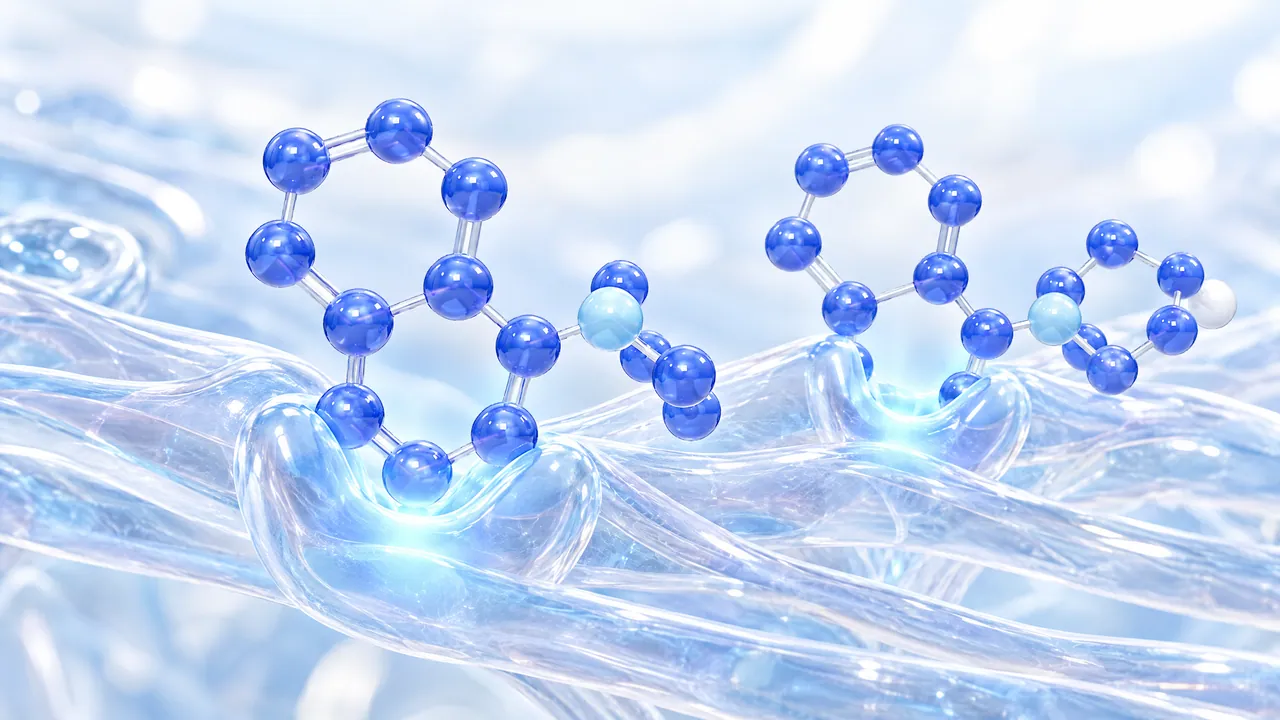
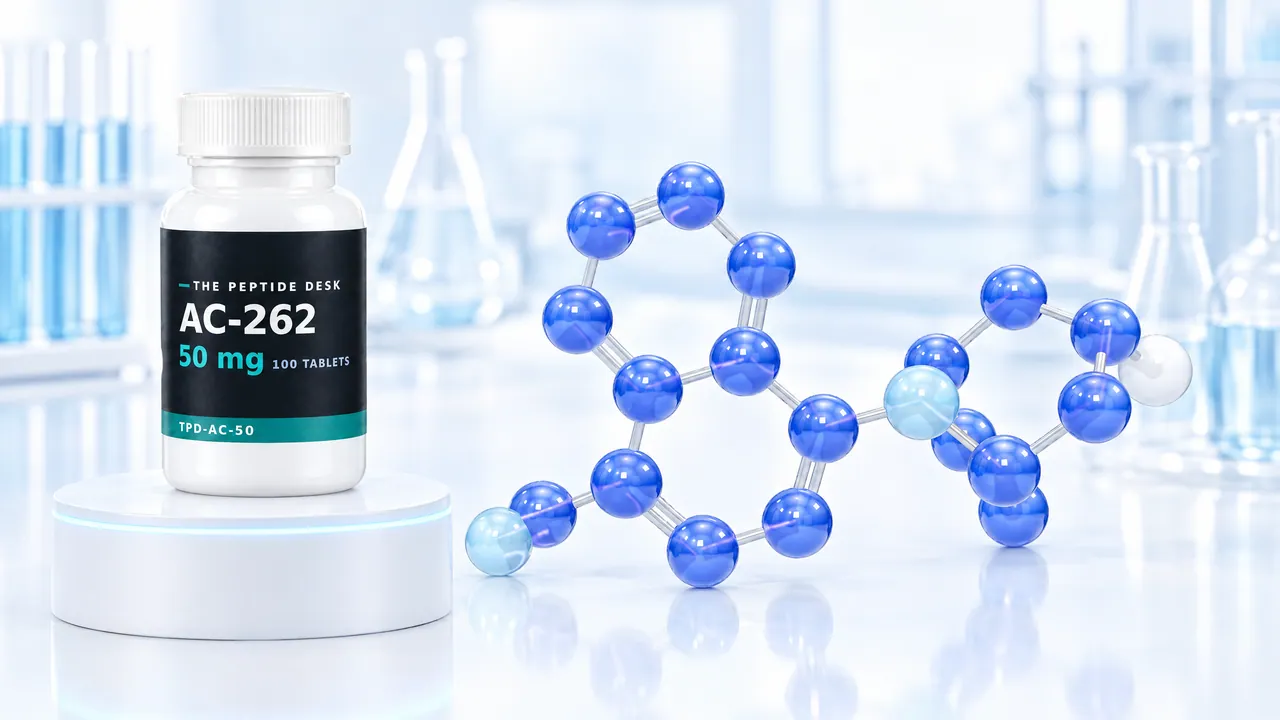
White tablet bottle with a black TPD label for AC-262 on a white podium with a glowing rim, next to a large blue 3D molecule model in a bright lab
Preclinical · not approved

Summary

At a glance

Sources checked on 26 Oct 2026

Longest study on its effects
2 weeks

in castrated rats, the only published study on its effects1

Found in the lab assay
9 metabolites

4 of them detectable in horse urine and 3 in blood, for doping control2

Online SARM products with a SARM
52 %

only 23 of 44 purchased products contained any SARM at all4

Liver injury from SARMs
15 case reports

systematic review of the class, no report names AC-2623

Human trials in the registry
0 trials

no trial with AC-262 on ClinicalTrials.gov, as of 26 Oct 20266

  • AC-262 is a non-steroidal selective androgen receptor modulator (SARM). In cell assays it only partly activated the androgen receptor, less than testosterone.17
  • In castrated rats it promoted the levator ani muscle over two weeks and lowered the raised LH. The prostate and seminal vesicles responded only weakly.1
  • Other work comes from doping control: in horses several metabolites were found in urine and blood, the parent compound also in hair.2
  • For SARMs as a class a systematic review describes liver injury in case reports. SARM products sold online often did not contain what the label said.34
  • ClinicalTrials.gov lists no human trial of AC-262 (as of October 2026). Everything here is preclinical research, not a recommendation.6
Profile

Updated October 2026

Class
SARM

non-steroidal, partial agonist

Form
Tablet

50 mg

Half-life
Not determined in humans
Use
Oral

daily

WADA
Banned

category S1.2

Status
Never tested clinically

not approved

Sizes
50 mg

1 size in the shop

Contents 13 sections
  1. At a glance
  2. What is AC-262?
  3. How it works
  4. Use and dosing
  5. What the research shows
  6. Research status
  7. Side effects
  8. Detection and competition
  9. Storage
  10. Related compounds
  11. FAQ
  12. Glossary
  13. Sources

What is AC-262?

AC-262, in full AC-262,536 and also sold as Accadrine, is a non-steroidal selective androgen receptor modulator (SARM). It came out of a screening programme at ACADIA Pharmaceuticals that looked for alternatives to testosterone therapy. ACP-105 comes from the same company.

The entire published research on its effects consists of one two-week study in castrated rats. Clinical development never started. Other work on AC-262 comes from doping control labs studying how to detect it. In the range AC-262 comes as a tablet with 50 mg.

This information is for research and educational purposes only. No medical advice.

Comparison

SARMs compared

Five SARMs from the TPD lexicon, as described there. Tap a card to open its entry.

Simplified: all act on the androgen receptor. According to their first descriptions AC-262 and ACP-105 activate it only partly. There is no head-to-head comparison in humans. 15

How it works

AC-262 binds the androgen receptor and only partly activates it. In cell assays it did not reach the full effect of testosterone but stayed below it. This is called partial agonism. It was the reason the developers hoped for a milder profile.

In castrated rats AC-262 grew the levator ani muscle, a classic readout for anabolic activity. The prostate and seminal vesicles responded only weakly. At the same time AC-262 lowered the LH that is strongly raised in castrated animals. That shows it triggers feedback to the brain, so in healthy animals it would likely brake the body's own hormone axis as well.

Where it acts

Where AC-262 acted in experiments

Tap a point or a card. Colour = androgen receptor, grey = observed. Effects only from the rat study.

  1. Skeletal muscle

    The levator ani muscle grew, a classic readout for anabolic activity (rats)1

    AR
  2. Hypothalamus and pituitary

    Raised LH fell: feedback on the hormone axis (rats)1

    AR
  3. Prostate and seminal vesicles

    Only weak androgenic effect, unlike testosterone (rats)1

    AR
  4. Liver

    Liver injury in case reports on SARMs as a class, not on AC-262 itself3

    Observed in trials

Known targets7

Compound PubChem CID 44512434: one described target, Partial agonist (cell assay).

Androgen receptor
Gene
AR
UniProt
P10275
ChEMBL
CHEMBL1871
Action
Partial agonist (cell assay)
Two blue 3D molecules dock into glowing pockets on transparent glass muscle fibres
Binding to the androgen receptor in muscle. Symbolic image.

Use and dosing

Dosing

Dosing, titration and syringe

Loading the dosing information …

  • Getting started and stepping up, drawn as a staircase
  • Units on the U-100 syringe for every step
  • How long one vial lasts
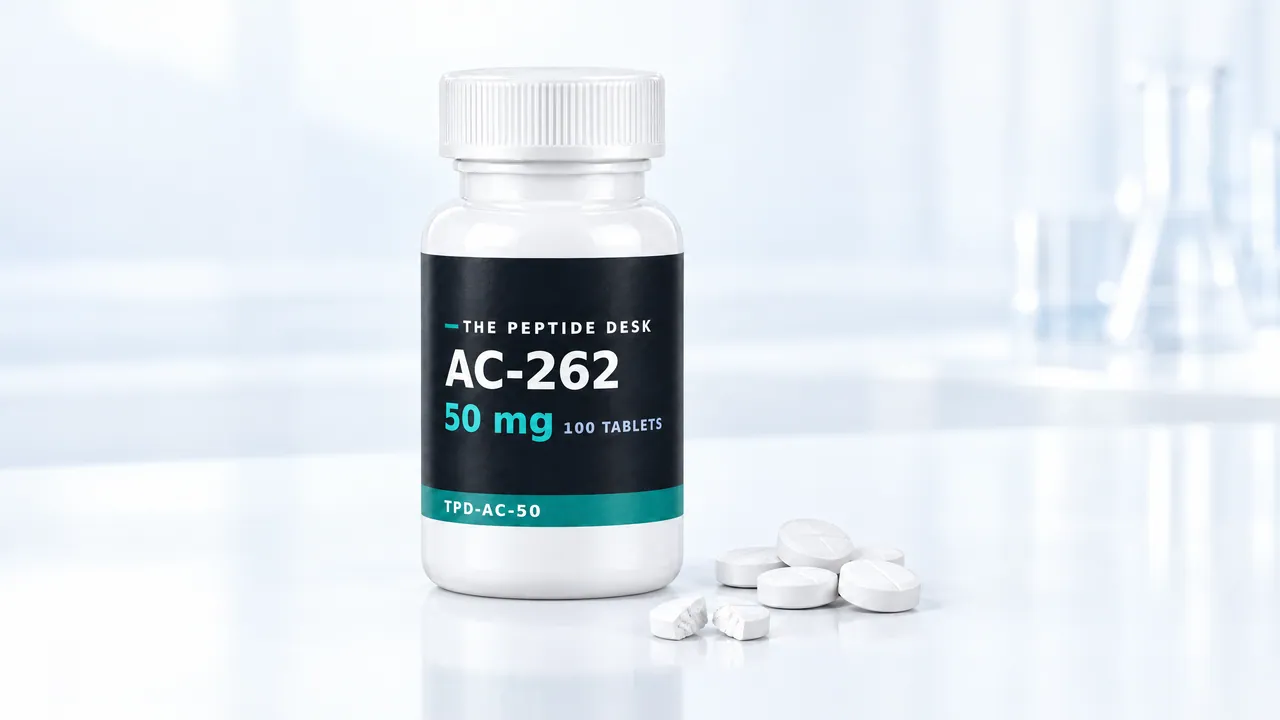
White tablet bottle with a black TPD label for AC-262 on a bright table, next to a few white scored tablets and a halved tablet
Tablet taken by mouth. Symbolic image.

What the research shows

Piu and colleagues (J Steroid Biochem Mol Biol 2008) described AC-262 as a potent, selective androgen receptor ligand with partial activity relative to testosterone. In a two-week study in castrated rats it improved anabolic readouts, above all growth of the levator ani muscle. It also pushed down the raised LH. The androgenic effect on the prostate and seminal vesicles stayed weak.

Cutler and colleagues (Drug Test Anal 2020) gave AC-262 to two horses to find the best detection targets. Besides the parent compound they found several metabolites in urine and blood, plus incorporation into hair. The authors note that AC-262 was never available as a therapy.

Two papers on the class put this in context. Vignali and colleagues (J Xenobiot 2023) found liver injury in case reports and rises in the liver enzyme ALT in trials across the SARM safety data. Van Wagoner and colleagues (JAMA 2017) showed that of 44 SARM products bought online only 52 percent contained any SARM at all. In 59 percent the amount differed markedly from the label.

Study results

What the trials measured

Interactive: switch tabs, tap points, show or hide arms. Arms are named relative to each other, no dosing advice.

What 44 SARM products bought online contained4

Share of products in percent, analysed to doping control standard

Contained at least one SARM4
Analysed online products 52%
Contained another unapproved drug4
Analysed online products 39%
Amount differed markedly from the label4
Analysed online products 59%
Contained undeclared substances4
Analysed online products 25%
No active compound detected4
Analysed online products 9%

Values from the abstract (USA, 2016). The SARMs found were ostarine, LGD-4033 and andarine, AC-262 was not among them. The study shows the risk of unverified products, not the effect of a specific SARM.

Translucent glass sculpture of an upper body with muscles on a wooden table, next to a rolled white towel and a glass of water in front of a bright window
Data on its effects come from a single rat study only. Symbolic image.

Research status

Where the research stands

Where the compound stands on the way from lab research to approval. As of 26 Oct 2026. 6

  1. Preclinical Cell assay and two-week study in castrated rats (2008)
  2. Phase 1 no registered trial
  3. Phase 2 no registered trial
  4. Phase 3 no registered trial
  5. Approval not yet
Not approved and no registered human trial. Clinical development never started.6

So far there is no registered trial in humans. 6

Side effects

Without human studies this list rests on the rat data and on what is known for SARMs as a class.

  • Suppression of the testosterone axis. AC-262 lowered LH in rats. In healthy humans a brake on your own testosterone production should be expected. How strong is unknown.
  • Liver. Liver injury has been described for SARMs in case reports. In trials liver values rose frequently.
  • Lipids. Falling HDL is common with androgen receptor agonists.
  • Unknowns. Long-term effects, interactions and human pharmacokinetics have not been studied.

This classification does not replace medical advice.

Detection and competition

Under the WADA list AC-262 falls under S1.2 (other anabolic agents) and is banned at all times. Doping control labs have developed detection methods for urine and blood. In the horse study the compound also showed up in hair.

Anyone subject to testing should assume AC-262 will be detected. How long detection is possible in humans has not been published.

Storage

Store dry, at room temperature and protected from light, keep the tin closed. Do not keep it in the bathroom, the humidity there degrades tablets.

Keep out of reach of children and mind the expiry date. Do not decant tablets into unlabelled containers.
Three white bottles on a bright shelf next to a folded light blue towel
Store dry, at room temperature and out of reach of children. Symbolic image.

Related

Related compounds

Same targets: all in the TPD lexicon.

FAQ

Common questions about AC-262 (AC-262,536)

Short answers, each backed by the sources below.

Is AC-262 approved or studied in humans?

No. There is no approval and as of 26 October 2026 ClinicalTrials.gov lists no trial with AC-262. The only published study on its effects ran for two weeks in castrated rats.61

What does partial agonist mean?

AC-262 binds the androgen receptor but in cell assays does not switch it on as strongly as testosterone. The developers hoped for a milder profile because of this. In rats it acted clearly on muscle but only weakly on the prostate and seminal vesicles.1

Does AC-262 brake the body's own hormone axis?

In castrated rats AC-262 lowered the strongly raised LH. This shows feedback on the hypothalamus and pituitary. How strongly the body's own testosterone production would be braked in humans has not been measured.1

What is known about safety?

There are no human safety data for AC-262 itself. A systematic review of SARMs in healthy adults found 15 case reports of liver injury. In clinical trials the liver enzyme ALT rose in a mean of 7.1 percent of participants.3

Can AC-262 be detected in doping control?

Yes. In horses, labs found nine metabolites in the lab assay, four of them in urine and three in blood, plus the parent compound in hair. A modified form of the parent compound stayed detectable longest. How long detection works in humans has not been published.2

Why does the source matter so much with SARMs?

In an analysis of 44 SARM products bought online only 52 percent contained any SARM at all. In 59 percent the amount differed markedly from the label and 25 percent contained substances that were not declared.4

Glossary

Terms explained briefly

Dotted words in the text open these explanations directly.

ALT
Alanine aminotransferase, a liver value in the blood. A rise can point to strain on liver cells.
Androgen receptor
Binding site for testosterone and related hormones in many tissues, such as muscle, bone, prostate and brain.
Castrated rats
An animal model without its own testosterone production. It allows the effect of a compound on the androgen receptor to be measured without the body's own hormone.
Levator ani muscle
A pelvic floor muscle in rats. It responds strongly to androgens and serves as a readout for anabolic activity.
LH
Luteinising hormone from the pituitary. It signals the testes to produce testosterone.
Metabolites
Substances into which the body converts a drug. Doping control often looks for them because they can stay detectable longer.
Partial agonist
A substance that switches a receptor on but not up to the full effect of the natural hormone.
Preclinical
Research before first use in humans, in cell cultures and animal models. Results cannot be transferred directly to humans.
SARM
Selective androgen receptor modulator. A non-steroidal compound meant to address the androgen receptor mainly in muscle and bone.
WADA
World Anti-Doping Agency. Its prohibited list includes SARMs under S1.2, other anabolic agents.

Evidence

Sources

Show all 7 sourcesHide sources 5 Studies1 Trial registry1 Database checked 26 Oct 2026

Studies

  1. First description: partial agonist, anabolic in castrated rats

    Piu et al., Journal of Steroid Biochemistry and Molecular Biology, 2008

    Checked 26 Oct 2026 via doi.org, Crossref, PubMed
  2. Metabolism in horses: detection in urine, blood and hair

    Cutler et al., Drug Testing and Analysis, 2021 (online 2020)

    Checked 26 Oct 2026 via doi.org, Crossref, PubMed
  3. Systematic review of SARM safety in healthy adults

    Vignali et al., Journal of Xenobiotics, 2023

    Checked 26 Oct 2026 via doi.org, Crossref, PubMed
  4. Analysis of SARM products sold online

    Van Wagoner et al., JAMA, 2017

    Checked 26 Oct 2026 via doi.org, Crossref, PubMed
  5. Discovery of ACP-105 from the same compound search

    Schlienger et al., Journal of Medicinal Chemistry, 2009

    Checked 26 Oct 2026 via doi.org, Crossref, PubMed

Trial registry

  1. Search on ClinicalTrials.gov (no trial with AC-262)

    ClinicalTrials.gov, U.S. National Library of Medicine

    Checked 26 Oct 2026 via ClinicalTrials.gov API v2

Database

  1. Structure of AC-262536 in PubChem

    PubChem, U.S. National Library of Medicine (CID 44512434)

    Checked 26 Oct 2026 via PubChem

In the shop

AC-262 (AC-262,536) in the catalog

Sizes, prices and shipping times are on the product page.

To the product