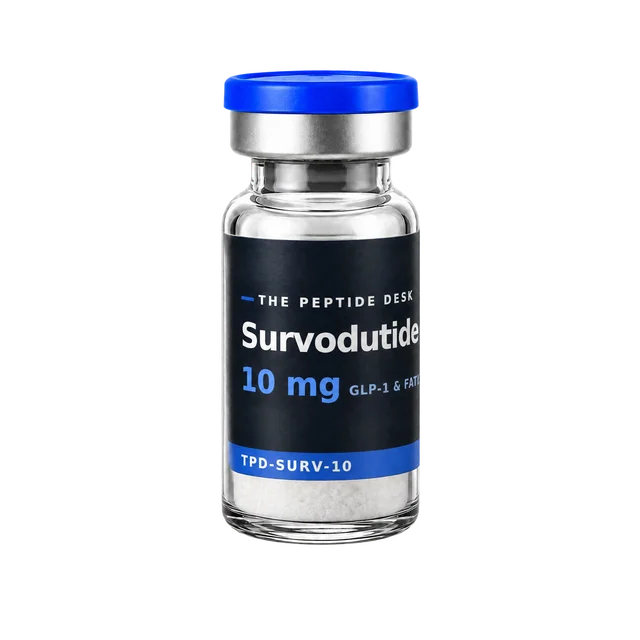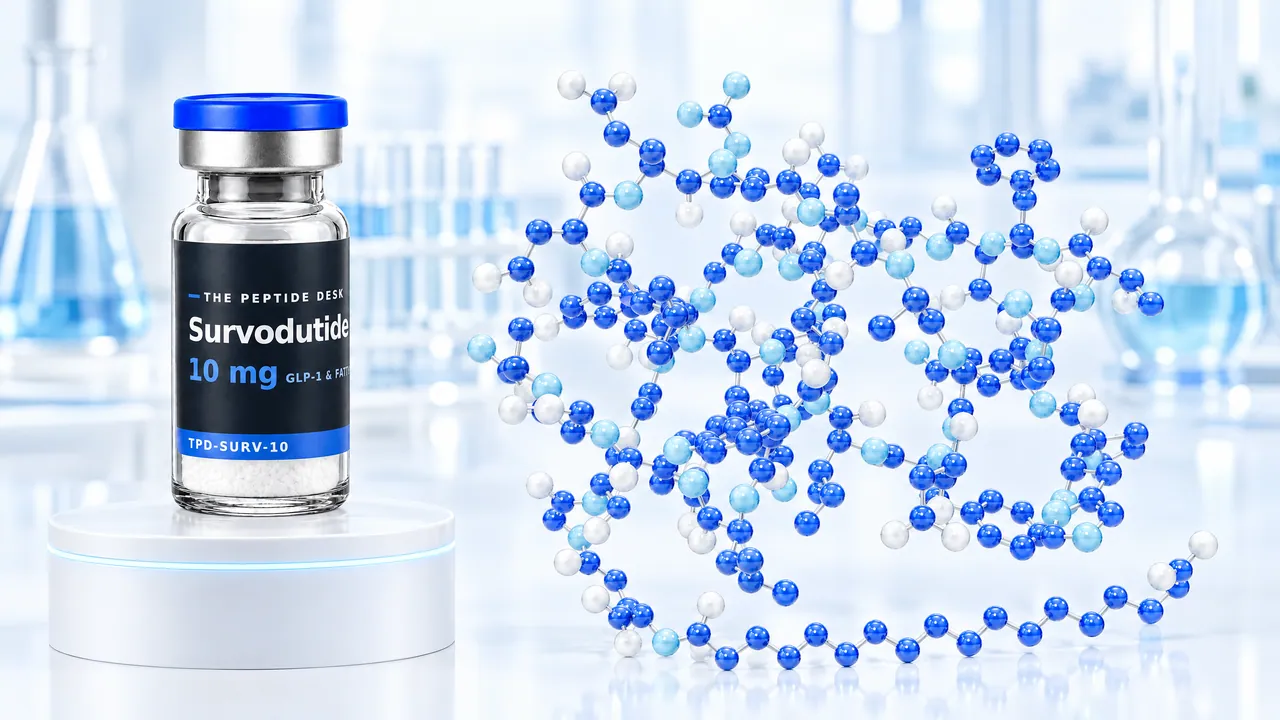
What is Survodutide?
Survodutide (development name BI 456906) is a dual agonist at GLP-1 and glucagon receptors. That places it right between the others: semaglutide hits only GLP-1, retatrutide three receptors and survodutide two, namely GLP-1 plus glucagon, but no GIP. The ratio is GLP-1-leaning (about 8 to 1), with the glucagon share in a supporting role.
It is injected once a week. Survodutide is not approved. The first results from the phase 3 SYNCHRONIZE programme were published in 2026. It ships as a freeze-dried powder you dissolve in bacteriostatic water before the first use.
Comparison
One, two or three receptors
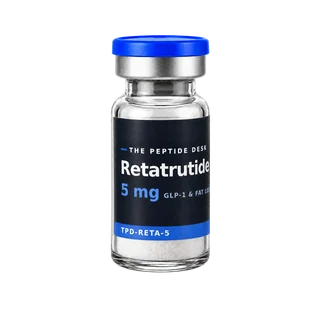
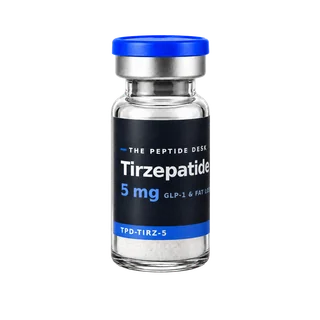
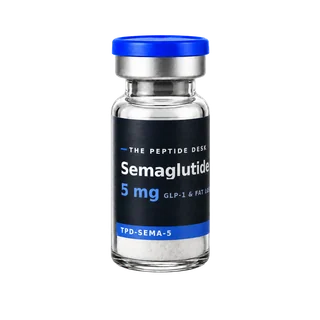
Which receptors each compound targets, as stated in the TPD lexicon. Tap a card to open its entry.
Simplified: more receptors does not automatically mean better, each path also brings its own effects. 12
How it works
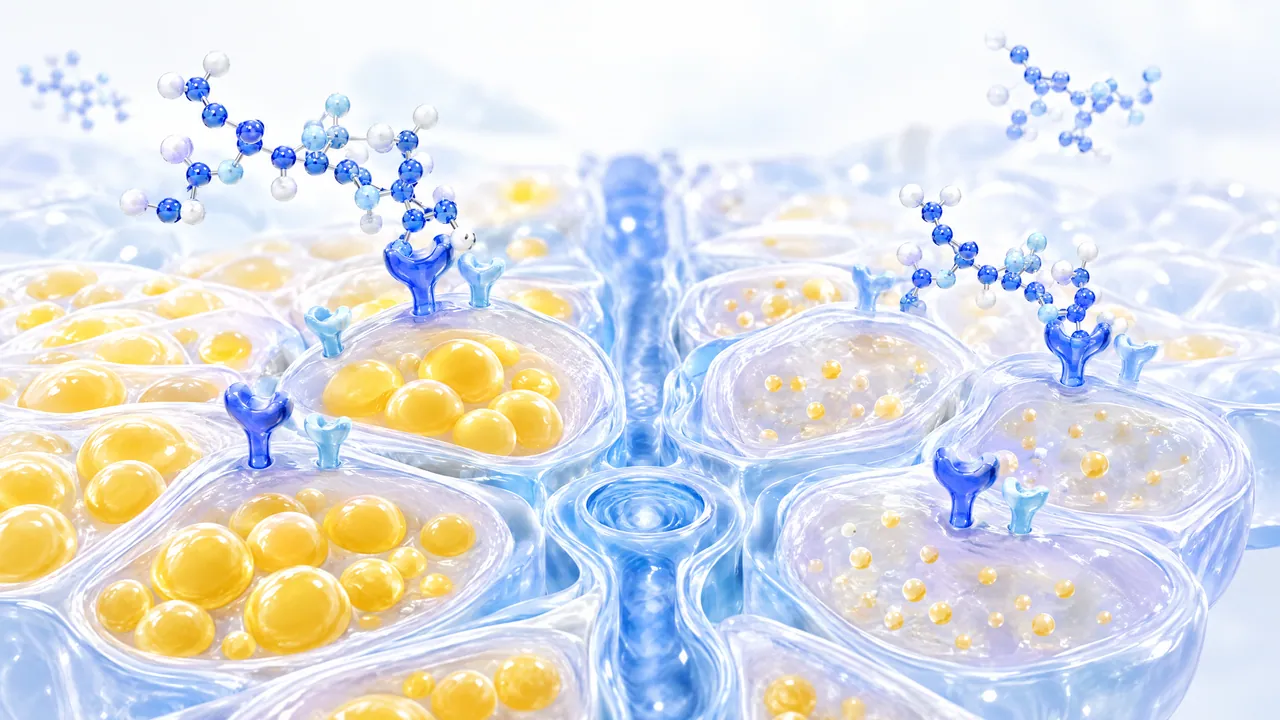
The GLP-1 part does what you know from semaglutide and co.: it boosts the insulin response, slows gastric emptying and dampens appetite, the food noise gets quieter. The glucagon part comes in support and mainly raises energy expenditure and fat breakdown, especially in the liver.
Studies suggest this combination moves more on weight and especially on liver fat than GLP-1 alone. But because the focus clearly sits on GLP-1, the glucagon effect is milder than in the triple agonist retatrutide.
Where it acts
Two receptors, several organs
Tap a point or a card. Colour = receptor, grey = effect seen in trials.
- Brain
Lower food intake (shown in mice)3
GLP-1 - Liver
MASH improved more often in a phase 2 trial, liver fat clearly lower2
Glucagon - Pancreas
HbA1c fell more than on placebo in type 2 diabetes in phase 39
GLP-1 - Body weight
Clearly more weight loss than on placebo in phase 38
Observed in trials - Stomach and gut
Most common side effects, mainly while the dose is being raised10
Observed in trials
Targets in the ChEMBL database12
Compound CHEMBL5314776: two recorded mechanisms, all agonist with direct binding to the human receptor.
- Gene
- GLP1R
- UniProt
- P43220
- ChEMBL
- CHEMBL1784
- Action
- Agonist, direct binding
- Gene
- GCGR
- UniProt
- P47871
- ChEMBL
- CHEMBL1985
- Action
- Agonist, direct binding
What you need
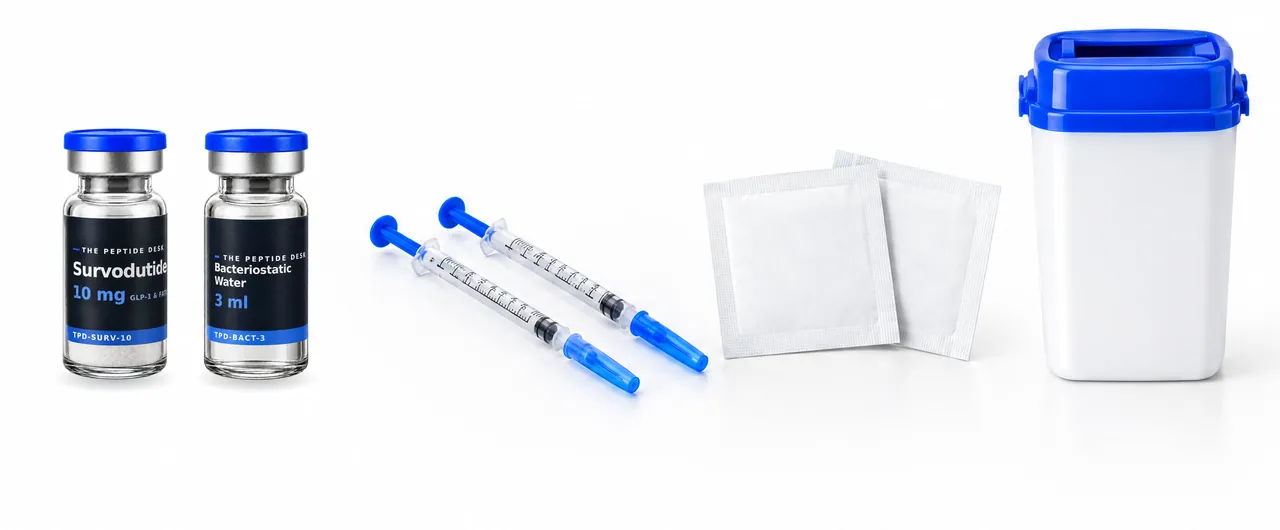
Before you start, have everything ready. The list is short:
Supplies
5 things, numbered as in the picture
Tick off what you already have. Vial and BAC water are our real shop photos at the same size.
-
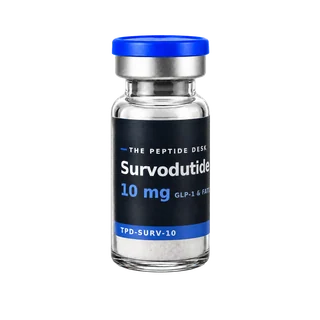
Survodutide vial
The Survodutide vial with the freeze-dried powder
-
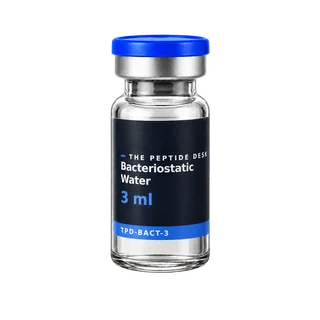
Bacteriostatic water
Bacteriostatic water to dissolve it
-
U-100 insulin syringes
U-100 insulin syringes for the injection (they also work for drawing the water, you just draw more often; a larger syringe is faster but not a must)
-
Alcohol swabs
Alcohol swabs for the vial cap and the skin
-
Sharps container
A sealable sharps container for used needles
As an Amazon associate we earn from qualifying purchases. Links open Amazon - no extra cost for you.
With everything clean and in one place, the rest is straightforward.
Reconstitution
The powder is dissolved in bacteriostatic water. How much water you add sets the concentration and therefore how many units you later draw on the insulin syringe for your dose.
Use the peptide calculator for exactly this: pick the water volume to instantly see the concentration and the units per dose. Roughly: less water means higher concentration and fewer units.
When dissolving, just add the bac water and let the powder dissolve. It does not matter if the water hits the powder directly. Swirling or shaking are both fine.
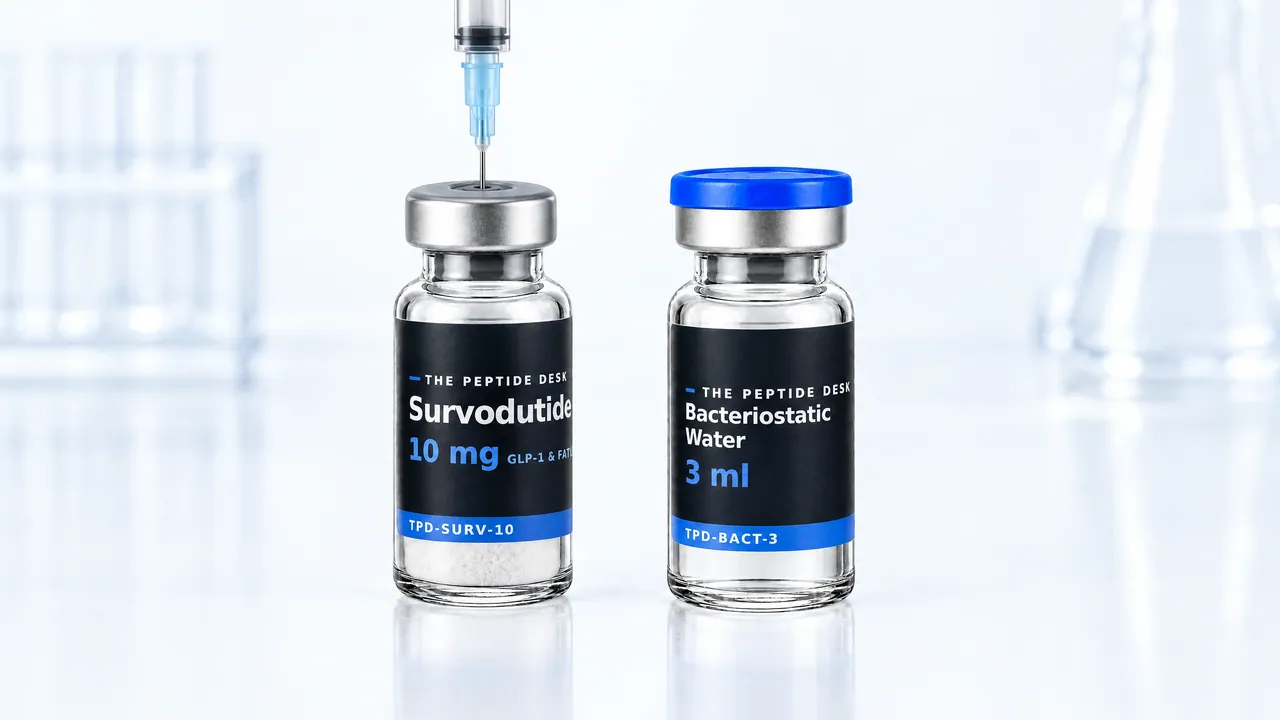
Step by step
Dissolving the powder
Four steps, the same for every vial size.
- 1Wipe the cap
Clean the rubber stopper with an alcohol swab.
- 2Add BAC water
Just add it, it does not matter if it hits the powder directly.
- 3Swirl or shake
Until everything has dissolved, both are fine.
- 4Draw up
With the U-100 insulin syringe.
Injection
The injection is subcutaneous, into the fat layer under the skin. Common spots are the abdomen (keep about two finger-widths clear of the navel), the front and the inner side of the thigh, or the back of the upper arm.
The short version:
Injection
Where and at what angle
Pick a spot or switch the angle. Subcutaneous means: into the fat layer, not the muscle.
Rotate the spot each time, never the same one twice in a row.
Rule of thumb: where there is more fat under the skin, insert straight at 90 degrees. In lean people with little fat, 45 degrees, so the needle stays in the fat layer. Simplified diagram.
-
Clean the spot with an alcohol swab and let it dry
-
Pinch up a small fold of skin
-
Insert the needle: at 90 degrees where there is more fat under the skin, at 45 degrees in lean people with little fat
-
Inject slowly, wait a moment, then withdraw
-
Put the needle straight into the sharps container
Rotate the site each time so the tissue does not get irritated. Never the same spot twice in a row.
Dosing
Dosing
Dosing, titration and syringe
Loading the dosing information …
- Getting started and stepping up, drawn as a staircase
- Units on the U-100 syringe for every step
- How long one vial lasts
What the research shows
Survodutide is well documented but not approved. In the phase 2 obesity study (le Roux, 2024), weight dropped dose-dependently over 46 weeks, by nearly 15 percent on average at the highest dose and by up to about 19 percent among those who completed. In a liver study (Sanyal, 2024), MASH (a form of fatty-liver inflammation) improved in a large share of participants, far more often than on placebo. A smaller diabetes study also showed a clear drop in long-term blood sugar (HbA1c).
The first phase 3 results came out in 2026. In SYNCHRONIZE-1 (le Roux, NEJM 2026, 725 adults without diabetes) weight fell by 13.0 percent after 76 weeks on the higher dose, versus 5.4 percent on placebo. SYNCHRONIZE-2 tested people with type 2 diabetes, SYNCHRONIZE-MASLD fatty liver. The higher dose in the phase 3 programme was 6mg per week.
The individual studies with links are in the source block below.
Study results
What the trials measured
Interactive: switch tabs, tap points, show or hide arms. Arms are named relative to each other, no dosing advice.
Body weight at the end of the trial8910
Mean change in percent per trial
Values for all participants as randomised (treatment-regimen estimand), as stated in the abstracts. SYNCHRONIZE-MASLD had only one Survodutide arm. The trials are not directly comparable.
Body weight after 46 weeks1
Mean change in percent, 387 people with overweight without diabetes
Values by planned treatment according to the abstract. From the second level on the effect rose only a little. 60 percent of participants completed the 46 weeks.
Liver after 48 weeks210
Share of participants, phase 2 trial with biopsy (293 people) and phase 3 trial SYNCHRONIZE-MASLD
The phase 2 trial enrolled people with biopsy-confirmed MASH and fibrosis. The middle dose did best there, the authors describe the dose response as a curve. Values from SYNCHRONIZE-MASLD for all participants as randomised.
Long-term blood sugar HbA1c at 76 weeks9
Change in percentage points, SYNCHRONIZE-2, mean baseline 7.4 percent
Values as stated in the abstract. For HbA1c both doses were about level.
Research status
Where the research stands
From the first human trials to the phase 3 programme SYNCHRONIZE: the developer's registered trials testing Survodutide, with status, participants and results. As of 26 Oct 2026. 11
- Preclinical Cell assays and mice
- Phase 1 18 trials, 14 completed
- Phase 2 3 trials, 3 completed
- Phase 3 9 trials, 6 completed
- Approval not yet
Show all 12 phase 2 and 3 trials on a timelineHide timeline
NCT04153929 · 413 participants, started Apr 2020, primary endpoint reached Oct 2021.
Registry entry ↗ · Results: Blüher et al., Diabetologia, 2024
NCT04667377 · 387 participants, started Mar 2021, primary endpoint reached Sept 2022.
Registry entry ↗ · Results: le Roux et al., The Lancet Diabetes & Endocrinology, 2024
NCT04771273 · 295 participants, started Apr 2021, primary endpoint reached Nov 2023.
Registry entry ↗ · Results: Sanyal et al., New England Journal of Medicine, 2024
SYNCHRONIZE-CVOT · NCT06077864 · 5,531 participants, started Nov 2023, primary endpoint reached Jun 2026.
Registry entry ↗ · Results not yet in PubMed
SYNCHRONIZE-1 · NCT06066515 · 726 participants, started Nov 2023, primary endpoint reached Dec 2025.
Registry entry ↗ · Results: le Roux et al., New England Journal of Medicine, 2026
SYNCHRONIZE-2 · NCT06066528 · 755 participants, started Nov 2023, primary endpoint reached Dec 2025.
Registry entry ↗ · Results: Wharton et al., New England Journal of Medicine, 2026
SYNCHRONIZE-JP · NCT06176365 · 274 participants, started Jan 2024, primary endpoint reached Dec 2025.
Registry entry ↗ · Results not yet in PubMed
NCT06214741 · 307 participants, started Feb 2024, primary endpoint reached Jul 2025.
Registry entry ↗ · Results not yet in PubMed
SYNCHRONIZE-MASLD · NCT06309992 · 218 participants, started Apr 2024, primary endpoint reached Oct 2025.
Registry entry ↗ · Results: Kaplan et al., Nature Medicine, 2026
LIVERAGE · NCT06632444 · 1,800 participants (planned), started Oct 2024, primary endpoint planned Dec 2031.
LIVERAGE-Cirrhosis · NCT06632457 · 1,590 participants (planned), started Nov 2024, primary endpoint planned Jun 2029.
NCT07754461 · 600 participants (planned), started Aug 2026, primary endpoint planned Jan 2028.
Bar: start to primary endpoint (planned for running trials). Green = completed, blue = progress until 26 Oct 2026. Phase 1: 18 trials on safety and pharmacokinetics, not shown as bars.
Side effects
Like the whole class, gastrointestinal effects come first: nausea, fullness, sometimes diarrhoea or constipation. In the studies this was clearly dose-dependent and well manageable through the stepwise titration. The glucagon share is exactly why you ease in slowly and do not go up too fast.
Tolerability
Gastrointestinal effects in the trials
Out of 100 participants per group, how many had the event. SYNCHRONIZE over 76 weeks, liver trial over 48 weeks.
| Event | Placebo | Lower phase 3 dose | Highest study dose (6 mg) |
|---|---|---|---|
| Gastrointestinal effects, SYNCHRONIZE-18 | 48% | 81% | 90% |
| Gastrointestinal effects, SYNCHRONIZE-29 | 39% | 73% | 78% |
| Nausea, liver trial2 | 23% | 0% | 0% |
| Diarrhoea, liver trial2 | 23% | 0% | 0% |
| Vomiting, liver trial2 | 4% | 0% | 0% |
Values from the abstracts. The complaints were mostly mild to moderate and occurred mainly during escalation. In the liver trial the dose was raised quickly over 24 weeks. Serious events there were about as common as on placebo, 8 versus 7 percent.892
Lifestyle
Survodutide takes the hunger away, the rest is on you. A few things get more out of the research phase and keep you healthy:
-
Enough protein
If you eat little, make the little you eat protein-rich, or you lose muscle along with fat.
-
Drink enough
With low appetite you often drink less without noticing. The risk of dehydration then goes up.
-
Resistance training
Keeps muscle mass while the weight comes off.
-
Eat slowly
With delayed gastric emptying you fill up faster, big portions sit heavy.
Alcohol and very fatty meals make the nausea noticeably worse, especially early on.
Storage
The undissolved powder is robust, normal room temperature (around 20 to 25 degrees) is fine, ideally kept in the dark. Once dissolved, the solution goes into the fridge (2 to 8 degrees) and stays stable there for at least 4 to 6 months with barely any loss of potency, in practice considerably longer. The bacteriostatic water brings a preservative that keeps the dissolved form stable for longer.
Shelf life
How long it keeps
Robust, no fridge needed.
At least 4 to 6 months with barely any loss of potency. The bacteriostatic water brings a preservative.
- Keep it dark
- Dissolved: 2 to 8 degrees
- Note the mixing date on the vial